


A Model Workshop And Some Useful Articles
Description
This section is from the book "The American Garden Vol. XI", by L. H. Bailey. Also available from Amazon: American Horticultural Society A to Z Encyclopedia of Garden Plants.
A Model Workshop And Some Useful Articles
NEW cultivators appear to realize the value of a convenient work shop close at hand, in which to do the many little jobs of mechanical work so often needed. There are always articles getting out of repair, and frequently the delay in taking them to a mechanic, or the loss from doing without them when needed, amount to much more than the cost of having them fixed. If a convenient place, with a few ordinary tools is at hand, most of these things may be done at home with but little loss of time ; or at least a temporary substitute provided, until a suitable time to have it done more satisfactorily.
Besides this, there are many little conveniences which one who is willing to give the matter some thought, may provide for use about the place or in the house. It is safe to say that the stormy days used in making things of this kind will prove more satisfactory than those spent about the village store or other lounging places.
The farm on which the shop described is located, is remarkable for the number of things of this kind to be found. It is also very noticeable how well the owner, who is well advanced in years, is enabled to carry on his work, and at the same time, how many leisure hours he finds to read his papers and enjoy the comforts of life. At every turn about the house, the barn, smaller buildings or farm, are to be found tools or fixtures, the cost of which was little or nothing, aside from the time expended in making them, and this usually applied when least valuable.
The workshop, a ground plan of which is shown in Fig. 1, has served as a factory from which nearly all these appliances have sprung. It is simply a cheap frame building 16x24 feet, boarded and battened, with an upper story high enough to be convenient for storing lumber or other things. At A sets a high block with an iron or steel wedge driven into the end (Fig. 2); something solid on which to do riveting, and all sorts of pounding, is always wanted. This answers the purpose admirably, making a first-rate anvil for farmer's use. B is a cheap board bench which catches all the extra nuts, bolts and other pieces of iron which accumulate. It is not very attractive in appearance, but has its place, and quite an important one too, for often just such a piece as is wanted can be here picked up and a trip and fee to the blacksmith saved. A few new bolts, rivets, etc., are kept ready for use when occasion requires. Any piece of timber which has been split may often be neatly repaired by putting one or two bolts through it.
Over the bench are shelves for bits, drills, etc.
A little ingenuity in working metal is always serviceable and will lead the way out of many difficulties. If a hole is needed through any light piece of iron, a device similar to that shown in Fig.3 will greatly aid in drilling it. The cradle finger broken out in the heavy lodged grain last fall is just what is wanted, if you have saved it. Bore a hole near each end, and fasten a piece of strong small rope in the small end. Next, an old file ground off at the end and fastened in a large spool, like those used for chalk-lines, or something of similar shape, is needed. Give the rope one turn around this, run it through the hole in the other end of the stick and draw it as tight as possible, wrapping it two or three times around to aid in holding it. Then take a piece of iron or block with some sort of a rounded point, with which to press against the end of the spool, so that it can turn readily, and you have a very satisfactory drill which will make a hole much quicker than you might imagine. Each time the stick is moved back and forth the length of the rope, it gives a good many turns of the file, which, of course, cuts just as well one way as the other.
It is but a step to the grindstone to grind down the file as often as it gets too dull.
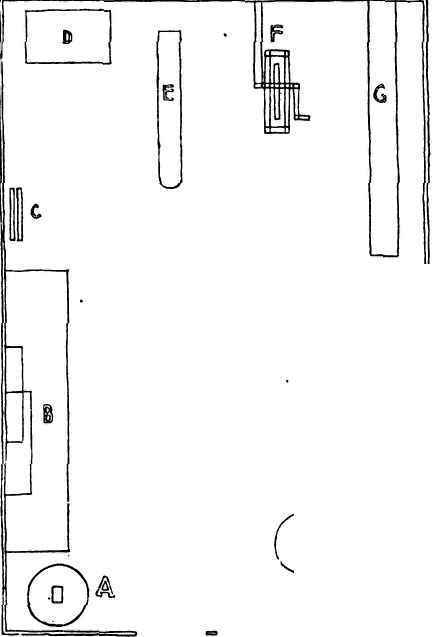
Fig. 1. Plan of my Workshop.
Of course, no enterprising man wants to run to a mechanic every time his saw needs filing, so he will want a saw clamp, and it may be cheaper to make one like that shown in Fig. 4 than to buy. One upright scantling is securely fastened to the floor and girt in front a window. The other is mortised to allow it to play on the cross piece. A wedge-shaped piece of board works in a slot in this cross-piece to fasten the clamp, which is simply two narrow strips of board with the upper edges beveled, and held together at one end by a screw. One board is shown dropped down in the cut.
At D sets a tool chest, E shave-horse, F grindstone; G is a turning-lathe, run by foot and connected with a large balance wheel on the upper floor ; H work-bench, I hewing block.
Fig. 2.
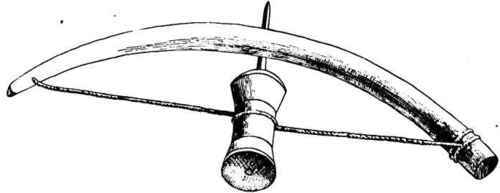
Fig. 3. Drill for Boring Metals.
The building affords an excellent place to keep small tools of all kinds for both outside and inside work, aside from its value as a place for work. The sides are well filled with nails, hooks and pegs which serve as places for all sorts of garden and farm tools, as well as those for shop work. The room under the benches and overhead is used as a place in which to keep a little lumber, and such odds and ends as are left from time to time. It costs nothing to let these lie there and they frequently furnish just the piece that is wanted.
As an instance, the owner mentioned using a piece the past winter, which he felt certain had been there over 25 years, and at last the place came for which it was exactly the right thing! Some might question the policy of saving a thing of that kind for use 25 years hence, but there should always be some 9tock of material on hand, and no doubt most of it finds its use much sooner than this. In this particular case, the shop was built before the dwelling, and rendered excellent service as a place in which to work out finishing material for the house, for it was in the days when wood-working machinery was not so plenty as now, and most of the work had to be done by hand. Fig. 5 shows a grater which possesses some advantage over the common board leveler for certain kinds of work. It can be made from an old stone-boat which has become so worn that it cannot be expected to last much longer, using strong spikes of some kind, standing backward, for the teeth. Those in the one illustrated are old teeth from a threshing machine cylinder. Any stones or rubbish which need to be removed from the field may be thrown on the boat and drawn along until it is convenient to unload them.
The weight of these, together with that of the boat, will hold the lumps in place so that they are more effectually ground by the teeth. The driver will usually be willing to ride if the weight is not sufficient without. If a boat were to be made especially for the purpose, it would be better to have it wider than a common stone-boat, in order to accomplish more work and cover the tracks made by the horses' feet.
Fig. 4.

Fig. 5.
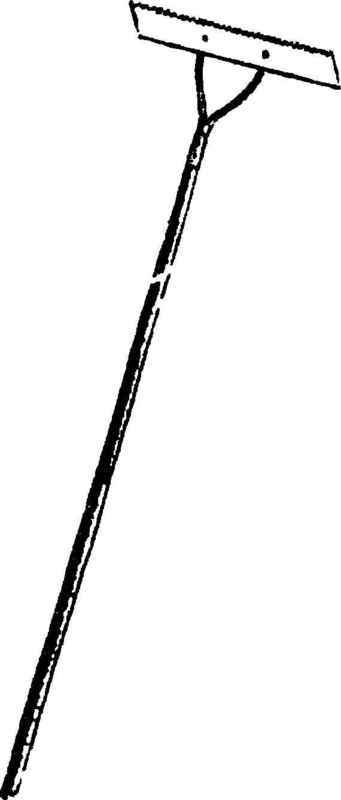
Fig. 7
Fig. 6 represents a stone-fork, an exceedingly useful tool, and which deserves a wider reputation. Manufacturers would be rendering good service to put such a fork generally on the market. It is made with six short, heavy tines, close together, and is very convenient in throwing small stones, corn-stubbles, cabbage stumps, or any sort of rubbish on to a wagon or boat in clearing ground for a fine crop. One active man with such a fork in his hands to throw out the loose stones can often do more to improve the public road than a gang of men and teams with plows and scrapers will do in double the time.
At Fig. 7 is shown a small garden hoe made from a piece of old buck-saw, to which is riveted a pronged shank, which any blacksmith can readily make. This is very useful among small plants in soft ground. It is not only light and convenient, but the teeth are also an aid in cutting weeds close to the plants.
Fig. 8 illustrates a device for dropping seeds, which is of more interest to the elderly men who find it hard to stoop down and work. The part reaching the ground, which is fitted into the bottom of the box, is made of two strips of wood grooved out on one side and fastened together, forming a tube through which the seed drops. Carrying the tool in the hand, the number of seeds that are wanted in a hill is pushed in with the thumb, which remains over the opening, preventing the escape of more seeds till the next hill is reached. The covering is usually done with the foot. This tool was devised before the introduction of the patent corn planters, now so common, and which largely take its place. One advantage which it has over them is that it can be used for small seeds of any kind wanted in hills, as well as for large ones.
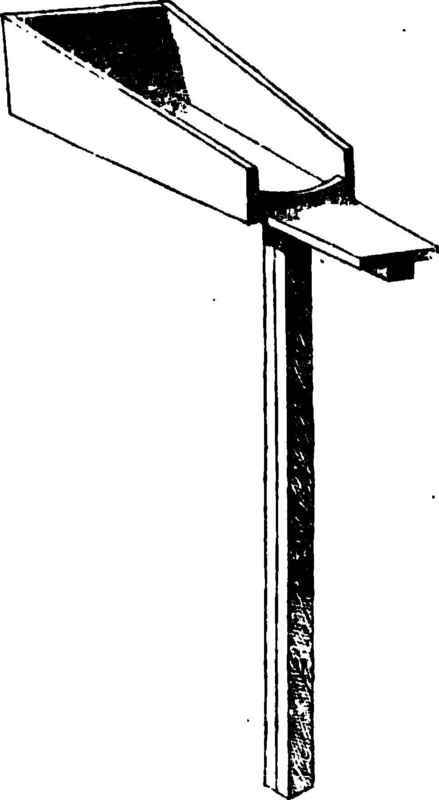
Fig. 8.

Fig. 6.
Pennsylvania. Fred W. Card.
A landskip, for instance, is always irregular; and to use regularity in painting, or gardening, would make our work unnatural and disagreeable. - Shenstone.
Continue to:


My Books

