


A Race Of Flowerless Plants - III
Description
This section is from the book "The American Garden Vol. XI", by L. H. Bailey. Also available from Amazon: American Horticultural Society A to Z Encyclopedia of Garden Plants.
A Race Of Flowerless Plants - III
YEAST AND BACTERIA - PUTREFACTION AND FERMENTATION----PEAR BLIGHT.
IN THE first article of this series mention was made of some fungi which do not have mycelium, one of them being the yeast-plant. This plant (Fig. A 6) consists typically of a single oval cell of such size that three thousand of them placed end to end would measure only one inch.. The yeast plant propagates itself chiefly by a process called budding. A slight swelling is formed near one bud; it enlarges until it is nearly or quite as large as the original cell, then separates from the parent cell and becomes an independent plant; or it may remain attached and by repetition of the process a chain of several cells may be formed before separation takes place.
Domestic yeast consists essentially of this yeast plant, which grows in all yeast bread. In process of growth it forms and gives off large quantities of a certain gas - carbonic acid - which, by its expansive power, forces the particles of dough apart and so causes the bread to "rise." Alcohol is produced at the same time and escapes in baking or soon afterwards. The production of alcoholic fermentation, as in beer and wine, is the special property of yeast, and, with slight exceptions, only yeast can produce it.
The bacteria are closely related to the yeasts. They differ from them in being, as a rule, smaller and more thread-like, and in their mode of reproduction. They multiply, not by budding, but by cutting themselves in two (A 11, 16, etc,) A cross-partition is formed and separation takes place sooner or later. In shape they are rounded or in various degrees elongated, simple or pointed, straight, bent, wavy or spiral, and sometimes extremely long and slender. Fig. A (after Cohn) is a genera] collection of various kinds of bacteria, illustrating most of the typical shapes (all highly magnified), but very many species are known which are not shown here. The different kinds are as distinct as the different kinds of grasses, or pines.
While yeasts produce fermentation, bacteria causes putrefaction, as in spoiled beef; but putrefaction is only a special kind of fermentation. There are few species of yeast, but many of bacteria, and as a rule each of the latter produces its own special kind of fermentation or change in the thing it grows in. Putrefactive fermentation proper we observe in the spoiling of beef (Fig. A 8), acetous fermentation in the formation of vinegar, butyric fermentation - rancidity - in butter, and so on. Some kinds produce peculiar and distinctive colors; as the form shown in Fig. A 1, which produces a red color, sometimes seen in spots on bread, looking like drops of blood. Some species ferment and decompose dead vegetable matter and make soil of it, so that it becomes available again for crops. Recent experiments show that crops cannot grow in a soil destitute of bacteria.
Again, many species prey upon animals and man, and by causing fermentation or decomposition in the blood or various organs of the body produce fevers and various other diseases. Nearly all epidemics and contagious diseases are known or believed to be caused by bacteria. Small-pox is caused by a bacterium (Fig. A 2.) The same organisms produce the same disease in cows, but in a less violent form. A person inoculated with small-pox from a cow, i, e., vaccinated, has a mild form of the disease, after which he is supposed to be free from contagion.
In Europe one of the most contagious diseases of stock is known as charbon. In France, in 1881, an experiment was made with sheep to find a mode of protection against this disease similar to vaccination for small-pox. The bacteria causing charbon (similar to Fig. A 14), were for this purpose cultivated artificially in chicken broth, a few of them being transferred to fresh broth every few hours, where rapid multiplication took place in each interval, till they had thus passed through many, say thirty generations. By this method a cultivated variety was obtained which was less virulent than the wild bacteria, if we may call them so. Then a flock of fifty sheep was taken, and of these twenty-five selected at random, inoculated with the cultivated germs, marked and turned out with the rest. Ten days later, the entire fifty were inoculated with germs fresh from a diseased animal. At the end of forty-eight hours the twenty-five previously inoculated were alive and well, while the twenty-five not previous inoculated were dead.
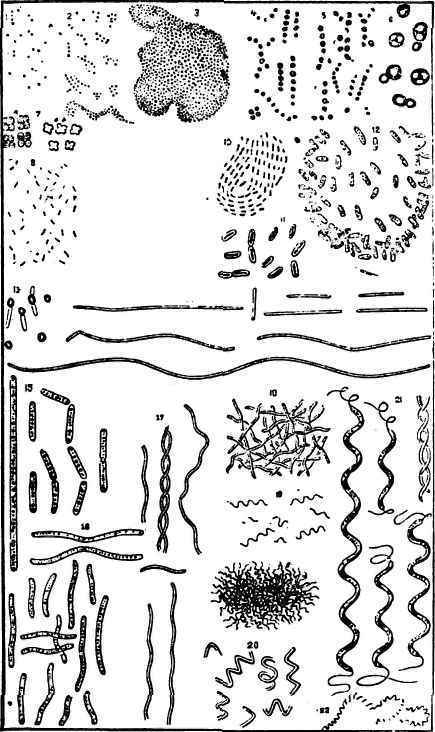
Fig. A.
The following illustrates the vitality of bacteria. A widow living adjacent to the estate of a great land owner in Germany cut clover upon his land to feed her cow and goat. They became sick, and on investigation it was found that at the spot where the clover was cut a steer, dead from charbon, had been buried the year before, and that the germs of the disease had been brought up by earth worms. Cases are recorded where bacteria have been kept sealed up for years without losing their vitality. They will often survive hard freezing and considerable boiling.
The discovery of bacterial diseases in plants is quite recent and was made by Professor T. J. Burrill, of the University of Illinois. In searching for the then unknown cause of pear blight, he observed, first in 1877, what appeared to be bacteria in the diseased trees and their viscid exudations. In z88o he began to inoculate healthy trees by inserting small pieces of diseased bark or some of the exudation by means of the point of a knife blade or a needle. The blight developed in the inoculated branches, and repeated experiments and tests established the fact that the cause of blight is bacteria. The name fire-blight expresses the prevailing idea that its development is rapid, but this is not the case. Blight results from inoculations usually in eight to twelve days, but sometimes not so quickly, and its progress is slow.
Apple trees were successfully inoculated with virus from the pear, and the reverse, and the quince blight was similarly proved to be the same. The disease followed the inoculation in a majority of cases. In more recent years these experiments have been repeated by others, especially by J. C. Arthur, with confirmatory results.
Pear blight bacteria, when magnified one thousand times, appear as in Fig. D (after Burril). They usually consist of two joints, but sometimes of one only. Twenty-five thousand could lie side by side in an inch. Their effect on the tree is merely to produce fermentation. Cells of a certain layer in the bark are stored full of small starch grains which the tree has laid away in this customary place to use as food in adjacent parts when needed. The bacteria cause this starch to ferment or putrefy in much the same way that starch will "spoil " when left standing, and with a corresponding bad odor ; but the fermentation is of a special kind, its products being carbonic acid and butyric acid. Fig. B (after Burrill) showed a thin section of bark, highly magnified, from a healthy branch. The cells are filled full of small egg. shaped grains of starch. Fig. C (after Burrill) shows a similar section from a diseased branch. The bacteria have destroyed all the starch grains. And this destruction goes on just as fast as the disease progresses and no faster; cells may be seen near together quite full of starch and also in all the degrees of emptiness.
With the food supply destroyed, the diseased branch gradually dies of starvation and becomes discolored, as do the leaves- The change in appearance does not take place immediately or is very slight at first, so that it is difficult to tell from external ap-pearance how far the disease has progressed. The cell walls are not injured and the disease does not penetrate into the wood. No opening can be seen in the cell walls, even with the most powerful microscope, and it is not known how the bacteria pass from one cell to another. Neither is it known how the germs first enter the tree, but there is reason to believe that they frequently enter through the blossoms at fruits where there is little or no protecting epidermis.
Soil or culture which would produce hardy growth may prevent blight to some extent, but will also reduce the crop. The only practicable remedy is to cutoff infected branches and destroy them. It will not do to leave them lying about, as the bacteria can outlive the winter and afterward propagate the disease. The branch must be cut below the lowest diseased tissues, and care must be taken not to spread the contagion by cutting into a diseased part and then into a healthy part. If there is any doubt about the safety of your knife, disinfect it. as often as necessary, by passing it through a flame.
Harvard University, A. B. Seymour.
Continue to:


My Books

