


Edible Toadstools
Description
This section is from the book "The American Garden Vol. XI", by L. H. Bailey. Also available from Amazon: American Horticultural Society A to Z Encyclopedia of Garden Plants.
Edible Toadstools
So widespread is the ignorance on the subject of edible toadstools, that the writer believes it possible that even the enlightened readers of The American Garden may find some new ideas in the following modest notes on the subject.
There are about a thousand species in the United States, classified under the following divisions : Those having gills or plaits under their caps, and called Agorics; those with spikes or mane-like protuberances under the caps, known as Hydnei; those with thousands of mouths on a sponge-like surface, called Polyporei or Boleti; those with the spore bearing surface tied up inside a cover, or Lycoperdons; the coral-shaped, or Clavariei.
No general test can be given by which a poisonous mushroom can be distinguished from an edible one, but they must be learned individually, as plants and fishes have been, for some varieties may prove wholesome to some people and indigestible to others. In gathering toadstools, never twist them from the stems, but cut them off about an inch below the cap, and lay them down with the gills upwards; otherwise they shed their spores largely, and thus lose flavor. All mushrooms must be rejected that are shiny, acrid or otherwise nauseous, all that are not perfectly fresh when gathered, and all which have been kept longer than a few hours, as they spoil rapidly. As far as known, most of the serious cases of poisoning have been caused by the members of one genus, amanita, and although some members of the tribe are good, it is safe to avoid all toadstools which have the following characteristics : (1) A scurfy or warty top, which often rubs off and leaves the cap smooth; (2) a fixed ring around the stem, generally large and reflexed* in white-spored species : {3) a volva or collar around the base of stem, which generally remains in the ground when the mushroom is gathered.
All amateurs are advised to let alone toadstools which have any sign of a volva; also not to rely upon the silver spoon or any such popular tests.
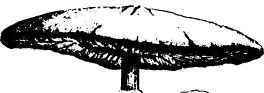
Fig. 1. Poisonous Mushroom.
Fig. 1 gives the amanita or poisonous mushroom, which very closely resembles the Agaricus campes* tris, or mushroom proper of commerce. Fig. 2 represents the little puff-ball, Lycoperdon sp., usually known by children as the Devil's Snuff-box, from the fact that in age the interior is mostly filled with snuff-colored dust.
All white-fleshed puff-balls are edible, and when not showing any discoloration on being cut, will be pronounced by the most fastidious a great table delicacy. They may be cooked in many ways: cut into slices and fried, or put upon a buttered griddle; made into a batter with beaten eggs, or served as soup ; prepared with milk as oysters are, and for this purpose they should be cut rather fine.
Fig. 3 is one of the russulas (Russula ne-terophylla). It is of a drab or mauve color ; cuticle very thin,peeling from the edge, but adherent towards the center; bell-shaped at first, but finally the center of cap becomes depressed. The gills are rather dusky in color, brittle, breaking into unequal segments if pressed. The stems are stout and solid, generally tapering to a point at base, but some gathered by the writer, which were of a very fine nutty flavor, bulged out on one side, as in the illustration. They grow in woods, woody paths or clearings. A11 russulas should be tasted raw, and those rejected which are hot or acrid. Cook for a few moments with butter, pepper and salt, on a gridiron.
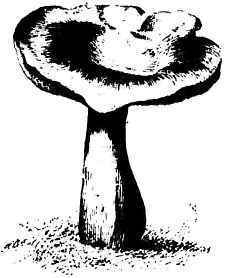
Fig. 3. RUSSULA NETEROPHYLLA.
*Agaricus campestris,the edible mushroom of gardens, has a movable ring. - Ed. Am. G.
Fig. 4 is a very common mushroom, growing in crowded bunches upon decaying stumps. The flavor is very nutty and delicate, and it makes a good dressing for beefsteak, or it can be served alone; in either case, it should be cooked upon a gridiron. The cap is light brown, with a tendency to split open in the center, showing the white flesh beneath. Owing to their crowded manner of growth the cap assumes various shapes in age, but the young mushroom is of the true button type. The stems are long, thin and rather stringy.
Fig. 5 is one of the coral or Clavariei fungi. This is a very easily distinguished mushroom, and a very common one in damp woods. During a rainy spell it may be gathered by the peck in many parts of this country. They do not look very inviting to the uninitiated, but when once tasted are generally pronounced very good. They grow in bunches three or four inches high, and look, as their name indicates, like sprigs of coral stuck into the ground; Those eaten by the writer were of a dark cream color. Most brightly colored ones are said by some writers to be edible, and the bold may try the experiment, but the timid will most certainly let them alone.
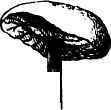
Fig. 4. A Common Mushroom.
Fig. 5 represents the finest specimen ever found by the writer. It was growing at the foot of a pine tree. Sometimes it grows in clay or clayey sand. It closely resembles brain coral in its convolutions. It is cream color, shading into brown. The flesh is firm and white, having the taste and consistency of a half-ripe chestnut. No recipes can be given for the cooking of this "find," as not having any book at hand to prove its respectability, it was never allowed to grace the dinner table, and the writer could only enjoy it in small quantities eaten raw. He knows personally that it is good ! L.s.
Charleston, S. C.
Continue to:


My Books

