


False Shag-Bark Hickory (Hicoria Microcarpa)
Description
This section is from the book "The American Garden Vol. XI", by L. H. Bailey. Also available from Amazon: American Horticultural Society A to Z Encyclopedia of Garden Plants.
False Shag-Bark Hickory (Hicoria Microcarpa)
Hicoria microcarpa, Britton, Bull. Torr. Bot. Club, xv. 283 (1888). Carya microcarpa, Nuttall, Geneva N. Amer. P1. ii. 221 (1818).
THE False Shag-bark Hickory is a tree which is very im-perfectly understood by botanists, and one rarely recognized by others. Some botanists have even doubted its existence, and our highest authority upon American trees has consid-ered it but an incidental form of the true shag-bark. This confusion has evidently resulted mostly from scant and imperfect specimens in the herbaria of botanists. The writer has long observed the tree in central Michigan, and more recently in central New York, and it appears to possess certain marks which clearly distinguish it from other species.
It is important that horticulturists should obtain a correct understanding of this tree, for it is often mistaken for the shag-bark hickory, and now that nut-culture is assuming some importance such confusion should not exist. The hickories are also among our most picturesque trees for planting in large grounds. The ornamental features of these two species are very unlike.
The false shag-bark is more closely related to the pig-nut than to the shag-bark or white hickory, but it agrees with the true shag-bark in possessing a loose bark, and in the disposition of the husks of the nuts to split open at maturity. It may therefore be well to first contrast it with the shag-bark, with which it appears to have been generally confounded.
The first, and perhaps most striking difference between the false and true shag-barks is in the habit of growth. Figures 1 and 3* show characteristic specimens of each. The false shag-bark usually has a narrower top than the other. Its lower and intermediate branches take a nearly horizontal position, and the spray is so disposed that it falls in layers or strata. The shag-bark, on the other hand, is a rugged and broken grower, and is therefore more picturesque. It is in every way a bolder tree. The spray is coarse and somewhat sparse, and it breaks up into angular and irregular figures.

Fig. 4. Nut of Shag-Bark.
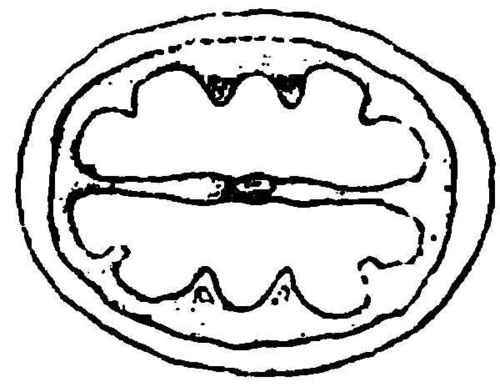
Fig. 5. Cross Section of Nut of, False Shag-Bark.
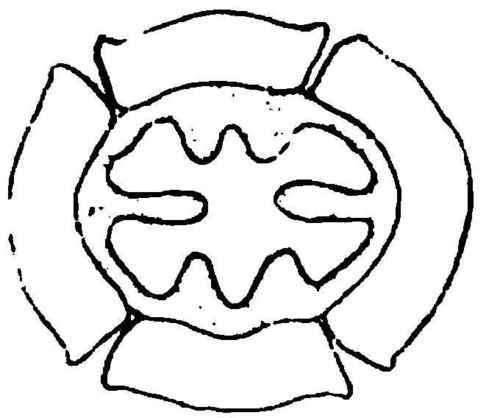
Fig. 6. Cross Section of Nut of Shag-bark.
The bark of the two species is dissimilar. In the false shag-bark it breaks up into thin strips from one to three inches wide, while in the other it breaks into wide and flat plates, which are often six inches broad. Figures 10 and 11 bring out these differences. This dissimilarity of bark is so great as to enable one to distinguish the species at a glance. The winter buds of the two are strikingly unlike. Figure 8 shows a representative twig of the false shag-bark, and figure 9 one of the shag-bark. The difference does not reside entirely in the sizes of the buds. The bud-scales of the shag-bark are conspicuously pointed, while those of the other are blunt or nearly so. These differences are most apparent when the bud-scales begin to enlarge with the bursting of the leaves. Those of the shag-bark are then very broad, and are terminated by a prominent point often a fourth inch or more long. Those of the false shag-bark are much narrower and obtuse, or bearing only a rudimentary point.
There are differences between the two in foliage and season of flowering (the catkins of the false shag-bark appear fully a week after those of the other species), and the catkins of the false shag-bark are slimmer and bear hairy anthers, while the others are smooth, but these dissimilarities need not be discussed here.

Fig. 7. Pig-Nut.
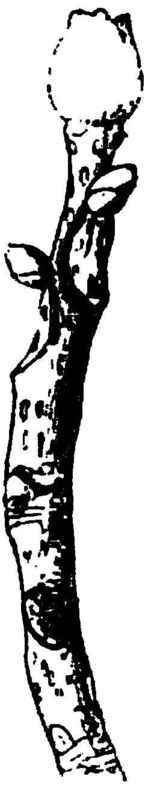
Fig. 8. Shoot of False Shag-bark.

Fig. 9. Shoot of Shag-bark.
*The negative from which a "half-tone" illustration of the shag-bark was to have been made, was broken in transportation; but the artist has made a faithful tracing of the form and habit of the tree on page 387. - Ed.
The most characteristic differences are found in the nuts. The husks and nut-walls of the false shag-bark are very thin, and the husks rarely split off entirely but the divisions cling together on their lower portions. The mature nut in figure 2 is an admirable representation, and figure 5 is an illustration of a characteri s t i c cross-section of a nut with its husk. The nut of this species is more conspicuously beaked than that of the other species. The husks and nut-walls of the true shag-bark are very thick and heavy, and the four divisions of the husk break away entirely and leave the nut free. Figures 4 and 6 show these peculiarities. These features of the fruits are so striking that they at once clearly separate the species. The nut of the false shag-bark is sweet and edible, but it is nevertheless inferior to that of the shag-bark, and all who desire to plant hickory trees should be able to distinguish the two.
The thinness of the husk of the false shag-bark and its disposition to split only part way down, allies this species to the pig-nut (Carya porcina of botanies); and, in fact, closer observation is required to distinguish these two than those previously discussed. But the fruit of the pig-nut is unmistakable. It is pear shaped - reminding one strongly of a Seckel pear; it lacks the point of the other ; the tip looks like the "eye" or calyx of a little pear. Is much less ridged, and the husk does not split off. It is now the last of May, but I have today gathered the last year's nuts of the pig-nut and the husks are still firm, although some of them have cracked for a third or half their length. But even when the husks crack, the divisions remain firmly appressed to the nut, and never become loose as in the case of the false shag-bark. The husks are also thicker. The meat is acrid and inedible. The smooth, regular, compact, pear-like nuts at once distinguish this species. Figure 7 is a faithful illustration of the fruit of the pig-nut. The nut itself - after the husk is removed - is slightly retuse or hollowed at the top, and the point is very small.
The nut of the false shag-bark, on the other hand, is nearly or quite full on top, and the beak is prominent.
There are other points in which the pig-nut differs from the false shag-bark. The most striking dif-erence lies in the bark, which is close, f u r -rowed much like a bass-wood, and is never shaggy, so far as I have observed.
It has seemed necessary to go somewhat into detail in the description of these hickories, as they have never been fully and properly characterized. On account of unreliable field data, it is impossible to determine the distribution of the false shag-bark. It evidently occurs from New York to Illinois, and south to Delaware. I have observed it to be a common tree in some places. The pig-nut has a wider range, growing from Maine to Minnesota, and southward to Florida and Texas. The true shag-bark has much the same range as the pig-nut. All three species grow in sight from my window.
A singular confirmation of the specific distinctness of the false and true shag-barks is found in the behavior of a certain disease or injury which attacks one species and not the other. This is a swelling which very closely resembles the plum-knot, and which attacks the young branches of the shag-bark. A few steps from my door is a shagbark which is badly infested, while two false shag-barks whose branches touch or interlock with the other are not injured. If this distortion of the branches of the shag-bark should become common, it would interfere seriously with the use of the tree for ornamental purposes.*
The botanical names of the hickories have re-cently undergone a complete metamorphosis. The genus carya by which these trees are commonly known, was founded by Thomas Nuttall in 1818.
But it now transpires that Rafinesque in 1808, and again in 1817, proposed the name hicoria, a Latinized form of the aboriginal name. As Rafinesque's name is clearly the older, it must supplant carya. Professor Britton has recently arranged the species under hicoria, and although he has made some unnecessary and unfortunate changes in the specific or "given" names, they must be adopted. The shag-bark is now called Hicoria ovata (formerly Carya alba), and the pig-nut is Hicoria glabra (formerly Carya porcina). The mocker-nut (formerly Carya tomentosa) becomes Hicoria alba. The specific name of the false shag-bark, microcarpa, means "small-fruited," and it was evidently given to record a distinguishing mark between this species and the shag-bark. But while the nuts of the shag-bark are usually larger, they are very variable, and often as small as those of the small-fruited species.
The common names of the species need correction and limitation. All the hicorias are properly hickories, but in many parts of the east they are called "walnuts," the shag-bark being known as "white walnut:" These names are misnomers, for the term walnut properly belongs to the genus jug-lans, which includes the black walnut and butternut. L. H. B.
*Recent examination shows that this distortion is due to the work of an insect. - -Ed.
Continue to:


My Books

