


Pachysandra Procumbens. Damping-Off. Opinions And Practice Concerning The Malady. Part 2
Description
This section is from the book "The American Garden Vol. XI", by L. H. Bailey. Also available from Amazon: American Horticultural Society A to Z Encyclopedia of Garden Plants.
Pachysandra Procumbens. Damping-Off. Opinions And Practice Concerning The Malady. Part 2
But the elements taught us that we did not know what we were about, for, on one occasion, the day after the seed was sown, there was a heavy thunderstorm, and where the water leaked through onto the bed, where the seed was sown, the young plants sprung up in great abundance, and they remained stronger and better all through the season than their neighbors. Ever since that time we have kept the seed bed thoroughly moist from the day the seed is sown until the young plants are quite strong. In order that there may be no misapprehension in this matter, it perhaps will be necessary to state, that, because the treatment indicated suited the germination of the seed and for a time sustained the young plants, it does not follow that the soil in which plants are growing should be kept in a state of saturation all the time.
There is also a thread-like fungus which attacks cuttings in propagating beds, and seedlings in seed-pans, but generous supplies of water applied directly on the seedlings and cuttings will hold it to a great extent in check, and the young plants will be stronger and better than if allowed to exist in dry sand or soil and a dry atmosphere.
From. M. Watson. Jr., Bussey Institution, Jamaica Plain, Mass
Damping-off is a contagious disease attacking plants and cuttings just above or below the surface of the soil, resulting in death or serious injury. In my experience the cause is principally a fungus growth which fills the soil, and covers the surface with a mass of thread-like bodies, identified by Professor Farlow of Cambridge as the mycelium of Pythium om-nivora ; in no case have we failed to notice this present in a greater or less degree, but I have reasons for thinking other fungi may be concerned. The growth of this fungus seems to be due to the combination of too much moisture and too high a temperature; the ravages are more noticeable when plants are grown in a house warmer than they like. Plants are troubled most when grown under glass, chiefly in February and March, when a variety of seeds are sown, many of them almost unknown to us. It is serious on all germinating seeds, and young seedlings making their first growth ; I have also found it on cuttings in sand, on cinerarias in eight-inch pots, and on red cedars and other hardy plants in a propagating frame.
Preventives And Remedies
With cuttings, use a fairly cool house, avoid confined air, ventilate thoroughly, and admit as much sunlight as possible without wilting ; pot off or reset in fresh sand when any symptom appears. By these means we have not been troubled with attacks for several years. When a close atmosphere is necessary, guard against too much moisture and keep an even temperature. When large plants like cineraria are injured, it means the temperature is too high or too variable, and the remedy is simple. With young seedlings and germinating seeds, the difficulties are greater; for preventives, use a fresh sandy soil, free from any recently decayed organic matter; use well drained pots, pans, or boxes ; avoid over watering, particularly in dull weather, shade in the middle of the day only, and keep the temperature as low as the nature of the plants will permit. Do not sow seeds of plants like carnations and pansies in heat. The best remedy is to prick off into fresh soil as soon as any fungus appears; this can easily be done with the stronger growing kinds. Young plants of which nine-tenths of the root is eaten off can sometimes be saved. Fine seeded and slow growing varieties are not so easily managed.
We scatter on dry sand at first; for worse cases, we sift on sand so hot that it can hardly be handled ; this will sometimes check the fungus growth or make it possible for the later coming seeds to succeed where the first perished. We are now experimenting in seed sowing in live sphagnum with a little sandy soil added.
From Professor L. H. Bailey, Cornell University
Damping-off is a term loosely applied to the decay of cuttings, or young plants at or near the surface of the ground. The first appearance of the trouble is a brown-ness of the parts. The stem soon becomes constricted at the point of attack in many plants, and the plant soon falls over. In many cases, the top of the plant may re-main alive and fresh for some days after it has fallen over.
It is commonly supposed that damping-ofi is due to a fungus. The fungus which has been called the "pot-ting-bed fungus" in Europe is commonly supposed to cause the difficulty, but the subject is little understood in this country. It is by no means certain that all damping-off is the same. It is possible that two or three distinct troubles are called by the same name. Damping-off is most troublesome under glass and among plants which are crowded, but it may occur in the nursery-row out of doors. Certain conditions of atmosphere and culture induce the attack of the fungus. In my experience and observation, a soil dry beneath and wet on top affords the best conditions for damping-off. It is a common fault to merely sprinkle the propagating bed, allowing the under soil to remain dry and powdery. The operator may suppose that he has given enough water to wet the soil throughout. This conditions of affairs is particularly apt to occur when water is applied from a hose, for I find that there is then a tendency to apply too little rather than too much.
The amount of water can be guaged more readily if applied.

Fig. 1.

Fig. 2.
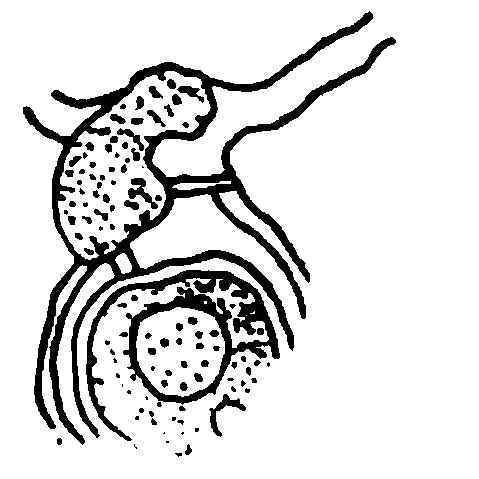
Fig. 3.
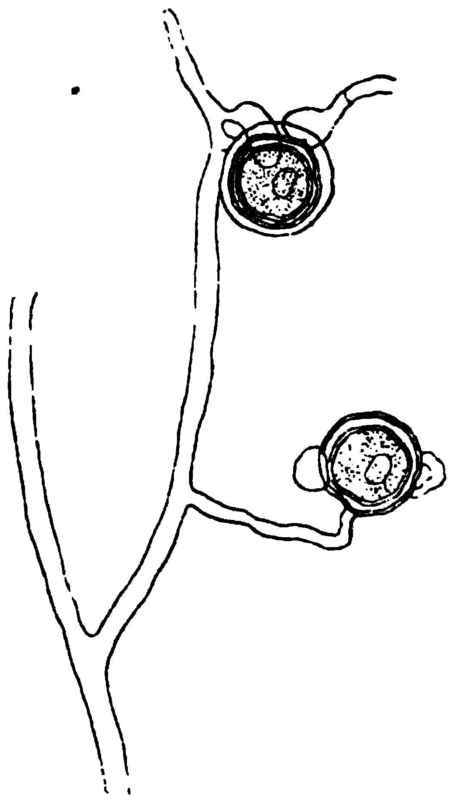
Fig. 4.

Fig. 5.

Fig. 6.

Fig. 7.
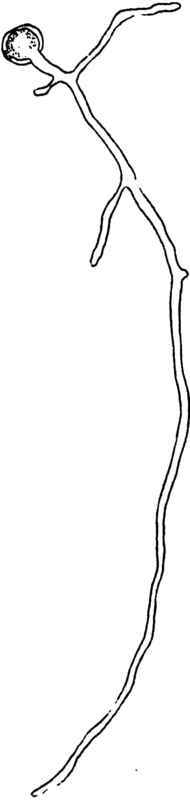
Fig. 8.
There is little to be done in the way of a remedy for damping-off, for unless the plants are particularly valuable it will scarcely pay to attempt to save them after they are attacked. But preventives can be employed. Keep the plants stocky, never allow them to crowd, give plenty of air, and endeavor to keep the soil uniformly moist throughout.
Continue to:


My Books

