


Profit In Northern Strawberries. The Testimony Of One Who Makes It
Description
This section is from the book "The American Garden Vol. XI", by L. H. Bailey. Also available from Amazon: American Horticultural Society A to Z Encyclopedia of Garden Plants.
Profit In Northern Strawberries. The Testimony Of One Who Makes It
There is great difference of opinion as to the best mode of cultivation of the strawberry, probably owing to diversity of soil and locality. The following method, according to my experience, is to be commended. In selecting ground, choose that which is as free from weeds and stones as possible, as the presence of either will double the labor. It would be advisable to thoroughly cultivate the soil upon which berries are to be set for two or three years before planting, and allow as few weeds as possible to go to seed. Fine berries and large crops have been raised on green sward, but the main objection is that the crop is liable to be destroyed by the ravages of the white grub. I believe a yellow loam to be best adapted to the berry, as it. produces fruit that is large, firm and of good flavor. Muck land will produce fine crops, but less firm and of inferior flavor. A gravelly soil will produce good fruit in a wet season, but in a dry season they are a failure.
The varieties of berries that have been raised to the greatest extent in this section are the Wilson, Crescent and Burt. In the opinion of some, the Wilson has had its day; and it is a fact that we cannot get such a growth of vines as we did a few years ago. But we have always obtained the largest yield from the Wilson up to the present time. Last year I obtained an excellent yield from the Burt, of which I raised only about one-tenth of an acre. On one bed of an acre we raised 250 thirty-six quart crates which were nearly all Wilsons. Another bed of one. half acre, Wilson and Crescent mixed, raised 84 crates.
Berries are generally set in this locality about the 1st of May. It is advisable to set them as soon as the ground is fit. In taking up plants for setting, the best are obtained by taking up the row clean, as the plants in the center of the rows have larger roots than those growing on the outer edge, the latter being the last settings of the summer. In selecting the plants, it is economy to choose only those that have a thrifty root. Remove all old runners and all leaves except about three, being careful not to disturb the crown. Should the plants be far enough advanced to show flower-buds, remove the buds; or remove them when they do appear, as, by bearing, the plant will be deprived of strength which is needed for its growth.
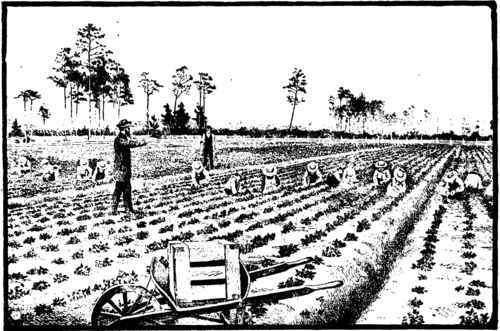
A Florida Strawberry Plantation : from a Photograph.
We set in rows about four feet apart and plants one foot apart. The method of setting is by line, using a common bricklayer's trowel. Some men in our vicinity have set as many as 8,000 plants in a day, but from 4,000 to 6,000 is considered a good day's work. In a week or ten days after the plants are set they should be cultivated and hoed, and then given an application of commercial fertilizer of from two to three hundred pounds per acre, scattered around the plants. It is generally conceded that commercial fertilizer is better than manure for growing berries, as the ground is kept more free from weeds; and, having made the test, I find that I can raise larger crops with less expense by its use. Berries generally need five hoeings during the season. If the first application of fertilizer seems insufficient, after the first or second hoeing give another application. I have usually found it necessary to do so, as I use nothing else.
Many fine growths of vines are raised in this way only to be destroyed from lack of protection during the severe winter. I have found straw to be the best covering. It should be removed in the spring as soon as the frost is out of the ground and another application of about 800 pounds of fertilizer per acre given, sown on the rows, being careful not to apply it when the vines are wet as some kinds will burn the plant. The crop will be ready for marketing about the 20th of June. One great trouble with strawberry growing is that people expect too much from too little labor and expense.
I raised last year from an acre and a half 334 crates, which sold for $1,033.28 in Oswego, which is about 8¾ cents per quart. The expense for raising said crop was: for plants, $12.00; for taking up, trimming and setting plants, $15.00 ; for hoeing, $40.00; for 1,800 pounds fertilizer, $31.50; for straw and putting it on, $25.00; for picking, $240.48; for overseeing pickers, carrying and crating, $35.00; for drawing berries to market, £25.00; use and loss of crates and baskets, $45.00; total expenses, $468.98, leaving a profit of $564.30. This is, of course, above the average yield and price. By referring to accounts which I have kept for the last six years, I find that my average yield during that period has been about 180 crates per acre and the average price 7! cents per quart, which, according to the above schedule of expenses, would leave a net profit of $189.55 per acre.
The above expenses include 2 cents per quart for picking. In some localities the price is but 1½ cents per quart, which would leave a greater profit. Ten or twelve good pickers will handle an acre of berries, and good pickers are very essential to a berry-grower's reputation. The swiftest picker is not always the most profitable, but rather the one who does his work well. In harvesting a large crop it is impossible to see that every box is picked as it should be, but it is very important that the grower gives particular attention to this part of the work and sees that it is done well. It seems the height of inconsistency for a man to put up a package of fruit which looks very well on the top while the baskets in the bottom of the crate contain berries of a most inferior quality, and send it to market with his name in full printed upon it. C. A. Stone.
Oswego County, N. Y.
Continue to:


My Books

