


Rose Rusts
Description
This section is from the book "The American Garden Vol. XI", by L. H. Bailey. Also available from Amazon: American Horticultural Society A to Z Encyclopedia of Garden Plants.
Rose Rusts
NO FUNGUS is more familiar to the horticulturist than that which constitutes the orange rust of the blackberry. For this reason I wish to refer to it in order to call attention to a certain rust of roses. The latter resembles the former in color, and both are of a deeper orange color and larger in mass than is common in fungi of this class. This rose fungus differs,, however, in several points. It grows not only on the blades of the leaves, but on the stems, petioles and midribs. It forms not an expanded layer, but a strongly convex pustule, often of considerable size, and the stem or leaf is frequently bent away at that point. It occurs at the same time of year as the orange rust, or a little later. Microscopically, it resembles the orange rust in having the spores in chains, and in this respect both are like the cluster-cup of the barberry, which is the aecidial form of wheat rust. The cluster-cup spores, however, are included in a sort of cup or peridium, which is wanting in both the others. Still, it may be that each is the aecidial stage of some fungus. No other fungus form has ever been certainly found to be associated with the orange rust. With the rose rust, however, two other forms have been found associated, corresponding to the red and black rust of wheat.
The three forms may be found on the same rose bush, at the same time, inti-m a t e I y associated. The uredo spores are delicate orange or yellow spores, consisting of a finely warty membrane, inclosing i n spherical form its protoplasm and orange coloring matter. Each is borne on a short pedicel, from which it easily falls when ripe. These spores break through the epidermis of the under leaf surface in small pustules, the pustules being surrounded by a row of curved sterile bodies much larger than the spores. Later, but while both kinds of orange spores are still fresh, black spores begin to appear, commonly in the same clusters with the uredo spores. They are rather tall spores, and stand at the top of stalks somewhat longer than themselves, so that they are easily seen with the aid of a magnifying glass. In wheat rust the black spores have only two cells ; in rusts of this genus (phragmidium) there are several, or many cells. This species commonly has about six cells, the number varying from three to nine.
On account of its pointed apex, it is called Phragmidium mueronatum (Fig. 3). Other equally pointed or mucronate species were not known when this was named.
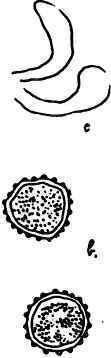
Fig. 2. Spores of Rose Rust.
This fungus, in all its forms, is common on both wild and cultivated roses. The first stage has been observed as early as April, and the last as late as November. The form shown in Fig. x is not so common, but still is not rare. It is not known to have but one stage, and this occurs on the stems, or sometimes on the petioles, forming comparatively large black masses, i. e., perhaps sometimes an inch long. As a microscopic object, this species is remarkable for the beauty of its spores, which is owing largely to the presence of the very long flexuous pedicels. It is called Phragmidium speeiosum.
The third species which grows on roses in America may not be very rare, but if not rare, it has not been distinguished from the first. It is very similar to the first, but differs from it constantly in the larger number of cells in the black spores, which number sometimes as many as thirteen, but commonly about nine to eleven. Fig. 2 represents one of the black spores (a) with its swollen pedicel, two uredo spores (b) and two of the sterile bodies (c) which accompany the latter. This is apparently the form called by Mr. Peck, in the New York Museum Reports, Phragmidium mueronatum, var. Americanum, but I am convinced from comparison of authentic specimens that it is identical with the European Phragmidium Rostr-alpime. All of these species are injurious to rose bushes, but the injury is not very conspicuous, and apparently not very serious in its extent. When any of them is troublesome, some relief should be expected from burning the fallen leaves, taking care, if possible, that none escape. Only the black spores are supposed to survive the winter, and these are destroyed by the burning.
The effect of the fungus is to make many of the leaves fall prematurely.
The rose rusts are interesting to the botanist on account of their life history and the remarkable beauty of their spores.
Harvard University'. A. B. Seymour.
Continue to:


My Books

