


The Brown Rot Of Stone Fruits
Description
This section is from the book "The American Garden Vol. XI", by L. H. Bailey. Also available from Amazon: American Horticultural Society A to Z Encyclopedia of Garden Plants.
The Brown Rot Of Stone Fruits
We have lately entered upon a new era in our knowledge of the economy and methods of fighting the multitudinous fungus diseases which plants are heir to. Twenty, or even ten years ago, very few of these rusts, smuts, blights, mildews and rots were understood, and for still fewer was there known any successful remedy. But now, thanks to botanical investigations and experiments, we have brought under control a number of these insidious foes, and there is good reason for hoping that to many others we shall soon be able to say: "Thus far shalt thou go, but no farther".
One of the most destructive of these diseases is t of stone cherries, even apar causes growers of resent, the immature, days the vered with t y down, h consists of the fruit or spores of the fungus. If a small quantity of this velvety material be placed under a high magnifying power, it will be seen to consist of threads of cells, as shown at Fig. 2. These cells are the spores or productive bodies of the fungus. If a plum covered by the velvety down mentioned above be lightly shaken over a piece of glass, and the glass put under the microscope, it will be found that a great many of the spores have fallen away from the threads, and the field of the microscope will present the appearance shown at Fig. 3. It is by means of these spores that the disease spreads. The wind blows them all through the orchard, many falling upon healthy plums, where they germinate b y sending a minute tube which enters the fruit. Once inside the fruit, this tube continues to develop into mycelium which penetrates all the tissues of the plum and causes it to turn brown.
This mycelium eventually develops a crop of spores, and causes the plums to become withered and dry, and to remain upon the trees in a mummied or dried condition. (See Fig. 4, page 166.) In this way the fungus stays on the trees all winter and even until the next year's crop of fruit ripens.
At the Ohio Experiment Station the past year, we attempted to keep this fungus in check. In our treatment of the plum orchard, we began late in March by picking and burying all the mummied plums on the trees. Then we sprayed them early in April, before the leaves came out, with a simple solution of copper sulphate ; and twice during May (15th and 25th), the first time with London purple alone (to kill the curculio), and the second with a combination of London purple and the Bordeaux mixture, which treatment was repeated June 1.
After these sprayings, the, fruit was fairly well covered with the copper sulphate and lime, which stayed on despite the many rains until it ripened in September a period of nearly four months. A t the time o f picking, an undesirable amo u n t was still present - so much that it was necessary to wash the fruit. This year I intend trying some other compound of copper instead of the Bordeaux mixture on this account. Probably the ammoniacal solution of carbonate of copper, or eau celeste, will serve the purpose.
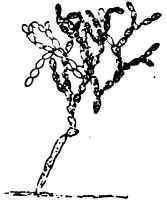
Fig. 2. Threads of Spores.

Fig. 3. Spores.
The results of the experiment, although not as encouraging as I could have wished, were sufficiently so to warrant its continuation through future seasons with strong hopes of ultimate success. Although the meteorological conditions were unusually favorable for the rot, it did not appear until quite late, and injured only a small per cent. of the crop - not nearly so much as usual.
Ohio. Clarence M. Weed.
Continue to:


My Books

