


Two Humble Flowers
Description
This section is from the book "The American Garden Vol. XI", by L. H. Bailey. Also available from Amazon: American Horticultural Society A to Z Encyclopedia of Garden Plants.
Two Humble Flowers
IN FLORICULTURE as in all else, the tendency seems to be toward that which makes the most show. People need to be educated to know that there is pleasure in little things. Perhaps it was for this, that such flowers as the humble hypoxis were placed among the more pretentious ones in nature's garden. It is a plant worthy of notice and even of cultivation. I was so much attracted by its cheerful little blossoms last spring, that I procured a bulb and transplanted it to my garden, where it bloomed unconcernedly.
It grows from six to eight inches high, several scapes arising from the same root, each about four-flowered, dividing at top into an umbel with a short peduncle for each golden star. The blossoms have a curious way of opening, the three outer segments opening first, leaving the three inner standing upright. The former differ somewhat from the latter, being a trifle herbaceous upon the outside, though each division is slightly greenish underneath, and all are of a beautiful golden yellow above. Its six stamens are crowned with pretty arrow-shaped anthers. Its leaves are narrow and grass-like, all radical, somewhat hairy, as are also the slender flower scapes and under portions of the perianth.
This golden star-grass is a bright little thing, and well worthy a place among early flowering plants. It comes into bloom in May and continues through early summer. As it grows upon moist land, it might be made to brighten some out of the way corner, too damp for ordinary plants. Although such a humble plant, it belongs to the pretentious family of amaryllis. It is known in the botanies as Hypoxis erecta, Indian Cucumber Root (Medeola Virginica) is an interesting plant found sparingly in this vicinity. The name Medeola is derived from that of the fabled sorceress Media, because it was anciently supposed to possess great medicinal properties, a claim wholly ignored by scientists of the present day. Gronovius received the first of its kind from Virginia, hence its specific name. Its white fleshy rhizome is thought to have something the taste of a cucumber, a fact from which it derives its common name. It belongs to the family of trilliums, and is a most interesting plant.
It has a simple, slender stem which grows from one to two feet high, covered with a loose white substance which resembles wool. About midway it bears a whorl of from six to eight sessile, parallel-veined leaves, obovate-lanceolate in form. At the top is another row of only three leaves, ovate, and considerably smaller. In the axil of each is produced a pendulous greenish yellow flower with six recurved segments. The petals and sepals are alike both in form and color. The short anthers are borne upon slender filaments. The most noticeable parts of the flower are the straggling stigmas, three in number, of a reddish-brown color, and exceeding in length the sepals and petals, presenting a most remarkable appearance. The flower is followed by a dark purple berry, three-celled but few-seeded. This medeola is a plant decidedly worth more attention. S. E. Kennedy.
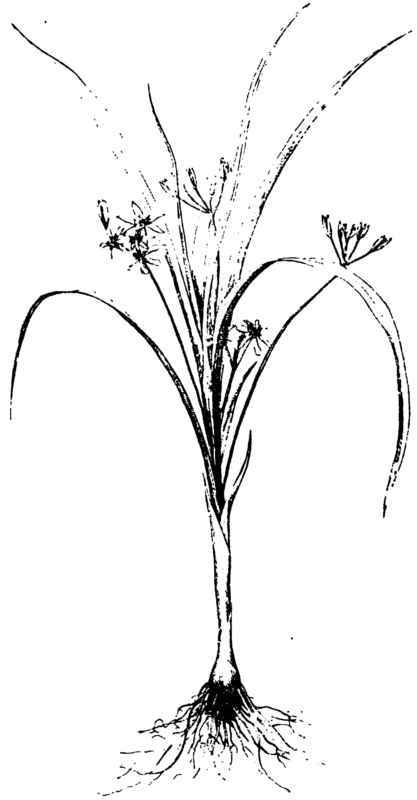
HYPOXIS ERECTA.
Continue to:


My Books

