


Windbreaks For Oranges
Description
This section is from the book "The American Garden Vol. XI", by L. H. Bailey. Also available from Amazon: American Horticultural Society A to Z Encyclopedia of Garden Plants.
Windbreaks For Oranges
I have been much interested in the bulletin on windbreaks from the Cornell Experiment Station. I have given a good deal of attention to the sheltering of orchards by belts of timber, and have found that they protect from winds and ordinary late and early frosts. At Rivers our orange groves are subject from October to March to so-called " northers," a wind blowing from due north and usually for three days and nights continuously. When orchards are not protected from these winds, the injury some seasons amounts to fully 75 per cent. of the whole crop. Have found also that when the shelter belt was planted on all sides, and that on the east side was tall enough to shelter the orchard from the first rays of the morning sun, the injury from frost was only perceptible in the branches first exposed, while in orchards without the shelter on the east side, the damage was quite marked throughout the orchard. The following diagram will illustrate my meaning and experience :
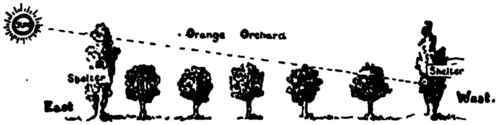
A. orchard trees not injured by frost. B. tree top nipped by frost. The Eucalyptus globulus (Blue Gum), Schinus Molli (so-called Pepper Tree) and the Monterey Cypress, are all used for shelter belts, the last named is the best. - H. J. Rudisill, Los Angeles, California.
[Note. - This is another instance of the old and ever new experience that frosted plants suffer less when kept in the shade. The trees and branches first struck by the sun suffered most. This is a kind of protection from-shelter-belts which had never before occurred to us. - Ed].
Continue to:


My Books

