


Romuleas, Brodiaeas, Gladioli, Oxalises, Alstroemerias, Watsonias, Etc. Continued
Description
This section is from the "Bulb Gardening" book, by Mary Hampden. Also see Amazon: Bulb Gardening.
Romuleas, Brodiaeas, Gladioli, Oxalises, Alstroemerias, Watsonias, Etc. Continued
A Selection Among Late Summer And Autumn. Gladioli
Gladiolus Princeps
Scarlet.
Gladiolus Brenchleyensis
Scarlet.
Gladiolus Baron Joseph Halot
Indigo-blue.
Gladiolus Hollandia
Rose and orange.
Gladiolus America
Rose.
Gladiolus Lilacina
Lilac and yellow, with violet spot.
Gladiolus Hora Novissima
Pink, red and yellow.
Gladiolus Paragon
White, with blue spot.
Gladiolus Butterfly
Yellow, spotted carmine.
Gladiolus Crimson King
Crimson-maroon.
Gladiolus Glory
Pink, with violet spot.
Gladiolus Le Pactole
Yellow, with dark spot.
Gladiolus Salvador
Magenta and yellow, with blue spot.
Gladiolus Saundersii
Scarlet, with maroon spot.
Gladiolus Childsii Rufillus
Scarlet, speckled with white.
Gladiolus Childsii Cylindus
Blush, speckled with yellow.
Gladiolus C. Euler
Orange-rose.
Gladiolus C. Flaminus
Rose, with white spot.
Gladiolus C. Mahogany (Or Angelina)
Brown terra-cotta, with yellow lines.
Gladiolus C.Tennyson
Scarlet.
Gladiolus C. Sir Thomas Dewar
Red-maroon and yellow.
Gladiolus C. Madame Calve
Salmon, with white, and vermilion spot.
Gladiolus C. Lady Constance Gore
White, flaked purple and striped with violet.
Gladiolus Ochroleuca
Pale yellow, passing to white.
Gladiolus Philon
White, with yellow centre.
Gladiolus Richard Milner
Yellow and orange.
Gladiolus Mrs. Oppenheim
White, tinted carmine.
Gladiolus English Wonder
Rose, with violet stripe.
Gladiolus Cesidas
Purple.
Gladiolus Duke Of Devonshire
Scarlet, with white throat.
Gladiolus Lord Rothschild
Scarlet-crimson, shaded purple.
Gladiolus Mrs. Laxton
Rosy-red, with white centre.
Gladiolus Mary Anderson
Mauve, with white lines.
Gladiolus Loluanus
Rose, with white centre.
Gladiolus Marguerite Troil
Mauve, with white and lemon.
Gladiolus Persimmon
Blue, with white lines.
Gladiolus Picciola
Scarlet, with yellow centre.
Gladiolus Theodata
Brick red, with crimson stripe.
Gladiolus Zopyrus
Purple-maroon.
Wood Sorrels
Wood Sorrels are pretty plants for giving beds, or borders, the light carpeting that is beneficial to Gladioli, as to most bulbous plants. These little Oxalises, with their shamrock foliage of green or brown, can be lifted with the Corn Flags and planted at the same time. They increase rapidly, so should be propagated by their offsets, treating these as fresh bulbs.
Oxalises Floribunda And Purpurata
Oxalises Floribunda And Purpurata have rose-coloured flowers, the former possessing a white variety, while O. brasiliensis is magenta, and lasiandra rosy crimson. Then there is the Bermuda Buttercup, Oxalis cernua Bermudiana, of vivid gold.
Owing to their luxuriant spreading growth they are all valuable greenhouse plants, serving to hide pots if used in groups, or to drape the edges of shelves and stagings. They can be kept growing under glass, or be dried off, as preferred, and by treating them quite unceremoniously, potting them at all the seasons, or letting them go dry at odd times with a view to having them vigorous later, it is possible never to be without a supply of creditable specimens. In hanging baskets I have found them of remarkable value during winter, in a temperature of from 450 to 60°; while they will consent to make a show in earliest spring in a south-facing window.
Plant bulbs 2 inches deep out of doors, 1 inch deep in pots, and 6 inches or 1 inch apart in ordinary oil or compost.
Alstraemerias, Or Peruvian Lilies
Alstraemerias, Or Peruvian Lilies, may be had in bloom from late May to the beginning of October. They are 2 or 3 feet tall, should be planted in late October in a sunny border made up with peat and leaf-mould, fresh turf loam, and roadside sand. Yet they can do without peat, and I have seen them flourishing in woodlands in semi-shade. The half-hardy kinds, like many species of plant, are rapidly becoming classed as hardy, and have actually acquired stamina since their introduction. The following may live out of doors, mulched over winter after winter, or can be potted, singly or in threes or fives, in big pots or tubs for greenhouse adornment. Plant 6 inches deep; pot like Liliums.
The Best Alstroemerias
Alstroemerias Aurea
Orange, spotted carmine.
Alstroemerias Lutea
Pale yellow, spotted carmine.
Alstroemerias Revoluta
Orange-red.
Alstroemerias Psittacina
Known as the Parrot Flower. A crimson flower, streaked with green and bright brown.
Alstroemerias Pelegrina
Pale rose.
Alstroemerias Pelegrina Alba
White.
Alstroemerias Chilensis Hybrids
Rose, gold, lemon, blush with crimson markings.
Long sticks are needed for the Peruvian Lilies, or they may be held up by strings, passed from plant to plant of a row, and fastened to stakes at yard distances.
An old author mentions how a plant of Alstrœmeria aurea, from one bulb set in front of a greenhouse, became 4 feet tall, and threw up fifty flower stems by the end of the second year!
Watsonias, Or Bugle Lilies
Watsonias, Or Bugle Lilies, may be admirably associated with Gladioli, requiring similar culture whether out in the garden or in greenhouse pots.
Watsonia Ardernei, The Giant Of The Tribe
Watsonia Ardernei, The Giant Of The Tribe, sends up delicate-looking 4-foot spikes of snow-white flowers, and other spikes of lesser stature will follow when the first has been gathered from the base. Watsonia coccinea is a dwarf summer species, of true vermilion.
Watsonia Neriana
Watsonia Neriana has tawny-rose blossom spikes, while those of the tall Watsonia Augustifolia are pale pink.
It should be remembered that Gladioli and Alstrœmerias are striking centre or 'dot' plants, in symmetrically designed bulb beds.
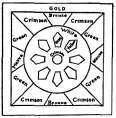

Carpet Bedding Designs, for Bulbous and Foliage Plants.
We have now, I think, looked thoroughly through the opportunities of the gardener who wishes to cultivate bulbous plants in the open or under glass; for, though some varieties have been omitted, no doubt, some species referred to only in passing on, if the suggestions that are in this book are followed, even in part, the subject of Bulb Gardening will be excellently understood.
To increase one's stock of plants is but recreation, after one has learnt how to manage scores of others.
Bulbs - the chrysalides from which seeds pass to plant-life - are poetic in themselves and in their results.
It is, believe me, no small good to persuade an adult, or train up a child, to rejoice in blossoms.
I like to recall the questions asked years ago by 'Old Humphrey,' before I lay down my pen.
'Have you ever sat on a shady bank gazing on the earliest Primrose of the year with admiring wonder? Or bent in a retired nook with intensity of interest over the blue minute flower of the Forget-me-not? If you have not done these things you know not the pleasure, the joy, the delight, that may be excited by a flower.'
From a Lilium giganteum to a Galanthus nivalis, all are precious.
Which shall we cultivate then? Surely all? - If possible.
Continue to:


My Books

