


The Construction Of Rock-Gardens
Description
This section is from the book "The Gardener V3", by William Thomson. Also available from Amazon: The New Organic Grower: A Master's Manual of Tools and Techniques for the Home and Market Gardener.
The Construction Of Rock-Gardens
In our last number we called the attention of our readers to Mr Robinson's interesting book on Alpine Flowers. We are now enabled to present an illustration taken from that work, bearing on the construction of rock-gardens - a feature of gardening by no means intelligently understood generally, judging from the sorry exhibitions of this kind of workmanship we sometimes meet with.
"Rockwork is," says Mr Robinson on page 30, "as a rule,made for the display of mountain plants, or those which by their dwarfness fall into the class commonly known as Alpines. Some cover rockwork with climbing shrubs and dwarf bushes, but in every case, unless where a rock is introduced for its own effect in the landscape, the object is to grow plants. Now, as very few of the subjects alluded to like shade, or even tolerate it, it follows this is an ignorant and bad practice. Many persons who arrange such things doubtless fear the sun burning up their plants; yet the sun that beats down on the Alps and Pyrenees is fiercer than that which shines on the British garden. But while the Alpine sun cheers the plants into beauty, it also melts the snows above, and water and frost grind down the rocks into earth; and thus, enjoying both, the roots form perfectly healthy plants. Fully-exposed plants do not perish from too much sun, but simply from want of water. Therefore it cannot be too widely known that full exposure to the sun is the first condition of perfect rock-plant culture - abundance of free soil under the root, and such a disposition of the soil and rocks that the rain may permeate through and fall off the rocks, being also indispensable.
"The preceding plan can be carried out in the very smallest places. The next is quite as easily formed on the fringe of any shrubbery. An open, slightly elevated, and, if possible, quiet, isolated spot, should be chosen, and a small rock-garden so arranged as to appear as if naturally cropping out of the shrubbery. With a few cart-loads of stones and earth, excellent effects may be produced in this way. The following illustration well explains my meaning; an irregularly sloping border, with a few mossy bits of rock peeping from a swarming carpet of Sandworts, Mountain-pinks, Rock-cresses, Sedums and Saxifrages, Arabises and Aubrietias, with a little company of Fern fronds sheltered in the low fringe of shrub behind the mossy stones.
" Having determined on the position of the bed, the next thing to do is to excavate the ground to the depth of 2 feet or thereabout, and to run a drain from it if very wet. If not, it is better let alone, as a good deal of the success depends upon the beds being continually moist; and in dry soils, instead of draining, it would be better to put in a subtratum of spongy peat, so as to retain moisture for the stony matter that the cavity is to be filled with. As to soil, rock-plants are found in all sorts; but a good turfy loam, with plenty of silver sand added, will be found to suit a greater number of kinds than any other. The compost should be of a somewhat spongy character; and if not naturally so, it should be so made by the addition of well-decomposed leaf-mould, cocoa-nut fibre, or, failing these, peat. If the trees of the shrubbery are of a nature likely to send hungry roots into the mass of good compost prepared for the rock-plants, it will be desirable to dig a narrow drain to below the level of their roots, and fill it with concrete to the surface; this will prevent the Alpine plants from being starved by their more vigorous neighbours. The kind of stone is not an important point, and many people have to take their chance in this respect, and use that which can be got.
Millstone-grit and most kinds of sandstone are good, where a selection can be made, but almost any kind will do. Vitrified material should be avoided.
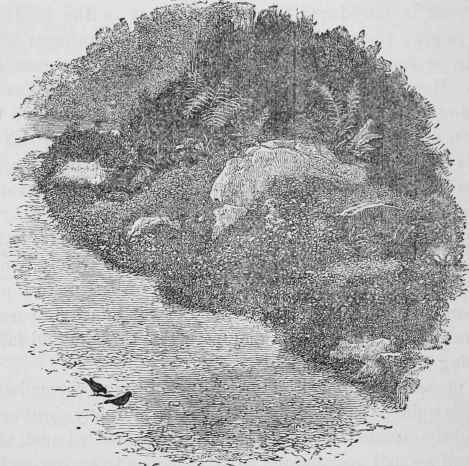
Rock-Garden on margin of Shrubbery.
"With the soil should be incorporated the smallest and least useful stones and debris among those collected for the work, so that the plants to be seated on the top may send down their roots through the mixture of earth and stone, and revel in it. When this is well and firmly done, the large stones may be placed - half in the earth as a rule, and on their broadest side, so that the mass, when completed, may be perfectly firm. Have nothing to do with tree roots or stumps in work of this kind; they crumble away, and are at best a nuisance and disfigurement to a garden. The intervening spaces may then be filled up, half with the compost and half with the stony matter, and the smaller blocks placed in position, the whole being made as tastefully diversified as may seem desirable, taking the size of the structure into consideration. When finished, it should look like a bit of rocky ground, stones of different shapes protruding - here a straight-sided one, under the lee of which a shade-loving plant may flourish; there two in juxtaposition, between which a cliff alpine may find a place.
Two or three feet high will, as a rule, be high enough for the highest points of rocky fringes of this sort, though the plan admits of considerable variation, and it may be tastefully made twice or thrice as high. In some of our public and private gardens, want of means is given as an excuse for the presence of the hideous pock-marked potato-pit-like masses of rockwork that disfigure them. The plan now recommended is as much less expensive than these as it is less offensive ! "
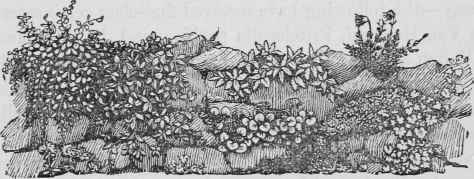
"While many have old ruins and walls on which to grow Alpine plants, others will have no means of enjoying them this way, but all may succeed perfectly with the plan suggested in the accompanying figure. By building a rough stone wall, and packing the intervals as firmly as possible with loam and sandy peat, and putting, perhaps, a little mortar on the outside of the largest interstices, a host of brilliant gems may be grown with almost as little attention as we bestow on the common Ivy. Thoroughly consolidated, the materials of the wall would afford precisely the kind of nutriment required by the plants. The wall would prove a more congenial home to many species than any but the best-constructed rock-garden. In many parts of the country the rains would keep the walls in a sufficiently moist condition, the top being always left somewhat concave; in dry districts, a perforated copper pipe laid along the top will diffuse the requisite moisture. In very moist places, natives of wet rocks and trailing plants, like the Linnaea, might be interspersed here and there among the other Alpines; in dry ones it would be desirable to plant chiefly the Saxifrages, Sedums,small Campanulas, Linarias, and subjects that, even in hotter countries than ours, find a home on the sunniest and barest crags.
The chief care in the management of this wall of Alpine flowers would be in preventing weeds or coarse plants from taking root and overrunning the choice gems. When these are once observed, they can be easily prevented from making any further progress by continually cutting off their shoots as they appear; it would never be necessary to disturb the wall even in the case of a thriving Convolvulus. The wall of Alpine plants may be placed in any convenient position in or near the garden; there is no reason why a portion of the walls usually devoted to climbers should not be prepared as I describe. The boundary-walls of multitudes of small gardens would look better graced by Alpine flowers than bare, as they usually are. However, once it is generally known that the very walls may be jewelled with this exquisite plant-life, it need not be pointed out where opportunities may be found for developing it".
Continue to:


My Books

