


The Rose. Chapter XIV. - How To Show It. Part 2
Description
This section is from the book "The Gardener V3", by William Thomson. Also available from Amazon: The New Organic Grower: A Master's Manual of Tools and Techniques for the Home and Market Gardener.
The Rose. Chapter XIV. - How To Show It. Part 2
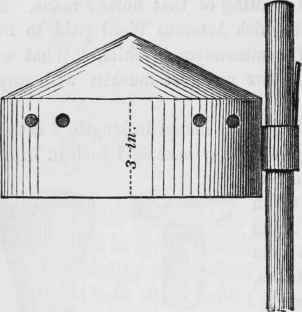
The young knight will not be armed cap-a-pie until he has supplied himself with a couple of helmets. If the weather is showery, or the sun scorches, just before a show, many Roses may be advantageously shaded by having a zinc cap placed over them 8 inches in diameter, 5 inches in depth, ventilated, and having a socket attached, which may be moved up and down a stake fixed by the Rose-tree until the cap is secured in its position by a wooden wedge inserted between socket and stake, as under. Roses of a more delicate complexion than others - such as Mesdames Vidot and Rivers, the two Louises Magnan and Peyronney, Miss Ingram and Monsieur Noman - and some whose vivid colouring is quickly tarnished by fiery suns - such as the brilliant Monsieur Boncenne - may be thus preserved for exhibition. Fresh Cabbage-leaves, renewed from time to time, may be advantageously placed on the caps, which, I may add, have a more pleasing appearance in the rosarium when painted a dark-green colour. Helmet No. 2 resembles No. 1, except that the top is made of glass and is flat.
This is used to accelerate the opening of Roses, and sometimes with success; but generally I have found that nature will not be hurried, and the Rose has been more refractory than the heat.
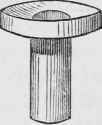
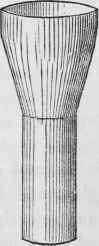
In using these caps - and their use, be it remembered, is exceptional - the amateur must be on his guard against placing them too near the Rose, lest, when moved by the wind, the petals should be injured by trituration. And not only in this instance, but in all, he must so watch his trees as to prevent all risk of that contact and chafing which quickly ruins the Rose. Watching the flower as it sways to and fro in the summer breeze, he must remove all leaves and shoots which, touching it, would mar its beauty.
Watchful ever, our young knight must keep his stricter vigil upon the battle's eve. He must know that all is in readiness, the extent of his resources, and how he is to apply them. The day before a show, I have not only the names of my best Roses noted in my pocket-book, but, dividing a sheet of paper into 48, 36, 24, 12, or 6 spaces, I place each Rose in the position which it will probably occupy on the morrow, and set my forces in battle array. Here is an example, copied literatim: -
12 Roses
Lefebvre. | Niel. | Due de Rohan. | Vidot. |
Furtado. | Beauman. | Devoniensis. | Colomb. |
P. Notting. | M. Bravy. | Ex. de Brie. | De Rennes. |
Your beautiful thoroughbreds may not all come to the post, they may not run in the order in which you have placed them - that is, some of your Roses may be too much expanded when you come to cut them, or may not be in size or in colour exactly suitable for the position assigned to them; but you will find, notwithstanding, very great assistance from such a plan as that proposed to you; and when you have gained by observation a knowledge of the development and duration of your Roses, you will meet with few disappointments in its realisation.
On the eve of the show you must have all your boxes surfaced with Moss, and sprinkled, set out upon trestles, 3 feet from the ground, in some sheltered corner or garden-shed; your zinc tubes, in rows upon their miniature bottle-rack, cheaply made, and having a strong resemblance to the stands on which Boots deposes our fat portmanteau, heaving a thankful sigh; and upon a small table your box, containing plans of arrangement, cards with names of Roses written upon them, sticks to hold them, a pair of sharp pruning-scissors with which to cut your flowers, a pair of small finely-pointed ditto, with which you may sometimes remove the decayed edge from a petal, and a piece of narrow ivory rounded at the end, such as ladies use for a knitting-mesh, and which, very carefully and delicately handled, may help you now and then to assist the opening Rose, or to reduce irregularities of growth to a more natural, and therefore graceful, combination; add a small hamper of additional Moss, and the dressing-room is ready for the royal toilet.
When should we cut our Roses? The nurseryman who exhibits 144 Roses in one collection - that is, 3 specimens of 48 varieties - and sometimes simultaneously a collection of 72 distinct blooms, conveying them great distances, is obliged to cut on the day preceding the shows, and having acres of young trees to select from, can generally find Roses of such calibre as will insure to him a continuance of perfect beauty for the next four-and-twenty hours; but I strongly advise the amateur, who has no such wealth of material, and must make the most of his limited means, to cut his Roses, whenever he has the option, upon the morning of the show. If the weather is broken, and clouds without and barometer within warn you of impending rain, then gather ye Roses while ye may, in the afternoon and the evening before the show; but if it is "In the prime of summer-time, An evening calm and cool," let your Roses rest after the heat of the day, and cut them on the morrow, when they awake with the sun, refreshed with gracious dews.
Wherefore, early to your bed, my amateur, your bed of Roses and of Thorns; for as surely as the schoolboy who, having received a cake from home, takes with him a last slice to his cubicule, awakes in feverish repletion, turning painfully upon the crusty crumbs, so shall this night of yours be fraught with pleasure and with pain. Now shall you taste daintily the candied peels, and now toss fretfully on piercing grits. Now you shall sleep, and all shall be serene, blissful. You are dreaming, so sweetly dreaming, the happy hours away. The great day has come,
"A happier smile illumes each brow,
With quicker spread each heart uncloses; And all is happiness, for now
The valley holds its feast of Roses".
Continue to:


My Books

