


Flow Pipes In Hot Water Boilers
Description
This section is from the book "The Gardener's Monthly And Horticulturist V27", by Thomas Meehan. See also: Four-Season Harvest: Organic Vegetables from Your Home Garden All Year Long.
Flow Pipes In Hot Water Boilers
"A Constant Reader," Bangor, Me., says: "Your remarks on the above subject (page 199 July number) seem very reasonable and may be made very practicable.
"Water certainly must need greater force to run up hill than down; the better showing is what every interested reader of your magazine would desire. As I am about to make some changes I would thankfully accept any information to gain better results; I am convinced from your remarks that you have this mode in practical use. Will Mr. William Saunders and Mr. Thomas Meehan please give an illustration of the operation-such as the elevation of the boiler, the exact descent of the pipes, etc.
"Thanking you and your valuable contributors for many useful and practical suggestions".
[The annexed figure I is a sketch of Mr. Saunders' boiler communicated to the Gardeners' Monthly for Sept., 1872. So far as we know it has always worked very well. But we subjoin a criticism of Mr. Saunders' plan as made by Dr. Fisher, of Fitchburg, Mass.:

(Fig. 1).
" Looking at this matter the way I do, I was very much surprised to see a sketch of an apparatus, on page 263 of the September number of the Monthly, given as a model, in which the descent of the pipe was gradual from the commencement of the flow to the end of the return. It is true that in such an arrangement there would be a circulation, but a little consideration will show its weak point. Suppose the water, as it leaves the boiler, to be at the temperature of 200°, and that upon its arrival at the botton of the boiler it has cooled down to 1oo°. The average temperature of the boiler column will not be 150°, the mean between the two extremes, but probably 160 or 1700, according to the arrangement of the fire. The average temperature of the opposing column, which includes the entire length of the pipe, will not be 1500, because the hotter end of the pipe will radiate heat faster than the rest of it, and thus the average will be something less than 150, say 1400. Then we have, as a basis of circulation one column of water in the boiler of the temperature of, say 1650, and another one in the pipes of 1400. Now if the pipes were laid level as I have described, and as I have attempted to show in Fig. 2, the basis would be a temperature of 165 for the boiler column, and a temperature of 100 only for the return column.
This would give a more rapid circulation than the other by just the difference due to the specific weights of the water at those different temperatures, and which could not be less than one hundred per cent".
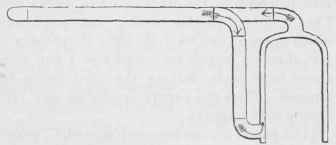
(Fig. 2).
The criticism is of course theoretical, but is well worthy of study.
The cut Fig. 2 explains Dr. Fisher's idea. The flow and return pipe being on the same level are not distinguishable from each other till near the boiler. - Ed. G. M].
Will Warm Water Run Down Hill? - "G. P. C," Taunton (we suppose Massachusetts), asks for more particulars regarding Mr. Saunders' method of permitting the warm water in a boiler to run down hill. The answer to another correspondent we suppose will be all he requires.
Continue to:


My Books

