


November, 1885. Number 323. Flower Garden And Pleasure Ground. Seasonable Hints
Description
This section is from the book "The Gardener's Monthly And Horticulturist V27", by Thomas Meehan. See also: Four-Season Harvest: Organic Vegetables from Your Home Garden All Year Long.
November, 1885. Number 323. Flower Garden And Pleasure Ground. Seasonable Hints
Gardening would be more nearly an echo of paradise than it is now, only for the annoyances caused by insect foes. The red spider is a terrible pest, and the past season it has been more than usually destructive. The evergreen box is a great favorite with this little vixen, and only for this the Box in its many varied forms would be one of the most popular ornaments of our gardens. Then many coniferous trees, more particularly the "White and Black Spruces and the Siberian Fir, seem particularly attractive to them, and of late years they seem to have discovered that a dose of Arbor Vitae is not bad to take. They are so very small that they can scarcely be seen without a pocket lens, but their existence may always be known by a. brownish tint to the tree in summer time; and on a dewy morning by the dense cobweb which is then made apparent like a silk net-work over the whole tree or bush. From this web-weaving power, and we suppose from some other anatomical characters they are classed with the Arach-nideae, or Spider family; but while spiders generally are carnivorous, these little wretches are suctorial, and live on the juices of the tree.
Spiders usually make webs to catch insects - just what these creatures make webs for, that eat no flesh nor drink blood, nor have anything to do but suck the pleasant juices of our petted plants is not clear.
But we are getting too much out into wild nature for "practical hints," where people want to know what to do, than to get merely moral lessons. Fortunately red spider cannot catch on well, and a powerful syringe or garden engine will soon clear a bush or small tree of them. They thrive during hot weather simply because there are no rains to knock them off. As they suck only, poisons will not reach them. But when we have to deal with insects that eat, such as the Elm-leaf Beetle, Potato Beetle, or caterpillars such as the Measuring or Canker Worm, a syringing or engineing with water in which Paris Green has been dissolved, will do the destructive work effectually. But very often it is much easier to gather by hand than to worry over poisons or mixtures. This is particularly the case with the drop-worm, basket worm, or, if we prefer the genuine name given by the entomological men of science, Thryriodopteryx ephemerae-formis. A boy will clear one's whole place of them in a day, and a second picking will gather in the few missed on the first venture. These curious creatures that commence to build a house over themselves when they are born, and die in the house they build - the house that is at once their cradle and their grave - are very common on Arbor Vitaes and other coniferous trees.
They kill the trees if not taken off early, for no tree suffers by the loss of its leaves like an evergreen. Yet it is no uncommon thing to find gardeners with great pretensions to knowing everything - so knowing that they do not even read a horticultural magazine - with valuable evergreens totally destroyed by reason of neglect in picking the bag worms off.
At this season of the year one may watch trees or shrubs in the woods for peculiarities in habit or growth, and get cuttings or grafts for propagating. This is especially the case with weeping or fasti-giate trees. Almost all the curiosities we have of this character, have been found wild originally by-some acute observer. They are not the results of the skill of the florist, but of nature's own unaided love of variation. Very few persons have any idea of the great range there is to natural variation till they begin to look for them. Annexed we give an illustration of a variation in the common Wood Honeysuckle, Azalea nudiflora, from a photograph furnished us by Mr. Lorin Blodget. The specimens were gathered in a piece of open woodland near Media, Pennsylvania, on the 25th of May last. The form with the few large flowers is common enough, but the smaller with the immense number of flowers in the head, would gladden the heart of an enthusiastic florist to come across, and would no doubt be very popular under cultivation.
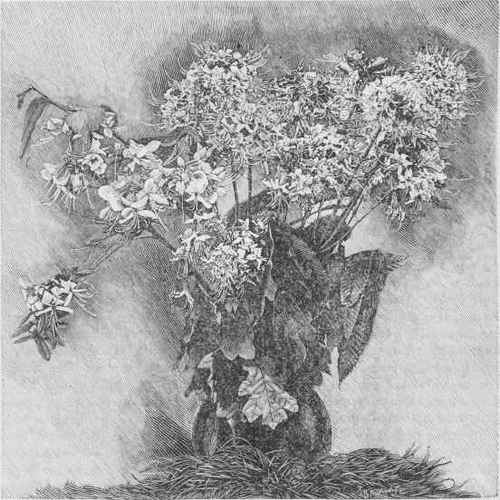
Azalea nudiflora.
We still see occasionally advice not to have anything to do with planting large trees, not to touch anything over five or six feet high, or thicker than broom handles. This advice smells somewhat musty. A tree twenty feet high and a foot in circumference will grow just as well as a small tree, providing it is vigorous, healthy, and has been several times transplanted before, so that it can be taken up at small expense, and with a reasonable chance of getting most of its roots out safely. It is pitiful to pass places just "finished" with nothing but little saplings scattered about, under the impression that larger trees would not grow or do well.
Now we go into details, as most chapters on "work for the month" do. For instance, we might say it is now so well understood that we may have an immense addition to our list of hardy evergreens, if we will only shelter them, that we expect all those who love these varied winter favorites will take measures this season to plant shelter belts in exposed places, or else to set the common hardy trees like Norway and Hemlock Spruce, and Scotch, Austrian and White Pines thickly about, so that the rarer ones can be put between them. Almost all young trees are tenderer than they are when older. It is therefore no test of the hardiness of some rare thing, that a small plant is killed in the winter. Silver Firs almost always get killed back for a few years in this section, unless protected, but yet gain a little in strength. After they are ten years old they will endure our hardest weather. So Spanish Chestnuts, English Walnuts, and many others will die back considerably, until they get strength. Therefore, protect any valued young plant, if possible, no matter how hardy its reputation may be.
We have said this before, but it is well to repeat accasionally general practical advice given in former chapters.
Nice smooth lawns are great attractions. If not level and smooth, earth may be filled in the hollow places at this season, and raked smooth and level. If not over two or three inches deep, the grass beneath will come through and make a sod before next summer; but, if deeper, a little grass seed may be sown.
In treating hedges of Osage, Honey Locust, or other deciduous plants, we like the plan of letting them grow as they will for two or three years, and then, when the stems are a couple of inches thick, saw to the ground. A mass of strong sprouts then pushes up, which can be pruned into shape the next summer. Where hedges are to be thus made, or older ones have been neglected, they can be cut down to the ground any time in the fall or winter season. It seems that in spite of all that has been said, Osage Orange and Honey Locust are the best plants for farm fences, or where any very strong fence is desired. Berberry, Silver Thorn, and Pyrus japonica are the next best - indeed, except that it takes rather longer to make a good fence, the last-named would be as good as the two first in all except cheapness. An extensive travel, however, teaches us that even Osage and Honey Locust are seldom successful as a protective fence, without great care, knowledge, and considerable expense. But the combination of wire and Osage, or Honey Locust, is all that can be desired. It need not be expensive barbedwire. Any light posts, with two or three strands of wire - the posts simply strong enough to hold the wire two or three years, till the hedge grows up - is all that is required.
When the posts rot away the growing hedge keeps the wires in place. Any sort of hacking of the hedge once a year, so as to keep it in bounds, will then make a thoroughly hog proof, or thief-proof fence.
Continue to:


My Books

