


Japan Ampelopsis
Description
This section is from the book "The Gardener's Monthly And Horticulturist V28", by Thomas Meehan. See also: Four-Season Harvest: Organic Vegetables from Your Home Garden All Year Long.
Japan Ampelopsis
It is now nearly twenty years since this beautiful creeper was introduced to the notice of horticulturists by those famous cultivators, the Messrs. Veitch, of Chelsea, near London, who exhibited a specimen at a meeting of the Royal Botanical Society on the 27th of May 1867. The original plant still occupies its position on the house of Mr. Dominny, so long known for his faithful service with that firm. It is commonly known as Ampelopsis Veitchii, the name under which it was then exhibited, but had been named previously Ampelopsis tricuspidata, which is therefore the correct name. Only for the fact that the genus Ampelopsis is regarded as distinct from Vitis - the true grapes - its name would probably be Vitis Japonica, under which name it appears to be described in Thunberg's Flora Japonica. His description fits some of the varying phases of this plant. He says it is called in Japan "Tsta," that is to say "The Ivy." In America it is commonly known now as the Japan Ivy. It is botanic-ally a singular plant, the leaves being sometimes in threes, sometimes merely three-toothed, from which it gets the name - tricuspidata, and sometimes heart-shaped as described by Thunberg. Another interesting fact is that it is only every third leaf that has a tendril opposite to it, and that third leaf has no axillary bud as in other plants.
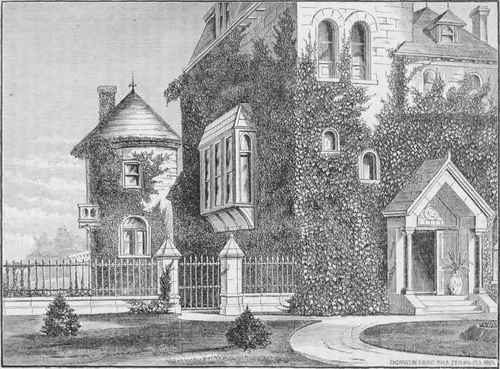
Ampelopsis Veitchii.
Its interest to horticulturists is universal. It covers a wall or fence, and so smooth and evenly that the famous English Ivy could do it no better. The English Ivy however, claims the advantage of being always green. Though this is not evergreen it takes on such a beautiful crimson and orange color in the fall, that one is quite reconciled to the absence of foliage for a few months.
Its only known enemy so far is a disease similar to fire blight in the pear, in this that it only attacks the branch for a few inches in one place; but the result is to make the whole portion above for perhaps many square yards have yellow tinted foliage, which, during the winter following dies. Those who do not look deeply into phenomena, then consider the plant "tender." Fortunately, as in the case of the fire blight in the pear, it is only the part above the point of attack that suffers and sprouts from below come out and soon cover the spot where the other has been killed.
The cut which accompanies this has been kindly loaned, in order to illustrate our chapter, by Mr. A. Blanc.
Continue to:


My Books

