


New York Chrysanthemum Show
Description
This section is from the book "The Gardener's Monthly And Horticulturist V28", by Thomas Meehan. See also: Four-Season Harvest: Organic Vegetables from Your Home Garden All Year Long.
New York Chrysanthemum Show
This will be held on the 2d of November and following days, at Cosmopolitain Hall, 41st and Broadway. Mr. John Thorpe is Secretary for the time being, in place of James Y. Murkland, deceased suffer first; and the weakest from poverty in food or drink are always at the upper portion of the trees or extreme ends of the branches.
Wherever it is practicable to do so, our trees as well as our garden crops, should have a top dressing of compost manure, or fertilizers. If this cannot be done, some relief may come from thinning out the trees, so as to have less mouths in the shape of roots striving for a share of the food.
Another matter of interest on which our advice is often sought, is the destruction of poison vines in public places. The city of Philadelphia made an appropriation a few years ago, at the request of its Park Commissioners, to destroy the vines that poisoned so many visitors. But it was found that the more they chopped at them the more they grew, - and for the hundreds of dollars spent, thousands of new vines sprung up. The excellent gentlemen forming the commission did not know that the plants should be cut just at the time the young leaves were forming. If not cut before the leaves were firm enough to gather food from the atmosphere, the roots get strength to put out again.
At any rate our readers know that it is no use to cut down noxious vines at this season. Wait till they are sprouting in spring. They may possibly make a feeble attempt at sprouting a second time, but a second "disbudding " in this way will be certain death. It is wonderful how much labor and money is lost in gardening for want of a little thought. Not long since we found several men at work in a garden with hammers, drill and fuse, to blow to pieces and remove a large boulder in the way of a lawn. Two men for half a day would have dug a hole near deep enough to bury the rock two feet below the surface. The same with stumps; it is often much easier to bury them than to haul them long distances away. But the skilful gardener would have added more rocks to the boulder and made a rock garden, or gather the stumps into some special piece of attractive work. When the suggestion was made to the gardener in the case of the rock blowing, the reply came that it was not the spot for a rock garden. But the removal of a walk to another place, or the planting of a few belts of shrubs, would have made the spot appropriate, indeed just the very thing for one of the grandest effects in correct landscape gardening.
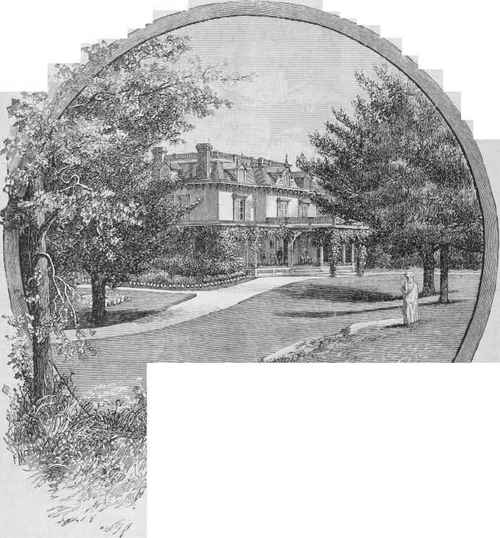
Residence of N. P. Baily, Fordham-on-Hudson, N. Y.
True garden taste indeed is more exemplified in the saving of money and labor, by adapting our circumstances to true art, than in expending thousands of dollars in making one's grounds the exact copy of some prettyplace that is popular elsewhere.
In all garden art it should be the endeavor to make a gradual transition between that which is evidently artificial and that which we would have look wholly natural. Our gardener friend above referred to was quite right in his view that a piece of rock work, which is only pretty when very natural, is wholly out of place on a neatly mown artificial looking lawn. Yet we see this incongruity in gardens with considerable pretensions to taste. As an illustration of good taste we give herewith a view of the country house and surroundings of N. P. Baily, Fordham-on-Hudson, N. Y. The artificial looking Echeverias, Sedums and Stone-crops in the last picture, and the regularly placed Norway spruces in the first, are just the things to make the transition scenes between nature and art, and the employment of large shells, vases, rustic work, or anything of this character, helps largely to ease off the artificial lines.
Continue to:


My Books

