


Training Raspberries
Description
This section is from the book "The Gardener's Monthly And Horticulturist V28", by Thomas Meehan. See also: Four-Season Harvest: Organic Vegetables from Your Home Garden All Year Long.
Training Raspberries
We are so accustomed to see our small fruits grown in the profitand-loss style of market gardens that only the few are privileged to see how tastefully they are often trained and cared for in the gardens of real lovers of fine fruit. It does not pay the mere market man to take extra pains for superior fruit, as a general rule - but it pays the amateur in pleasure a hundredfold to produce something better and nicer than his neighbors are accustomed to enjoy.
In regard to the raspberry, we seldom do more than train them flat against trellises, or bunch them together against a stake. The German gardener trains them in innumerable ways, and finds profit in all. The illustrations with this are from the German Gartner-Zeitung.
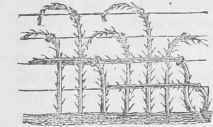
I shows how they are trained over a wire or slat arch; in such cases, of course, the plants are set on each side. Just how they are tied for bending over the trellis so that every part is covered, is apparent from the cut.
1.
2.

3.
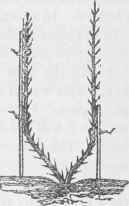
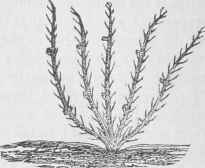
2 represents a training in U shape. This extends along the whole line, so that at the end of the line, in spring, we look along the line as through a deep furrow. In 3 we have the top simply spread out by the aid of a hoop; the branches or canes being shortened a little. 4 represents the canes nailed against a fence and trained fan-shape.
5 is a common form of garden culture. The canes, b b, are bent over, which permits the young canes, a, to grow up and get the full benefit of air and light. They are usually shortened somewhat according to the earliness of the fruit desired. If the canes are cut very short, as at c, on one side they will fruit later than if shortened to the proportion at c on the other side. If the raspberry is shortened severely they become summer or fall bearers. In kinds known as fall bearing they have to be cut very low to get the full benefit of the variety.
4.

5.
Continue to:


My Books

