


January, 1888. Greenhouse And House Gardening. Seasonable Hints
Description
This section is from the book "The Gardener's Monthly And Horticulturist V29", by Thomas Meehan. See also: Four-Season Harvest: Organic Vegetables from Your Home Garden All Year Long.
January, 1888. Greenhouse And House Gardening. Seasonable Hints
One of the prettiest features of modern household life is the attention paid to ornamentation. Not only in pictures and works of art, but in floral decorations, both fresh and dried, has there been a marked increase in taste. No home is now regarded as cheery without some trimming with fresh flowers, colored leaves or dried grasses. The Pampas grass is now raised by the acre in some places to furnish " plumes," and the Eulalia and Erianthus are grown in large quantities to furnish supplies for the florist. Where people have little money to spare to buy the better classes of articles, the fields and woods serve as collecting grounds; and most gardens, however small, have some one or more kinds of ornamental grass, to give pleasure as it grows, and to furnish material for home adornment. The seedsmen find it well to cater to this taste, and it is extremely interesting to compare their lists now with those of a decade or two ago. No or few grasses appear then, while now " ornamental grasses " make a large and full list by themselves. Every new addition is eagerly seized on, and if particularly good, get illustrated, as the old classes of flowering plants so well deserved.
In the list of Haage & Schmidt, just issued, we find a pretty novelty in the class of "quaking grasses," grasses with spike-lets so heavy, and pedicels so silk-like, that they tremble and quake under the slightest breeze. Its Latin name, Briza, is a rendering of the Greek, which signifies "to nod" as when in sleep, the heads usually nodding or bending on their slender stalks. In this new species - or rather newly introduced to cultivators, for it has been long known to botanists as a native of Mexico - the little spike-lets are more sturdy than common, but the weight curves the whole panicle over in a very graceful manner. It will do well in our gardens. In regard to its success in Germany, the above cited firm says: "Exceedingly graceful annual species, differing from all existing sorts of Briza by its erect flower spikes and being therefore a splendid acquisition to the collection of ornamental grasses used in the arrangement of winter bouquets. When fully developed it attains a height of about 2 feet, the individual flower spikes are 3 1/2 to 4 1/2 inches in length and are borne on long and firm stalks; the size of a single spikelet is about the same as that of B. media or B. geniculata.
Very attractive and extremely useful either in a dried or green state".
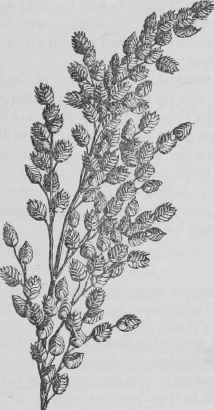
Briza rotundata.
The temperature of the greenhouse at this season should be maintained at about 50°, allowing it to rise 10° or 150 under the full sun, and sinking 10° or so in the night. Though many of our practical brethren differ from us, men for some of whose opinions we entertain the highest respect, we do not recommend a very great difference between night and day temperature; we think 10° ample allowance. It is following nature no doubt; but we would rather strive to beat nature. She cannot make the specimens we do, nor flower them so beautifully or profusely, and in many other respects we think the practical gardener can much improve on her red-tape notions and old-fashioned courses.
In the arrangements of plants in the greenhouse, continual change is commendable. Every few weeks the plants may be re-set, and the houses made to appear quite different. In the end where the lowest plants once were set, now the taller ones may be placed; here a convex group, and there presenting a concave appearance. Drooping plants on elevated shelves, and hanging baskets from the roof, make little paradises of variety in what were once unbearable monotony. Gardeners often wish to know the secret of maintaining a continued interest, on the part of their employers, in their handiwork, and this is one of the most potent - continued change and variety in the appearance of everything. Beautiful flowers, graceful forms, elegant combinations, all developing themselves with a healthy luxuriousness and ever-changing endlessness, will wake up an interest in the most indifferent breast.
Continue to:


My Books

