


November. Greenhouse And House Gardening. Seasonable Hints
Description
This section is from the book "The Gardener's Monthly And Horticulturist V29", by Thomas Meehan. See also: Four-Season Harvest: Organic Vegetables from Your Home Garden All Year Long.
November. Greenhouse And House Gardening. Seasonable Hints
Flowers are pretty, and plants are pretty, and there is considerable pleasure to be derived from growing them - but it is well to stop and think awhile on how much of pleasure we owe to taste in arrangement. One would believe no one objects to this, that everyone knows instinctively that some arrangement is necessary. No one would certainly leave plants or cut flowers in the windows or on the tables just as they are thrown down. They must be put together some way so that they may be, by their very arrangement, made beautiful. But every day's experience shows that it is profitable to stop and think; for, though everybody instinctively feels arrangement desirable, not one in a dozen draws half the beauty from floral adornments that good arrangement is capable of affording. It does not seem to be understood that there are principles in beauty. It is not correct, as people sometimes argue, that the impression of beauty is a mere notion and that what is pretty in one person's eye is ugly in another's. It has been so argued even by eminent persons. Addison once gave a sarcastic essay on beauty by a fancy sketch of a nation of people with whom no lady was handsome who had not goitre on the neck. The larger the swelling the prettier.
The more severe the mumps the more beauty.
But the slavery of fashion is wholly another thing from a perception of beauty. Take any thing outside of that which has not been tampered with by fashion, and put it to a vote of unprejudiced observers, and ninety per cent. will vote on one side that it is or is not beautiful. Now such an agreement can only be from some underlying principle which forces such an agreement, and these principles form what is known as the science of beauty.
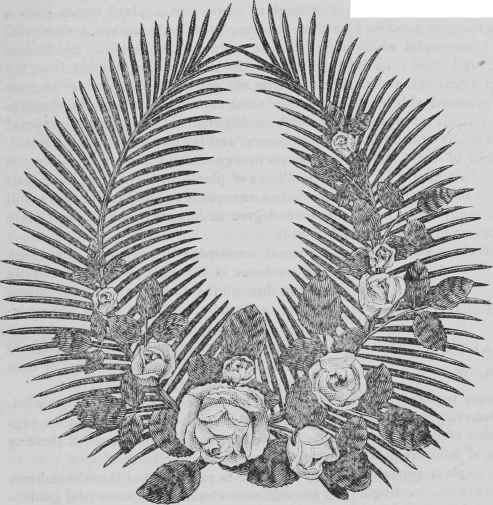
A Tasteful Wreath.
We give in illustration of our remarks, a wreath, the cut of which has been kindly loaned to us for the purpose by August Rolker & Sons, of New York, who make a specialty of furnishing florists' supplies. We are quite sure ninety in a hundred would pronounce it a model of beauty. We are as sure that scores of wreaths made up by persons every day would not be pronounced by ten in a hundred to have any special beauty. There must be some reason for this. Let us examine? There is a somewhat circular outline which is pleasing in most things - yet a pure circle is monotonous. It is a great point that, though regular in outline, it is not monotonously so. The roses chosen to ornament the wreath - flowers with a circular outline - are in harmony with the outline of the wreath; and yet the slight irregularity of the wreath's outline is not forgotten by the smaller size of the roses as the work progresses. The heaviest flowers are in the heaviest portions of the wreath, as are the heavier rose leaves, and the heavier foliage of the Sago palm from which the wreath proper is made. The cutting up of the frond into numerous pinnules gives the whole a grace it could never possess if it were but a uniform solid face - and simply because it breaks up monotony.
But the pinnules are not formed in exactly parallel lines. They all taper by graceful curves to a point, besides curving themselves. It is rarely that we find such a multitude of points of beauty developed in one object as we find here, and think no better illustration of the true principles of the beautiful science could be found anywhere. .
Those of us who are endeavoring to increase human pleasure by encouraging gardening are often met with the question, what is the use of it all? They regard money spent on flowers or in similar work in ornamental gardening as absolutely thrown away. They have no idea of sentiment. The school-boy, who in response to the request to "define mouth" replied that it was "a hole in the face to stuff pie in " would no doubt grow into a grand recruit for this class of people. They have no doubt all descended from those who objected to the costly ointment that was spread over the Saviour's feet. Perhaps the boy may learn that there is much more of sentiment about the mouth than stuffing it with pie. The mouth may furnish lips for kissing as well as a throat for swallowing, and he will not stop to ask '* what is the use " of the oscultory act.
Peter Osbeck, writing an account of his voyage to China, in 1757, says in his quaint old way:
"We are used to ask what a thing is good for? And often rashly think that alone useful which serves for medicine, cloaths, and food; as if the eye had no claim to its gratifications, and as if what is agreeable was not connected with what is useful. The dresses and utensils of distant countries are admired and carefully collected - why should not then the works of the Creator deserve at least an equal share of attention? "
And we feel quite sure that we in the gardening way, who have labored for so many years since old Osbeck wrote, will feel encouraged to go on, with the support which such excellent sentiments give.
Continue to:


My Books

