


Chapter LI. Garden Implements
Description
This section is from the book "Gardening For Pleasure", by Peter Henderson. Also available from Amazon: Gardening For Pleasure.
Chapter LI. Garden Implements
The tool-shed is an important and necessary appendage to a well kept garden. The following list includes such implements as are generally needed in private gardens:
The Wheelbarrow
The wheelbarrow is an important vehicle in the garden, for the moving of soils, carrying manures, and for conveying the products of the vegetable garden to the house or place of storage, and numerous other purposes. It may be purchased of different sizes and styles, or can be "home-made" by those possessing a little mechanical skill.
Fig. 102. - Garden Wheelbarrow.
The Spade
The uses of the spade in a garden are too obvious, and general, to need description. The best in use are Ames' cast-steel, which are light, strong, and durable, and work clean and bright.

Fig. 103.
The Shovel
The shovel is used for loading, and for mixing and spreading composts and short manures. They are made with long or short handles.
Fig. l04.
The Digging Fork
The Digging Fork, (Fig. 105), or Forking Spade, is used instead of a spade to dig in manures, to loosen the earth about the roots of trees, or for taking up root crops; being less liable to cut or injure them than the spade. It is often used instead of the spade, as by its aid the soil can be more readily broken and pulverized.

Fig. 105.
The Manure Fork
Is made of cast-steel with from four to six prongs, and is used for mixing, loading, and spreading manures, work which could not be efficiently done without it.

Fig. 106.
The Common Or Draw Hoe
There are several patterns of draw hoes, but the one in general use is the common square hoe, as represented in Fig. 107. Its uses in the garden are manifold, and it has frequently to do duty for several other implements. Its principle uses are to clean the surface of the ground from weeds, to open trenches for seeds, and to cover them.

Fig. 107.
The Prong Hoe
This is one of the most useful of all garden tools, and is far superior to the blade hoe for stirring and pulverizing the soil. It cannot, it is true, be used where weeds have been allowed to grow to any considerable bight, but then we claim that in all well regulated gardens, weeds should never bo allowed to grow so large that they cannot be destroyed by the prong hoe.
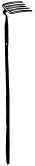
Fig. 108.
The Dutch Or Push Hoe
The Dutch or Push Hoe, (Fig. 109), is sometimes preferred to the preceding for cutting the weeds between the rows of vegetables, a work which can be done very quickly by its aid; it is not so generally useful as the draw hoe, but is better for the special purposes of destroying weeds. The Keel and Line, (Fig. 110), are necessary in every well regulated garden, enabling us to plant in straight and accurate rows. The line should be of strong hemp, and is wound upon the reel when not in use.

Fig. 109.

Fig. 110.
The Pruning Saw
The Pruning Saw, (Fig. 111), is used for cutting off branches that are too large for the knife, for removing dead ones, etc. It can be had in various sizes, from fourteen to twenty inches in length.

Fig. 111.
The Garden Trowel
The Garden Trowel, (Fig. 112), is used for setting the smaller kinds of plants when transferred from pots to the open ground; for transplanting annuals and many other uses, it is a very necessary little implement.

Fig. 112.
Pruning And Budding Knives
Pruning and Budding Knives, (Fig. 113), are necessary to every gardener. They are of different sizes and shapes, for the various purposes of grafting, budding, etc., and are made of the best steel.
Fig. 113.
Grape Scissors
These are slender-pointed scissors, used for thinning out the berries of foreign grapes when they are about half grown, so that those that are left may have room to develop. This operation should never be neglected if large berries and well shaped bunches are desired.
Flower Gatherers
A very useful article; the scissors cutting off, and at the same time holding fast the flower or fruit after it is cut, thus enabling one to reach much farther to cut flowers or fruits than if both hands had to be used. It is particularly useful in gathering rose-buds, as the stem can be cut off with but little danger from the thorns.
Continue to:


My Books

