


A Little More Grape (2)
Description
This section is from "The Horticulturist, And Journal Of Rural Art And Rural Taste", by P. Barry, A. J. Downing, J. Jay Smith, Peter B. Mead, F. W. Woodward, Henry T. Williams. Also available from Amazon: Horticulturist and Journal of Rural Art and Rural Taste.
A Little More Grape (2)
One year since, in making a record of the season relative to the crop of grapes at the West, I was enabled to chronicle it as one of the most successful ever known throughout the North and West. The past season, however, does not record as favorably, when the full maturity of varieties is taken into count. The vine over the entire country wintered safely; an account of injury came but rarely among the reports published in the spring; the fruit set well; little or no disease appeared anywhere until into September, when some localities furnished items of rot and mildew, but of no great amount of value, except with the late maturing varieties. Up to September we had an average amount of clear sunshine and dry warm weather, but during the month of September we had cool nights and a preponderance of cloudy days; and while rot and mildew attacked such varieties as Catawba and Isabella at the South and Southwest, the same varieties at the North progressed so slowly in maturing, that when an unprecedented early frost (8th of October) destroyed in part the foliage, they were unripe in most localities, nor did they mature sufficiently to be really palatable for table use, or of value for wine-making without the process of Gallicizing. The early maturing varieties, such as Concord, Delaware, etc., by means of the cloudy condition of the weather in September, continued a more than usual length of time to retain their full spirit and vivacity, without the Delaware becoming too vinous, or the Concord cracking as they do when over-ripe. Concord growers, by reason of the season, are again satisfied that there is no grape for the million to compete with it, either for table or market purposes.
Essays and labored writings touching the grape, its culture, soils to • which it is adapted, etc., together with reports and commenting notes, have been even more abundant the past year than ever before. Among these the best that has met my eye was an essay by Dr. J. Stay-man, Leavenworth, Kansas, and read before the Mississippi Valley Grape-Growers' Association, in the proceedings of which, I presume, it can be found, and from whence it should be procured and read by every grape-grower. In this essay, the most complete record and reasoning explanatory for the success or failure of the grape in soils and localities are given; and as the author's views coincide with my own observations respecting the comparative value of surface with that of under draining, I extract the following relative thereto:
"Having shown that wherever excessive moisture exists the cultivation of the grape is uncertain, and wherever extreme dryness exists it is successful in regions of favorable temperature, we shall now give what we believe to be the principal remedies to overcome this excessive saturation of the soil.
"If our conclusions are correct, surface draining is undoubtedly the most important; for if the soil does not receive more than a proper amount of rain, there is no necessity of underdraining, unless the soil is naturally wet or receives it from adjoining lands. The next most important is location, - in fact, it is but a different expression for the same thing, for we can more * effectually surface drain by selecting a location than by any other means. The sides of steep hills, gentle slopes, and even the summits of high hills are the best, and stony land mixed with shale or pebbles, with clay subsoil of sufficient richness, would be the most desirable. So important is surface draining, that we might sum up the whole success of grape culture to depend upon it in a wet season. We have closely watched the effects of planting upon level ground, even well drained, and I find it useless to compete with the high hills and steep slopes, and we have removed our vineyards accordingly, a few years ago, with most excellent promise".
To the new planter this point of selection of land is one of vital importance, for upon it in a great measure will depend his success or failure in profitably growing the grape ; and while I am not yet prepared to regard steep hillsides or high hills as absolutely essential, I am satisfied no success can be permanently depended upon where the surface water can not be drawn off by merely opening furrows or shallow surface drains. Localities connected with the country must decide the comparative values between high hills, steep banks, or a rolling lay of land from which the surface water drains off almost if not quite as freely as from a hill. A level piece of land from which the surface water can not be readily drawn off, will not grow a reliable and permanent vineyard, no matter how thoroughly it may be underdrained. The next item which the planter of a vineyard wants to know, after having selected his land, is, what grape to plant ? and in answer I fail to find any conclusive unity of opinion among writers, and my own notes and observations lead me so far from any decision, that if the question were asked me, I should do as others do, give a decidedly mixed list.
The Mottled grape has this year appeared at the Ohio State Fair in superb clusters, and because some persons have counted it valuable for wine purposes, a little clique of men thought there was a move to make money by its sale, and as they, on once seeing it, did not happen to judge of it favorably, they at once published a short description, and called it "hardly good," designed, I suppose, as a caution to the public not to be gulled by it, should any one offer it for sale. I spoke of it last year as one "most successful under high manurial cultivation, hardy, and preferable to the Delaware for wine purposes." I am now fully satisfied that statement was correct ; but if any one judges of it in comparison with the Delaware as a table grape, they will record it as far below.
The Miles, although a small grape, ripened the very first of all this season, and two years of its acquaintance induces belief that it is a profitable variety on that particular account. Side by side with Hartford it was ripe and sweet, just as Hartford was colored.
The Hartford colored and was eatable a week earlier than Concord, when grown in an open uniform exposure; Israella colored a few days sooner than the Adirondac, but it did not ripen as soon. The value of either one for market purposes, I think will require many years ere discovered. The Eumelau, a new (to the public) grape just brought out by Dr. Grant, is to me but a slight advance on the old Early Black July. It is early, and should be tested.
The Walter, another new sort, but now offered to the public, has been cautiously shown, and at the New York Grape - Growers' Show at Canandaigua, in October, received a first premium. It is a grape of good qualities, and should be tested widely. From a bunch kindly presented to me by its proprietor I made the accompanying drawing and description. It will be noticed that my drawing does not equal in size that of the published one by its proprietor, but after seeing what I have of Iona this season, I am not prepared to say his is overdrawn. I once thought Dr. Grant's pictures of Iona a little exaggerated, but I have this season examined bunches on the Lake Shore fully up in size to his best pictures.
Description of the Walter. Bunch of medium size, moderately compact shouldered, short peduncles; berry, round, medium size, larger than the Delaware, but not as large as the Catawba; nearly uniform in size; light copper red; skin, thick, but not harsh or astringent; flesh almost free from hard palp, juicy, rich, and sweet; seeds, one in a berry, long blunt oval in form, and of a light brown color.
The Hine has again shown as one promising of value, in size of bunch equaling Catawba, more delicate in quality of flesh, and early as the Concord. Messrs. Ellwanger and Barry have a number of new seedlings, of which they courteously sent me samples, and from them I have made drawings and notes descriptive; but as I am not advised of their offering any of their numbers for sale, I will only record the item of production, and add that there is in two or three of the numbers sent me a character of flesh differing largely from most, if not all, of our native or hybrid native grapes, and that if the vine of one of the numbers is hardy and productive it will be a decided acquisition should they choose to disseminate it.
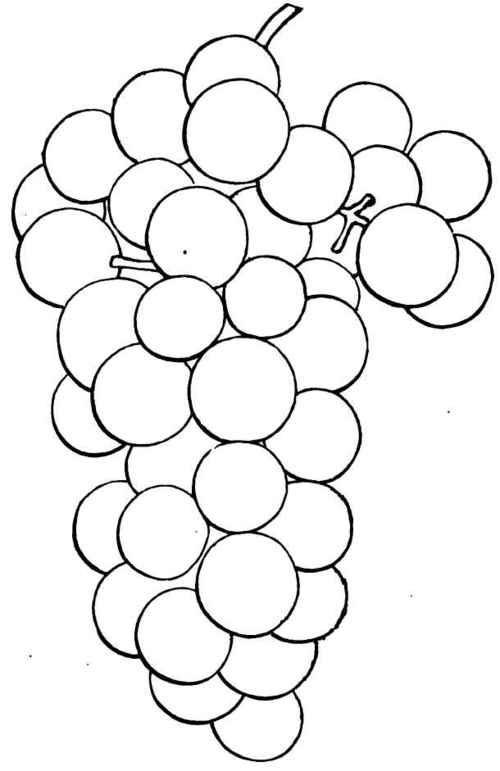
Fig. 108. - Walter Grape.
Of the Rogers varieties, much and more has this season been written pro and con the general tenor, however, giving them a tendency to mildew in leaf, a character which, in my observation, has only been apparent on vines growing on level lands having a clay hard-pan subsoil. The bunches on young vines of nearly all the numbers are often small and ragged, a fault that age appears to remove. Of the red 01 copper colored numbers, 3, 5, and 9 claim superiority - 3 being the most palatable, but not as sweet as 5 or 9, but void of the strong foxy aroma which 5 always has. Salem I have eaten but once this season, but that taste did not impress me of its superior value compared with 3, 5, or 9.
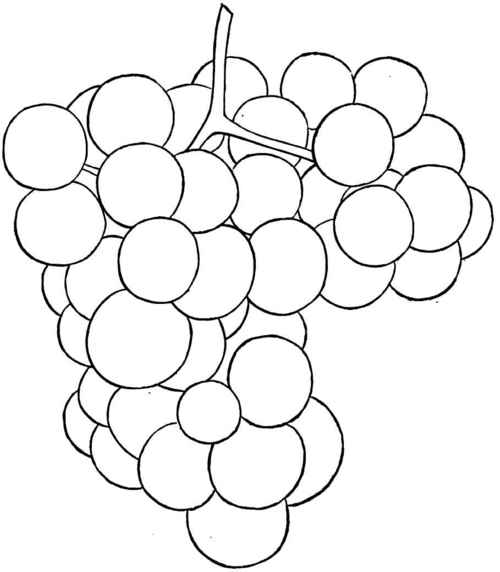
Fig. 104. - Rogers' Grape, No. 44.
Among the dark or black varieties, 4, heretofore counted as the best, has in this year's observations had to give place to 44, a drawing of which I here present The bunch is large, compact, and heavy shouldered; berries, large, round, black, with a heavy blue bloom; flesh, juicy, sprightly, with little pulp, moderately sweet, rich, equal or superior to 4 in quality and a better average bunch.
Norton's Virginia, as a wine grape here, on the Lake Shore, promises all its best, friends in Missouri have said of it; and notwithstanding the ttrds were more than usually numerous the past fall, and the owner of a vineyard of it had to gather earlier than otherwise he would have done, yet the wine is superior.
Isabella has not ripened well, and when the early frost came it was too imperfect to sustain itself, and hence the berries fell rapidly and early from the bunches. It has been this year an unprofitable sort.
With a word on Catawba I will close my fruit record, because every time I think or speak of it I am filled with sorrow at the record that in truth must be made. As a general rule, owing (of course) to the cloudy September and the unprecedented early frost, it has not ripened its fruit in but a few localities on the Lake Shore. Upon the highest points, with clay shale soils, it nearly perfected, at least so far as to be more than good, but generally it has only become colored, without any development of sugar, and yet if I had to plant a vineyard on the Lake Shore I should use seven-tenths of Catawba.
Continue to:


My Books

