


Interior Views, No. 6. - Exotic Graperies
Description
This section is from "The Horticulturist, And Journal Of Rural Art And Rural Taste", by P. Barry, A. J. Downing, J. Jay Smith, Peter B. Mead, F. W. Woodward, Henry T. Williams. Also available from Amazon: Horticulturist and Journal of Rural Art and Rural Taste.
Interior Views, No. 6. - Exotic Graperies
Now examine and study scientifically, if you please, the difference between a border composed of the materials advised, and the materials by which a border is made impervious to air and water. We all know, or ought to know, that every drop of water contains a very surprising amount of electrical fluid, and this fluid seems to be the life, perhaps, of every thing; at any rate, it is taken up by the roots of plants into their systems, and is one of God's means in Nature of perpetuating creation. Plants can not live without this element; and as on evidence of its vast importance to all vegetable life, we see its most wonderful invigorating effects through the thunder storm; for, during such periods, plants grow with more than double their ordinary rapidity. The influence this electrical element exerts on the roots of the vine is very great, and in more respects than one. Our business is to study this influence, and in so doing we shall find that it is of the utmost importance that each spongiole the vine may possess be supplied properly, constantly, and proportionally, (as far as our knowledge can possibly direct us in the latter,) with this element in question. This leads our thoughts to the very base of the question, which is the base of the vine border.
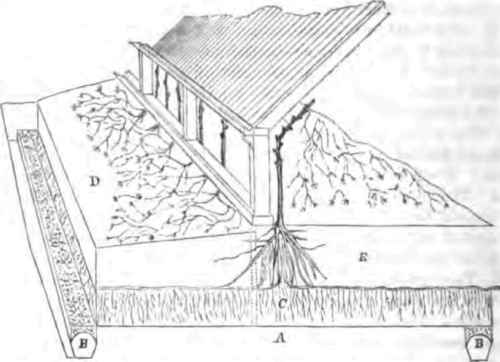
Perhaps there is as much wrong in the formation of this "base" as there is in the materials of which the borders are composed. Elements by which man lives, and adds to his comforts and enjoyments through life, are oftentimes the very means by which ho loses his life. This electrical fluid, so essential through every particle of the soil, to sustain health and fruitfulness in the vine, when massed in the hollow cavities of the border, is as much injury to the vine, by its action on the roots, as the element of water would be to a man confined in it overhead. The base to all vine borders should be dry; that is, no standing water should be at or near the base of any vine border. In ordinary soils, the rains will pass down and through it. Any such base is good enough for a vine border, and is all we ask for. The sizes of the border being determined, a drain can be laid to surround the base, and twelve inches below it, having a proper outlet. This drain should have connection with the external atmosphere, and this is all the draining necessary for any vine border. (See cut.) It will be now seen that our compost goes directly on the base of the border.
There is no one foot nor two feet of broken stones, oyster shells, nor any other material, for it is of more injury than use, more money wasted than common sense applied, and results in the production of more diseases than has ever been cured by all the scientific quacks who have applied their many and various nostrums. Thorough drainage, as it is termed, at the bottom of vine borders, which consists of, (as many of our readers know full well,) from one to two feet of broken stones, or some other material intended to answer the same purpose, if arranged according to the "highest possible authority," have no connection with the external atmosphere. These two atmospheres - the internal and external - are at two distinct temperatures, one colder, the other warmer. Now in the sum-mer time, when the external atmosphere is hot and dry, the internal atmosphere which surrounds this drainage in question, is much colder, consequently a condensation takes place, and water is produced among these stones and on the bottom-Now the moment the border becomes dry, or the moment a sufficiency of moisture is not presented to the absorbing roots, the latter become attracted through the law of affinity, to where moisture is; and where is this under the circumstances? Why, at the bottom of your border! in your air chamber! Here you will find the roots dangling among the stones, like the roots of air plants in a moist orchidaceous house! The same cause which makes grass grow near a drain, and be green when all that which surrounds it is dry and burnt up during hot weather, is the same law which causes the outside of the ice-pitcher to be dripping with wet in our thirsty days of July and August; and, hence, the very element necessary to be in every particle of soil to ensure health, becomes, through its injudicious application, the sole cause of disease and death! A glimpse at our cut will give the reader a truthful representation of the vine's roots in compost with such a so-called drainage.
The nature of these papers will not admit of our speaking as fully on many points as we could desire; and as it is, we have encroached too much on the valuable space of the Journal. The month of November being now advanced, is a good time to remedy the evils in borders; and to all who are dissatisfied with the results of their vine-growing, should this arise from disease in the vines, imperfect setting or fecundation, shank, mildew, cracking of the berries, poorness of color, imperfectly ripened wood, half crops, with a host of other things too numerous to mention, we say, take up the vines. Start at the outside of the border, and throw out a trench to the bottom of it, about four feet wide, and carefully lift all the roots that can be found; and if any of our readers should happen to find any in the border, and they are not on the bottom or out of the border in some foreign country, we hope they will be kind enough to tell us through this Journal.
In taking up the roots, see that they do not get dry. Sprinkle them constantly with water, and cover them, as far as practicable, with some material or other during the operation. If the borders have been well dosed with manure, and all the little other "tiny tid bits," add plenty of good sharp sand, and don't be afraid of it. See to its being thoroughly mixed. This done, the vines can be replanted, laying the roots on the surface of the ground, and placing on them about four inches of the soil. In replanting, make as many angles in the roots as is possible, or that your patience will admit of, for by so doing you will increase the number of new young roots. Peg them down on the even surface of the border, and then cover them up as soon as possible, and the work is done. Done, did we say Oh, no! the work is not done ! What remains? is the question. The feeding of the vine. Now lay on the top of this border (if it is of our compost,) just as much rotten dung as you please, all the special fertilizers you please - bone, lime, and everything else you think proper. We do not care how many tons of it you use, but put all on the top of the border. This is Nature's way of making borders. All her stimulants are placed on the top of the ground.
Trace all through the vegetable world, and where do you find air chambers under trees, and rotting matter among roots? Let us study Nature's never-deviating laws, and then we shall find "The age that is passing to rise and proclaim To the age that is coming 'laws' always the same".
[The printer in making this up prevents us from making a few remarks. They will be in place hereafter. - Ed].
Continue to:


My Books

