


The Kilmarnock Weeping Willow. Salix Caprea Pendula
Description
This section is from "The Horticulturist, And Journal Of Rural Art And Rural Taste", by P. Barry, A. J. Downing, J. Jay Smith, Peter B. Mead, F. W. Woodward, Henry T. Williams. Also available from Amazon: Horticulturist and Journal of Rural Art and Rural Taste.
The Kilmarnock Weeping Willow. Salix Caprea Pendula
This beautiful weeping plant having lately attracted attention, its history may not be uninteresting. There lived in a sequestered corner of Monkwood estate, near Ayr, an aged botanist, named James Surra, an enthusiastic lover of plants, and a zealous collector. From him Mr. Lang, nurseryman, Kilmarnock, purchased one plant, about 10 years ago. Afterwards Mr. Lang procured a few more plants from Mr. Smith; and as the old gentleman died shortly after, he never had an opportunity of ascertaining where he procured the variety. It is probable, however, that he found it growing wild, as the species, Salix caprea or Palm Willow, is one of the most common plants in the country. Mr. Lang has since been engaged in propagating the plant, and nearly 1000 have been sold. Sir W. J. Hooker received two plants of it in spring, 1852, and having observed, during last summer, how exceedingly ornamental it was, he gave Mr. Lang a decided opinion, stating that he thought very-highly of it, and that it was much admired in the Royal Gardens at Kew. The tree flowers freely in the as hardy as the most hardy plant we have, being in fact a native of the country, and not, like the Salix Babylonica, introduced from a foreign clime.
The name of Kilmarnock Weeping Willow was bestowed upon it to distinguish it from the common Weeping Willow, the Napoleon Weeping Willow, and the American Weeping Willow; it is quite distinct from either of these varieties, having leaves two inches broad. - Abridged from the Kilmarnock Journal.
With this tree we shall close our present record of weepers. We know of no one weeping tree that in the same length of time has become so universally known and so extensively planted. Its foliage, large, glossy, and abundant, its pendulous, close, and regular habit, with its brown colored branches, that are almost hidden within its foliage, render it one of the most distinctive as well as graceful trees that have been for many years added to our collections. It is perfectly hardy, and almost unlike anything else, seems to adapt itself to almost any position, whether as a point tree to define a road, a specimen of beauty and attraction on a small lawn or garden plot, or as an outline to some more aspiring tree of a similar drooping caste.
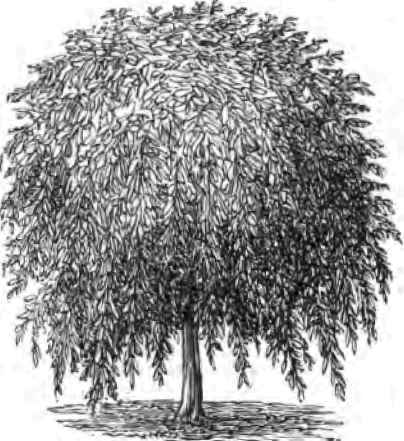
Fig. 43. - Kilmarnock Willow.
Continue to:


My Books

