


Notice of Two Large Plums
Description
This section is from "The Horticulturist, And Journal Of Rural Art And Rural Taste", by P. Barry, A. J. Downing, J. Jay Smith, Peter B. Mead, F. W. Woodward, Henry T. Williams. Also available from Amazon: Horticulturist and Journal of Rural Art and Rural Taste.
Notice of Two Large Plums
1. English Pond's Sredling
When I was in your country, two years ago, I paid a visit to Mr. Pond's garden, at Cambridgeport, Boston. I showed htm the portfolio which contained the drawings of all the fruits of our collection. He there perceived the name of "Pond's Seedling" Plum. He at once exclaimed that the drawing corresponding to this name was not the genuine variety originated by him; that his Pond's Seedling is smaller, and rounder, and does not in the least resemble ours. Now, as he is the originator of the true Pond's Seedling, I concluded that ours was false. I was confirmed in this opinion when I read the description you give of it in your "Fruits of America," page 309. If we have not the American Pond's Seedling, we have the English one, of which the Revue Horticole, (our standard fruit gardening Journal) has given a picture and description in the number of March 15th, 1847, page 101. This variety is very different, as you will observe by the sketches in oil which I send you herewith, from the American one.
The following is a description of the English Pond's Seedling, taken from a fruit grown in the nurseries of Mr. Andre Leroy, at Angers.
Fruit oval, 2 1/2 inches long, 1 1/2 inches in diameter, slightly uneven about the middle of the length; skin violaceous red, sprinkled with many blue small dots about the stalk; dusted with light gray about the apex; deeper colored on the sunny side, and covered everywhere with a nice whitish blue bloom; stalk half an inch long, slender, set in open cavity; a small suture divides the fruit in two parts, one of which is more swollen than the other; flesh yellowish, thick, juicy, adhering to the stone, slightly acidulous, very pleasant. If it is not first rate, is a good second rate.
This kind is very fertile, and always a constant bearer; very profitable both as a dessert and a cooking one. It is the largest and handsomest plum I know, not excepting the fine Magnum Bonum. It weighs two and a half ounces. It ripens from the end of August to the 1st of September. Tree vigorous grower; the young wood is smooth, gray spotted and dotted; leaves broad, roundish, terminated lanceolate.
[This same plum is known as Pond's Seedling in England, (see Catalogue of London Horticultural Society.) It has, no doubt, occurred by some error in sending out the variety from this country. The question is, what is the true name of this large plum? The description of the fruit alone would lead us to believe it to be the Duane's Purple of American nurseries. The branches of this tree, however, are gray, and the young shoots very downy. M. Desportes says gray but smooth. Still we incline to the opinion that it is Duane's Purple. An importation of the tree will settle the question speedily. En.]
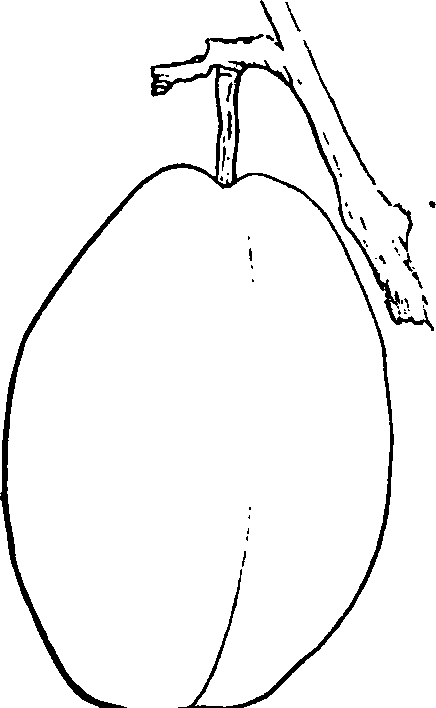
English Pond's Seedling.
2. Plum De L'Inde
We received some years ago, under the above name, the plum of which the description follows: Tree vigorous, with long upright branches; wood smooth, gray dusted; leaves roundish, sometimes lanceolated; thick nerved, having two glands at the base; petiole three-fourths of an inch long.- Fruit large, obovate, larger about one-third of the length, uneven; color violet redish, dotted with some broad gray and coarse spots; dusted with small gray and blue dots, principally about the eye; covered with very nice blue bloom; suture shallow; skin thick; flesh yellow redish, firm, juicy, melting, sweet, rather adhering to the stone. This very handsome plum is a good second rate one, and well deserves an extensive cultivation. It resembles very much our English Pond's Seedling, but it differs from it by its being rounder, and ripening fifteen days later, that is to say, about 15th September; it is also more red.
Baptists Desportes.
Angers, (France,) Sept, 1851.
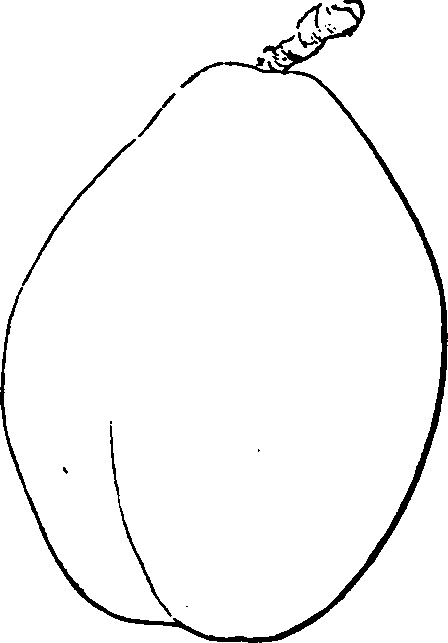
Hum de l'Inde.
Continue to:


My Books

