


Pears That Promise Well
Description
This section is from "The Horticulturist, And Journal Of Rural Art And Rural Taste", by P. Barry, A. J. Downing, J. Jay Smith, Peter B. Mead, F. W. Woodward, Henry T. Williams. Also available from Amazon: Horticulturist and Journal of Rural Art and Rural Taste.
Pears That Promise Well
In conformity with your request, I herewith annex brief descriptions of some of the more modern pears which promise to be worthy of extension. Great caution, I am aware, should be exercised in recommending new varieties for general cultivation. The system, therefore, which has been adopted by the American Pomologicai Society, of placing such as "promise well" on the probationary list, is safe and worthy of commendation. I regret, however, that time did not permit, at its late session, of a longer discussion of this class; and it is mainly this consideration which induces me to communicate the result of my own experience.
The year 1852 will long be remembered, by us of this region, as one of the most propitious in the annals of pear cultivation. After two or three unfavorable seasons, we have at last had an opportunity to test a large number of varieties which have been recently introduced, or of which but little has been known, and to judge of their characteristics with considerable accuracy.
Much depends on the soil, exposure, mode of cultivation, the maturity of the tree, and the temperature of the season; but quite as much depends on the process by which the fruit is preserved and ripened. This latter remark is peculiarly applicable to the very late sorts; and we apprehend that much is yet to be learned, not only as to the general process, but as to the particular means suited for different varieties. That the flavor of fruits may be preserved, or improved, by the manner in which they are kept previous to maturity, has been satisfactorily ascertained. This subject is now awakening general attention; and we are happy to know that quite a number of fruit rooms have been constructed in our vicinity, on the plan of non-conducting walls, so as to maintain an equable temperature and a proper hygrometic state of the atmosphere; both of which are considerations indispensable to success.
These improved facilities have enabled us to test, by a fair trial, some varieties which came to us from Europe, well recommended, but which have hitherto been considered as of doubtful character; and the result in several instances has shown that the fault was not in any natural deficiency of quality, but for the want of proper care in ripening the variety. As instances, we would name the Doyenne Goubault, Josephine de Malines, and Nouveau Poiteau, all of which may be classed as "very good." Some varieties ripen with greater ease than others, such, for example, as the Beurre d'Aremberg, Winter Nelis, and Lawrence, the great difficulty being to retard them from maturing during the warm autumn days. Others, like the Easter Beurre, Doyenne d'hiver nouveau, Beurre Bretonneau, and most of those with a thick, rough epidermis, are readily kept through the winter and spring, and into the summer. Some of this class we have preserved in perfect condition the past season, and had them in eating, with the Madeleine, in August.
As a general remark, it may be said that such varieties as are of a delicate character, either as it regards skin or cellular texture, when exposed to a temperature so low as to arrest the ripening process entirely, often lose the power of resuming it and are consequently immature, tasteless, and deficient in flavor. Others will endure a great degree of frost, and seem not to be injured when frozen entirely through. We have known instances where the latter class have remained under the trees during the winter, and, although frozen hard, were not injured in the texture or flavor of the fruit, and which afterwards ripened perfectly.
With these preliminary remarks, I submit the following list as promising to be worthy of general cultivation: -
Beurre Sterkman
Size - above medium. Form - obtuse pyriform. Calyx - open, moderately sunk in a broad basin. Stem - short and stout. Color - dull green ground, nearly covered with russet. Flesh - white, melting, with abundant juice. Flavor - very rich, sub-acid, highly perfumed, and resembling in this respect the Lodge or Smith's Bordenave. Season - October 1st to 15th. Class - "verygood," if not "best." Bears well either on the pear or quince stock.

LAHERARD. BEURRE STERKMAN.
Laherard
Size - above medium. Form - obovate, obtuse pyriform. Calyx - closed, generally without segments, deeply sunk. Stem - rather stout, one to one and a quarter inches long, a little depressed at insertion. Color - pale lemon yellow, with brownish red cheek next the sun. Flesh - white, melting, juicy. Flavor - rich, pleasant sub-acid, excellent. Season - October 1st to 15th. Class - "very good" or "best." This variety succeeds admirably on the quince, resembling in its habit and foliage the Urbaniste, but is a distinct sort.
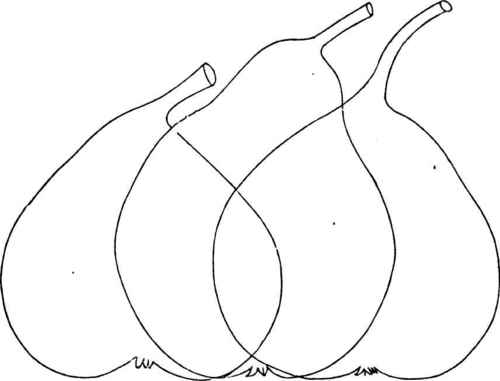
DOYENNE GOUBAULT. FONDANTs DEs CHARNEUSE. CHARLEs VAN HOOGTEN.
Fondante De Charneuse
Size - large. Form - obtuse pyriform, surface and outline irregular; neck, short and thick. Stem - short, thick, and inserted without depression. Calyx - small, moderately sunk in a narrow ribbed basin. Skin - dull yellowish green, coarsely dotted and clouded with patches of russet. Season - October to November. Class - "very good" Flesh - melting and juicy, with a rich sacharine perfumed flavor, and sometimes a little astringent.
Charles Van Hoogten
Form - obovate, acute pyriform. Size - above medium. Skin - dull pale yellow, thick. Stem - stout, set without depression, enlarged at the base. Calyx - open, in broad and flattish basin; segments, short, frequently abortive. Flesh - yellowish white, melting, buttery, and juicy. Flavor - sacharine, rich, with pleasant aroma. Season - October 1st to 15th. Class - "very good"
Doyenne Goubault
Size - medium, occasionally large. Form - obovate, acute pyriform. Stem - short and thick. Calyx - small, deeply sunk. Color - dull pale yellow, with a few traces of russet, particularly at the stem and calyx. Flesh - melting and juicy. Flavor - rich, sweet, aromatic. Season - December to February.
Class - "very good" Keeps well, and promises to be a very fine winter variety. Succeeds better on the pear than on the quince, and adheres well during the autumn gales.
Millot De Nancy
Size - medium. Form - obtuse pyriform. Color - pale yellow, with occasional patches and traces of russet. Flesh - melting and juicy. Flavor - sugary, with pleasant and peculiar aroma. Season - January to February 7th. Class - "good".
Conseiller Ramuez
Size - full medium. Form - obovate, obtuse pyriform. Color - dull green, slightly clouded and traced with russet Flesh - melting and tender, with a moderately sweet perfumed flavor. Season - October to November. Class - "good" A great bearer and vigorous grower, both on the pear and quince stock.
Zephirine Gregoire
Form - globular, acute pyriform, broad across the body, tapering into a thick, fleshy stem. Color - dull green, thinly clouded with a gauzelike covering of russet; cheek, brownish red. Flesh - very melting, tender and juicy, with a rich flavor, a little perfumed. Season - middle of November. Class - "very good" Excellent.
Poire D'Abondance
Size - above medium. Form - oblong pyriform, neck thick. Color - pale yellow, with numerous russet dots, mottled and intermingled with Vermillion and red on the sunny side. Flesh - melting and juicy, with a sweet, delicious flavor. Season - middle of October. Class - "very good." A handsome fruit.
(To be continued).
Continue to:


My Books

