


Plant-Forcing Economics
Description
This section is from "The Horticulturist, And Journal Of Rural Art And Rural Taste", by P. Barry, A. J. Downing, J. Jay Smith, Peter B. Mead, F. W. Woodward, Henry T. Williams. Also available from Amazon: Horticulturist and Journal of Rural Art and Rural Taste.
Plant-Forcing Economics
SOON after we engaged in horticultural pursuits in Iowa, some thirty years ago, there occurred at this place a violent hailstorm - countless numbers of hailstones falling of an oblong form, about one and one-half by three-fourths inches in diameter. At this demonstration of nature " in the ice business," we were much alarmed for the safety of our "air castles" when, in the future, they should become veritable glass houses.
We directed immediate attention to some means of protection in such emergencies, but finding it a difficult matter to accomplish satisfactorily, we wrote to A. J. Downing in relation to the use of shutters upon glass structures at the East. The import of his answer through the Horticulturist, was, that, although they wore formerly considered necessary and the advantages of their use were manifestly important, the difficulties and inconveniences of their application were so great that they were generally abandoned. Subsequently practical experience of the severity of our climate has impressed us more and more with their importance as a means of economizing heat, as well as for protection against sudden and unexpected changes and external casualties; and by unremitted labor and experiment, we have at last obtained a shutter that completely answers our purpose for hot-beds, cold-frames and forcing-houses when constructed with reference to its use.
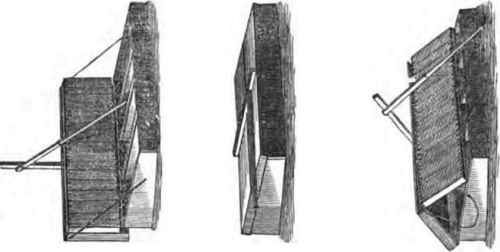
The accompanying illustrations represent this shutter in three positions; open, half open and closed. At the South it will be a very valuable safeguard against unseasonable " Northers," and at the far North, where the long nights during their long winters render a constant and protracted warfare against the encroachments of the ice king unavoidable, its utility is obvious.
Continue to:


My Books

