


Planting Orchards
Description
This section is from "The Horticulturist, And Journal Of Rural Art And Rural Taste", by P. Barry, A. J. Downing, J. Jay Smith, Peter B. Mead, F. W. Woodward, Henry T. Williams. Also available from Amazon: Horticulturist and Journal of Rural Art and Rural Taste.
Planting Orchards
When an orchard is to be planted, or where there are many rows?, the quincunx arrangement is always the best, because by that mode, each tree is eqai-distant from its neighbors, and each has an equal portion of air and light; it is also the best for lining in all directions. The rectangular mode of planting (Fig. 2) is only fit for avenues. The quincunx arrangement is based on an equilateral triangle, at each angle of which a tree is planted. To trace out on the ground the lines for the quincunx, which must not be coufounded with the rhomb, we first form a base line by means of poles, or with a line; on this line pegs are fixed at the places where we intend to plant, at the distance determined on, say at 42 feet In order to mark out the second line, we take two measures, each 42 feet long, placing the end of one of them against the first peg in the first line, as at A, and the end of the second against the second peg, B; we then bring the two measures together at the other ends, and a peg is put in at the point where they meet, at C. The three pegs thus form an equilateral triangle.' This operation is repeated at the other end of the first line, and the two pegs last put in give the second line, which is then filled up like the first with pegs, 42 feet apart The whole of the ground being thus marked out, we obtain the result shown in fig. 1. Each tree is equi-diatant from the six adjacent trees surrounding it; which can not be the case either in the rectangular or in the oblique square form.
In the quincunx mode of planting, it will sometimes happen that the distance between the rows running parallel to A D is determined; and sometimes the distance of the trees in these rows, as A B is fixed. It is neccary to know, from haying- one of these distances given, how to find exactly the other. We must repeat the word - exactly; for, supposing the row should contain as many as 50 trees, and the distances A B, or C P, should be only half an inch wrong, some trees, or even rows, would be two feet out of their right position. The trees could easily be placed so as to fine in one direction; but this being done, it would be seen that they were, in consequence, put quite as much out of line in another direction. Stake after stake may be altered, to an indefinite period, without forming correct lines, if a wrong principle has been adopted in starting. To prevent such confusion, to rave time and expense, and to make sure of staking out the whole satisfactorily, the following will prove very useful.
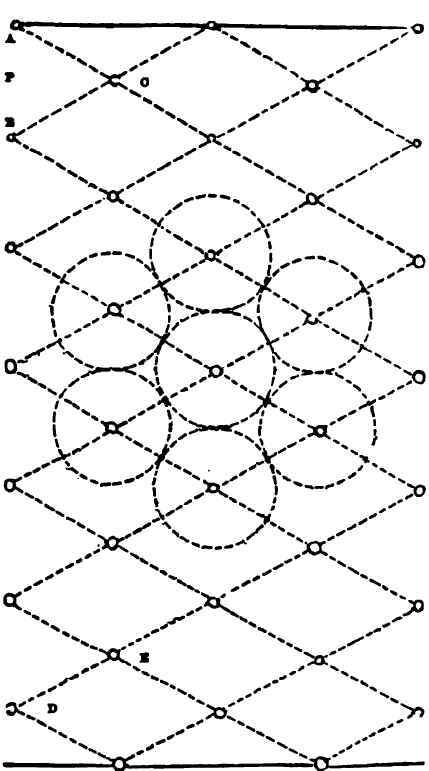
Fig. 1. PLANTATION IN QUINCUNX.
1. The distance. C P between the lines A D, C E, being given to find the distance A D between the trees in the line A D.
CP2 - A B2 - ( AB/2) 2 This reduced becomes 4 C P2 - 3 A B2
Hence the rule: multiply the square of the distance C P by 4 and divide the product by 3; the quotient is the square of the distance A B. Or, to the square of C P add one-third thereof; the sum is the square of A B.
2. The distance of the trees in the line A D being given to find the perpendicular distance C P between the lines AD, C E.
Multiply the square of A B by 3, and divide the product by 4; the quotient is the square of G P. Or, from the square of A B subtract one-fourth thereof, the' remainder is the square of C P.
It will be readily observed from the annexed diagram, that in square planting, a tree neither is nor possibly can be at an equal distance from all those which surround it; and that when four trees grow till their branches cross each other on four opposite points, there is at the same time a large space left elsewhere unoccupied between these trees.
To mark out the holes, we take a piece of cord, at one end of which we make a loop which is put on a peg where a tree is to be planted, and then fastening a pointed peg on the other end of the line, at the distance of the semi-diameter of the hole, we trace a circle with the pointed peg, which circle is the circumference of the hole. It is advantageous to make the holes some time before planting, and to leave them open, so that the earth may benefit by the action of the air. This operation should always be performed in dry weather; each kind of arth should be laid in a separate heap at the side of the hole, and so as not to interfere with the lines of the plantation; that is to say, the earth should be laid in the four angles formed by the crossing of the two principal lines, and not in the direction of those lines. - London Gardeners' Chronicle. .
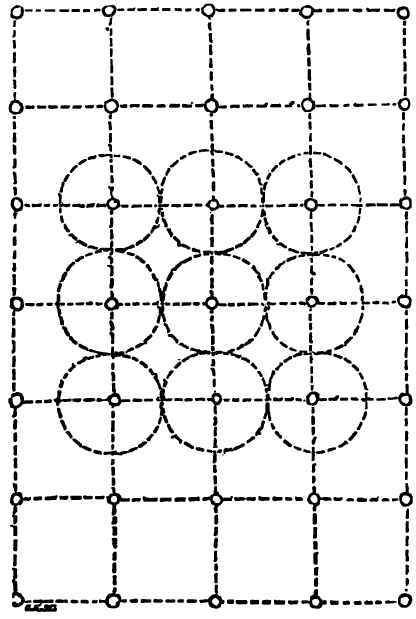
Fig. 2. PLANTATION IN SQUARES.
Continue to:


My Books

