


Raspberries - Soil, Culture, And Varieties
Description
This section is from "The Horticulturist, And Journal Of Rural Art And Rural Taste", by P. Barry, A. J. Downing, J. Jay Smith, Peter B. Mead, F. W. Woodward, Henry T. Williams. Also available from Amazon: Horticulturist and Journal of Rural Art and Rural Taste.
Raspberries - Soil, Culture, And Varieties
The growing of small fruits as productive and remunerating crops, not only to the market gardener, but to almost every family owning a small garden plot, has become so general and so well appreciated, that we feel we can do no better at this time than to make a record of our notes on Raspberries, as we did last month on strawberries. Following in rotation after the strawberry, and before peaches or other stone fruits, except cherries, have become abundant, the Raspberry seems to supply a vacancy without which we could hardly furnish our tables or minister to the wants, tastes, and health of the human frame. In a commercial view, as a crop to be grown for profit, one year with another, we believe the Raspberry superior in its net returns to that of the strawberry; but its cultivation is not nearly as extended and general. Why it is so we can only account for by supposing the masses to have obtained an impression that the canes of Raspberries must be laid down and covered each winter in order to insure a crop, and again by supposing the mass of fruitgrowers averse to anything like unto what may be termed extra labor.
That this laying down was a requisite with most varieties known and grown some fifteen 15 or more years since, we acknowledge; but at this time there are many varieties with large fruit and hardy canes profitable for market or private gardens that may be grown without any labor and care in covering. As a fruit for the table, no one among the small kinds possesses the richness and aroma of the Raspberry; and while there are some people who can not eat strawberries, we never knew one who did not relish and enjoy a dish of ripe Raspberries. Economically considered, they are also superior to strawberries, because of their less acidity, and therefore not requiring as much sugar to gratify the palate. For canning or preserving, the superiority of the Raspberry over other small fruits is such, that while many housekeepers do not put up strawberries, all do can or preserve Raspberries when they can be obtained.
Soil And Preparation
It is said by some writers that the Red or Antwerp class of Raspberries must have a good rich clay loam soil in order to succeed; but while we concede that as the best, we have grown them in light dry sandy soil, equally vigorous in cane and productive of fruit, by simply spreading over the ground, early in June, a deep mulch of straw or old litter, and letting it remain until the commencement of fall rains, when we remove it, to be replaced again the next June. By this method we have avoided that burning of foliage and drying away of the fruit too often complained of. The Black Raspberry seems more hardy and capable of enduring varied soils and climates, and hence it has for the past few years been more extensively planted than the Antwerp, although as a table fruit few, if any, of the varieties now in cultivation compare at all favorably.
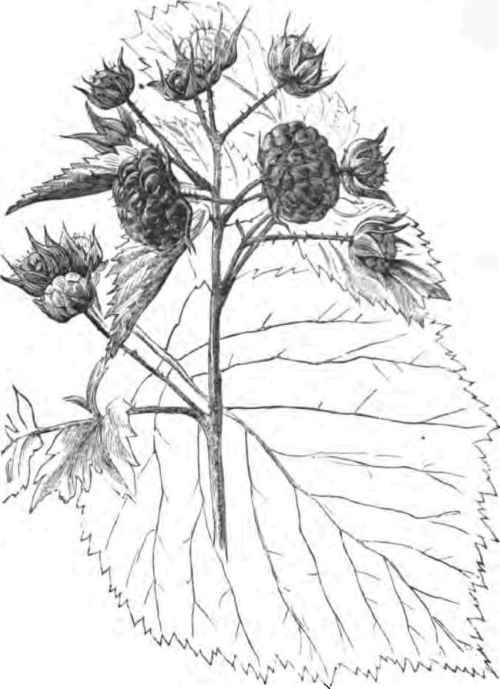
Fig. 119. - Mrs. Wood.
As with the strawberry, the preparation of the soil, making it deep and finely pulverized, is a great requisite to success and profitable returns. In heavy clay lands, without this thorough preparation and cultivation the first year, the plants grow feebly or die out entirely, and the crop of one or two years is lost; and in light sandy soils we have found that the deeper we plowed the better, and that the application of mulch at midsummer was a necessary requisite.
Time of Planting, - Although early spring is generally advised as the best time to plant at the North, or where the ground freezes deeply, we have found fall planting, and then plowing up to the roots and covering them, quite as successful; and in clay lands the soil works easier and better. 3ut we have practiced for some years taking the plants in July, and even into August, when the young canes are about half grown, placing the roots as we raise them into a bucket of muddy water and planting them, without any after watering, with perfect success, and had a good crop of fruit the following season.
Distance Apart
The old rule of growing in hills, three by four or four by six feet, two or three canes in a hill, we consider very much like the advice to grow strawberries in hills, as only an inducement for the cultivator to work among his plants and keep them clean. We have for some years grown our Raspberries in rows, our' canes standing along in the row sometimes two in a foot, sometimes one; and when we now plant we set a cane once in about sixteen to eighteen inches in the row, and the rows four feet apart, if of the Antwerp class; but for the Black Cap, or that class, we would give a plant two feet distance and make our rows six feet apart, that we might run our cultivator freely between the rows without injuring the lateral or side branches and fruit
Cultivating
In spring, early, we run a light plow, say four inches deep, all through between the rows, turning the earth from the plants and leaving our line of plants with about six to eight inches wide of unstirred soil. This we afterward work up with a pronged hoe, or with the spading fork, according as our hired men are Dutch or Irish. Afterward we run through the ground, from time to time, with the cultivator, until the time for putting on our mulch, which although not absolutely requisite on clay loam soil, yet there we "find its benefit in a saving in stirring the soil, provided it is a dry time.
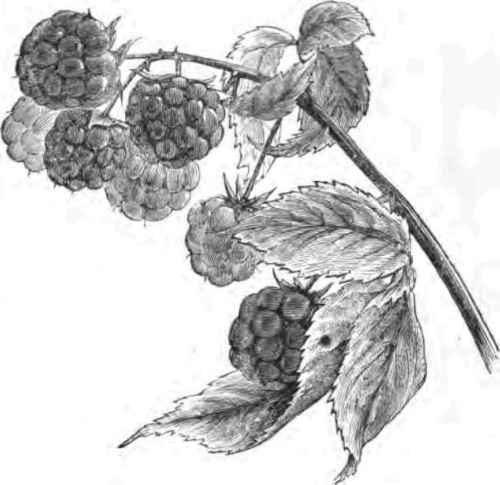
Pig. 120. - Philadelphia.
Pruning, Tying
The training of plants to wires, stakes, inside of hoops, etc., although generally advised, and when well done presenting very satisfactory re-cults and appearance, we have for some years discontinued, and confined ourselves to shortening back our canes and inducing thereby stronger and better laterals, with stiff stout canes that require no tying to stakes or wires.
Continue to:


My Books

