


Walks And Talks Or An American Farmer In England
Description
This section is from "The Horticulturist, And Journal Of Rural Art And Rural Taste", by P. Barry, A. J. Downing, J. Jay Smith, Peter B. Mead, F. W. Woodward, Henry T. Williams. Also available from Amazon: Horticulturist and Journal of Rural Art and Rural Taste.
Walks And Talks Or An American Farmer In England
To be a good traveler, a man need possess what is called versatility in an eminent degree. In other words, he must be of such varied attainments, and of such an inquiring, curious, investigating mind, that he may see everything, hear everything, understand everything, and be able to describe and criticise whatever he may meet. There are, it must be confessed, few such travelers. The majority travel for special purposes, and pay little attention to what does not immediately concern them. That Mr. Olmsted is of the few will, we think, be admitted by those who take up these volumes and accompany him in his " walks and talks" through England. In all his journeyings there is not a barren spot. Everywhere, and on all occasions he sees, hears, and derives impressions; and these impressions he gives in his own peculiar style, investing old and common place objects with a freshness and novelty at once entertaining and instructive.
His sketches of landscape, and of particular scenes and objects in the landscape, exhibit such glowing warmth of feeling, such a practical knowledge, as we would only expect in one exclusively devoted to the study of nature. He comes to a farm house, and with the same earnestness, the same keenness of observation and knowledge of detail, he gives a graphic description of all inside and out. Next he comes to an inn; and we have such a lively description of the master and mistress, and maid; the furniture, company, conversation and fare, that we imagine ourselves one of the company. The following is so good, and so characteristic of a class of English inns, that we cannot resist the temptation to allow our readers to enjoy it with us:
"Muddy, wet, and tired enough, I stopped at what seemed the last in the street, a house of humble appearance. I desired to be showed to my room. Master, mistress, maid, and boots, immediately surrounded and eyed me closely, and I could not but remember that I might, probably, bear a suspicious appearance to them. As I take off my cape, maid - a nice, kind dry climate is an advantage instead of a drawback; and it actually enables the Dutch, the Belgians, and the French, to supply Covent Garden market, in London, with garden products both earlier and better than the very skillful and energetic English market gardeners, with their abundant resources, can produce. Our summer climate is similar in many respects to that of France and Belgium; and we are well persuaded that a general adoption of their thorough hydropathic system would work such an improvement on our garden esculents as would greatly increase their consumption, and enhance the pleasure and profit of that most useful branch of gardening.
Another great advantage of an abundant supply of water, is the facility it affords for the application of liquid manure - a species of food that every good gardener regards as indispensable to the proper growth of kitchen garden plants, and of great importance to every branch of gardening.
Let us look at the question in an economical point of view. Under the present system, a very small garden in a dry time will consume the labor of at least one man in watering. He probably has to raise it with a hand-pump, and carry it in a common watering-pot from the barnyard, or at least a considerable distance, to the place where it is to be applied. The gardener is probably short of help, and many other things are suffering, so that he is compelled to stop watering as soon as he has given the most needy cases enough to keep them alive till next day. All his watering, all his labor and time, are expended in "keeping things alive." Now suppose that two or throe hundred dollars were expended at once in providing an efficient means of raising water into an ample reservoir, from which it could be conducted in pipes to the various quarters of the garden. One man could do more watering than five by the common system, and it could be applied in such quantities as would accomplish the desired end. The actual gain of time and increased products in two or three years would offset the original cost, to say nothing of the convenience, and the satisfaction that the gardener and proprietor both would derive from it.
Under such an arrangement, dry weather would lose the terror with which it is now regarded, and the kitchen garden would assume an entirely new aspect.
We shall not at this time attempt any minute description of the various modes of raising water now practiced. The natural facilities that every man finds on his own grounds, or under his control, must guide him in the choice of means. Some may have access to streams, lakes, or other unfailing sources of supply on the surface of the ground, easily raised by a ram or force-pump, and conducted in pipes to a suitable place for a reservoir. Others may be compelled to sink wells, and raise the water with buckets or pumps. In such cases it is economy to sink the well in a place suitable for a reservoir, that the water may pass directly into it from the bucket or pump. The French market gardeners and florists in the neighborhood of Paris, whose arrangements are the most economical and convenient we have seen, invariably have a well in their garden, located on the highest ground. Beside the well is an ample reservoir, from which the water is conducted to all parts of the garden. Some of the more old-fashioned among them raise the water by means of buckets. A wooden frame is erected over the well, to support an upright shaft, on which is fixed a drum. This shaft turns on a pivot at both ends, and the rope that raises and lowers the buckets is wound on the drum.
The rope passes oyer pullies fixed in the frame immediately oyer the well, and there is a pole and whiffile-tree attached to the shaft, for the purpose of applying horse power. But among all the better informed and more enterprizing cultivators, a pump, such as that represented by the annexed figure, has taken the place of the buckets, and is now in very general use. The cut explains its mechanism. It has three pistons, a vertical and a horizontal shaft, and is worked by a horse. Fig. 2 gives a side view of the horizontal shaft terminated by a wheel, a, which turns the wheels 6, c. Each wheel has a spindle, to which is fixed a crank fitted to the piston. Such a pump as this raises from three to five thousand gallons per hour, and costs about $250 to $300, according to the depth of the well.- From the reservoir into which the pump discharges, the water is carried over the garden in lead or cast iron pipes, and deposited in barrels or tanks at different points of the garden. These barrels are all sunk in the ground to within a foot or so of the top.
Fig. 1 in the second plate represents this arrangement.
This is but an imperfect sketch of what we regard as the best system of supplying gardens with water that we have yet seen practiced extensively and with complete success. If our ingenious countrymen will turn their attention seriously to this subject, we have no doubt but that they will woik out a system as well adapted to their wants as the French marai-chers (market gardeners) find this is to theirs.
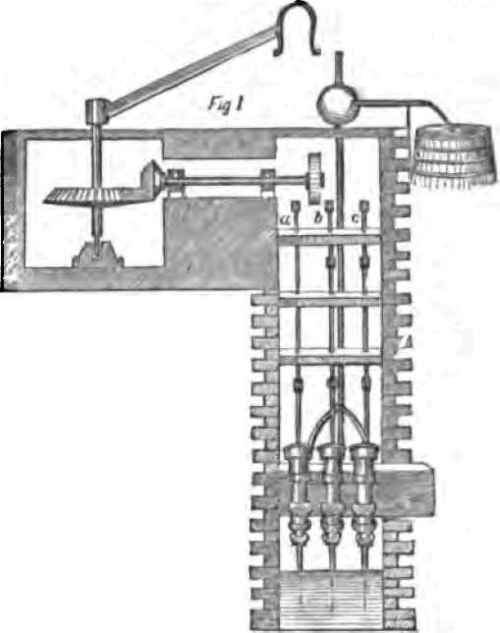
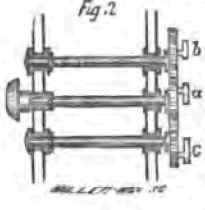
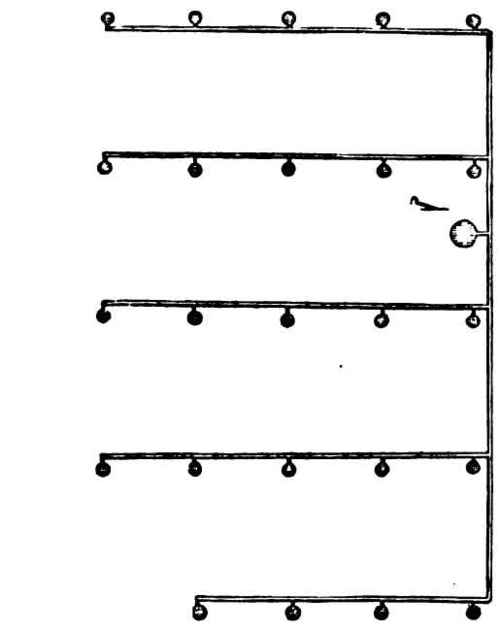
Fig.1

A correspondent who has given considerable attention to this subject, has promised to communicate to us soon the result of his investigations ; and we solicit others who may have experience in these matters to add their mite, for we regard the subject as a most important one, lying at the bottom of whatever improvement we hope to accomplish.
Continue to:


My Books

