


A Shower Of Flies - Side Grafting
Description
This section is from "The Horticulturist, And Journal Of Rural Art And Rural Taste", by P. Barry, A. J. Downing, J. Jay Smith, Peter B. Mead, F. W. Woodward, Henry T. Williams. Also available from Amazon: Horticulturist and Journal of Rural Art and Rural Taste.
A Shower Of Flies - Side Grafting
A Shower Of Flies
A recent number of the St. Louis Democrat says: "On the down trip of the steamer ' Editor' in the Illinois, the other night, at nine o'clock a shower or stream of the Mormon or Shad fly poured upon her decks, to the depth of six inches, and it was a very difficult matter to shovel them overboard. They were so numerous as to put out the watchman's light and envelop everything in midnight darkness. The trees along the shore look as if borne down by these short-lived insects. The visitation is said to prognosticate a sickly season".
Showy. German Asters
A great rariety of shades, of red, pink, and blue, plain and quilled very ornamental in beds - six to nine inches high.
Shrubs Under Drip Of Trees
It sometimes becomes necessary to plant some shrubs under the shade and drip of trees, in order to make up for the loss of branches, etc. The Daphne mezereum, Mahonia aquifolia, Hypericum percinum, barberries of all sorts, and also privet, are good plants for the purpose. For covering the ground in the summer, in places where the grass fails to succeed, the varieties of vinca, of ribbon grass, Hypericum hirsutum, and Irish ivy are among the many good vines and creepers that may be used.
Sickly Orange Trees
J. P. J., (Balti. more.) Bad soil is undoubtedly the cause of the sickly state of your yellow leaved orange and lemon trees. Take them out of the tubs and shake off a good part of the soil from the roots. Repot them in a mixture of one-half good rich loam - the top spit of a rich turfy pasture - one-third decomposed cow manure and one-third Hue charcoal with a little sand. Shorten in the branches all over the head, place the tubs in a shaded situation (on the north side of a building) - and water them plentifully as often as they appear dry.
Sickly Plants
For sickly plants the best way is to turn them out of the pots, shake or wash off all the soil from the roots, and, if any are decayed cut them off; also prune the stems and branches severely and pot again in fresh soil. Set them away in a shady-place after giving water sufficient to settle the soil, adding a little from time to time as re-turniug health and growth appears.
Sickness Of Western Editor
The serious illness of Mark Miller, our Western editor, has prevented sending copy for his department this month. We trust he will be restored to health, and usual duties, before long.
Corresponding Editors:
Josiah Hoopes, James Taplin, Mark Miller
Vol.29. March, 18t4. So. 333
Side Grafting
One form of this method is only a modification of cleft grafting - instead of splitting the stock, the bark is divided from the top of the stock downward for an inch or two, and then lifted slightly, as in budding; the cion is pared thinly on one side, and then inserted under the bark of the stock (fig. 9), as it is necessary that the bark of the stock should be separated from the wood. It is evident that this method of grafting must be deferred until the sap starts in spring. Another method of side grafting is shown in fig. 10. The cleft in the stock is a triangular incision, cut with an implement made expressly for that purpose - (fig. 11). The lower end of the cion is made to fit the incision, and then carefully fastened in its place with strips of waxed cloth.
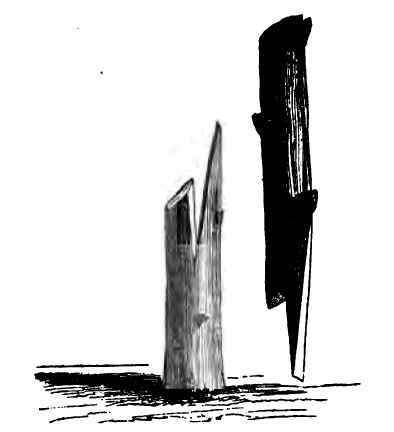
Fig. 13.
Continue to:


My Books

