


Bans - The Barnes Mammoth Strawberry
Description
This section is from "The Horticulturist, And Journal Of Rural Art And Rural Taste", by P. Barry, A. J. Downing, J. Jay Smith, Peter B. Mead, F. W. Woodward, Henry T. Williams. Also available from Amazon: Horticulturist and Journal of Rural Art and Rural Taste.
Bans - The Barnes Mammoth Strawberry
Bans
Here is something about bees which quite abates our early prejudice in favor of those always instanced little creatures that "improve each shining hour".
"Many curious instances have been noticed by naturalists, illustrative of the instinct which directs various animals to proportion the amount and nature of their labor to the exigencies of particular cases. Bees transported from Europe to Bermuda, omitted, after the experience of one season, to make the annual provision for the winter; and, laying aside their habits of industry with the necessity of exertion, became idlers and sources of vexation to the inhabitants".
Dr. Ward's article on the Pear will appear in our next.
Bananas In Texas
According to a Texas paper the Banana perfects itself in parts of Texas, the tree thriving as well as in its native latitude.
The Banksian Pine. Pinus Banksiana
This variety is classed as a scrub pine of low slow growth and little value, and so we regarded it twenty-five years ago, when we procured specimens of it in the barren sands of islands in Lake Michigan. Those same plants, however, are now some of them trees forty feet high and extremely beautiful. It has a swayed drooping habit as it grows, but makes a conical and very graceful tree. The foliage is short, light yellowish green, and so unlike any other variety that it is extremely valuable even in grounds of quite limited extent. It is perfectly hardy.
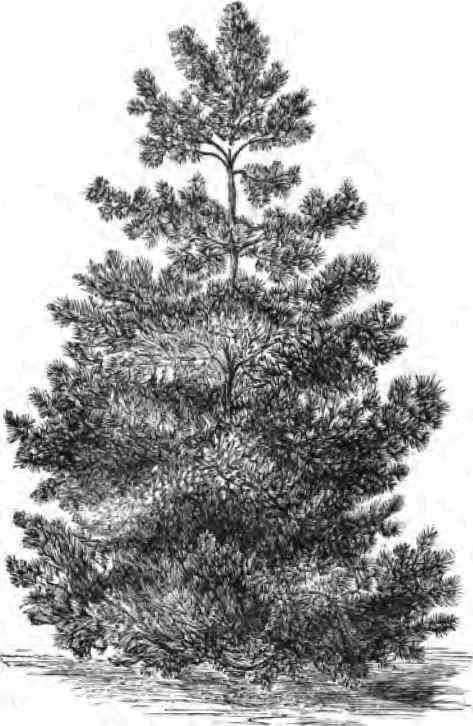
Fig. 50. - The Scotch Pine.
Banquet Drcorathones
At a banquet given recently at the Mansion House, London, upwards of two tons of ivy were used in draping the pictures, mirrors and walls, and amongst the cut flowers were upwards of 2,000 blooms of Marechal Niel rose, and large quantities of stephanotis, gardenias and other sweet-scented flowers, while among the plants employed were palms, pandanads, marantas, aralias and orchids.
The Bark Louse
(D. H. P., Lyons, Iowa.)
To get rid of this pest on the small branches, you must prune them in closely and wash all the remaining parts as you suggest '
Barklaya Syringafiora
A fine greenhouse shrub, with orange yellow flowers in the way of a Persian Lilac, only of an orange yellow color. Moreton Bay.
Barn-Yard Manure As Mulch
The Rural New Yorker says : We do not like to use fresh manure from the barn-yard as a mulching for strawberry plants, for two reasons. First, it is usually full of weed seeds, and these will grow and injure the plants unless destroyed. Second, if the manure is applied early in Fall, or before the ground freezes, all sorts of cut-worms and grubs will gather under it for protection from cold, and be on hand to attack the plants in Spring, Still, if we had no other enriching materials at hand, and our plants required it, we should apply even fresh horse manure, without fear of consequences.
The Barnes Mammoth Strawberry
In the East, it has been a failure this year, yet, in the West and South, it has been exceedingly successful. We apprehend it does best in a moist season.
Continue to:


My Books

