


Oenothera Biennis, (Tree Primrose.) - Ohio Board Of Agriculture
Description
This section is from "The Horticulturist, And Journal Of Rural Art And Rural Taste", by P. Barry, A. J. Downing, J. Jay Smith, Peter B. Mead, F. W. Woodward, Henry T. Williams. Also available from Amazon: Horticulturist and Journal of Rural Art and Rural Taste.
Oenothera Biennis, (Tree Primrose.) - Ohio Board Of Agriculture
Oenothera Biennis, (Tree Primrose.)
This is a biennial, so abundant as sometimes to be considered a weed. It delights in cultivation, and continues for a long time to furnish abundantly, its large, lemon-yellow flowers. Many plants, at a particular hour or season , open their corols, but none is more regular or easily observed than this. Soon after sunset its petals expand, not slowly, but with a sudden jerk; so that as they open one after another, the whole plant appears to possess animal life, and where, but a few minutes before, the buds were scarcely seen among the leaves, now appear broad, expanded flowers.
Off-Hand Notes
The singing of the robin and bluebird has lured me out from my cozy den, where I have been hybernating all winter long, among my dried plants, in the herbarium; and as I step my foot upon the turf, just turning green with the mildness of the early spring days, the violets, crocus, and snow-drops bid me welcome. The bright sunshine makes one feel like gardening, and this suggests a multitude of little hints that I have gained in previous years; so with your kind permission, dear editor, I will occasionally send this record of my experience, as it may occur to my mind.
Officers Elected
President
Marshall P. Wilder of Massachusetts.
Offsets
The proper season for removing the offsets is from August to the end of September. They should be taken from the plant either by being broken by the hand or by a piece of wood; never use a knife in dividing them, as it is very prejudicial to both parent and offset. Plant them singly, in small pots, in a compost the same as is directed for seedlings. Water carefully and with caution until the plants are well established, shading during the warmest part of the day. When well established, they should be treated as directed for general stock.
Ogdensburgh Apple
In the fall of 1858, Hon. A. B. James, of Ogdensburgh, N. Y., being in Milwaukee, purchased an apple in market, which he thinks resembled the Winthrop Greening. He saved the seeds and planted them the next spring. Of the seeds which grew, all but one were so full of thorns and evinced so wild an appearance that they were destroyed. That one grew stocky, and spreading like the Fall Pippin, with a leaf much like Red Astrachan, its young wood being a dark, rich, reddish brown, with many light gray specks, short-jointed, and its buds prominent, rounded. Soil, a sandy loam over a subsoil of hard-pan. The variety fruited for the first time in 1867, producing about fifteen specimens, from examination of which our drawing and description have been, made.
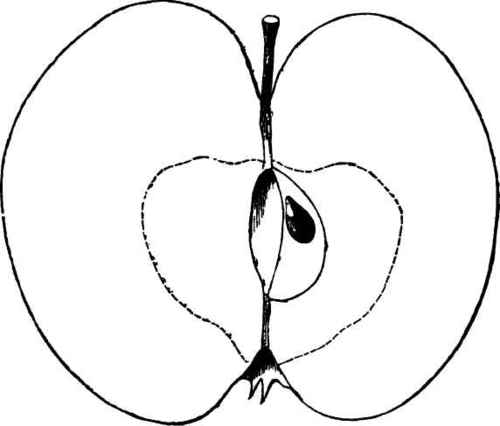
Pro, 45. - Ogdensburgh Apple.
Ohio Board Of Agriculture
The Thirteenth annual fair of the State Board will be held at Cleveland on Tuesday to Friday, the 16th to the 19th of September, 1862. The prize list is ample and liberal, and competition is open to all. We hope they may have a good time. Information may be obtained by application to J. H. Klippart, Corresponding Secretary, Columbus, Ohio.
Continue to:


My Books

