


The American Poulterer's Companion - Amorphophallus Rtiveri
Description
This section is from "The Horticulturist, And Journal Of Rural Art And Rural Taste", by P. Barry, A. J. Downing, J. Jay Smith, Peter B. Mead, F. W. Woodward, Henry T. Williams. Also available from Amazon: Horticulturist and Journal of Rural Art and Rural Taste.
The American Poulterer's Companion - Amorphophallus Rtiveri
The American Poulterer's Companion
A Practical Treatise on the Breeding, Rearing, Fattening, and general Management of the various Species of Domestic Poultry. By C. N. Bement. With accurate and beautiful Illustrations, and Portraits of Fowls taken from Life. 12mo, Muslin, - $1 25.
American Red
Mr. Saul proposed to strike it out. Mr. Prince: The name is indefinite; has a red bark and is very productive. Mr. Parsons: Very fine for preserving. Seed vessels of all other varieties too large.
American Rural Home
The first number of this new Journal, which takes the place of the American Farmer, at Rochester, N. Y., is very neat indeed. It is pleasant in looks, in contents a thoroughly social home paper. Western New York is a grand good field for supporting " Rural Home " papers, and a grander one for raising good practical men and editors.
American Stock Journal
We have received the first number of the second volume of this fine monthly. It is ably edited by D. C. Linsley, and abounds in practical information pertaining to the breeding, keeping, diseases, etc, of all kinds of domestic animals, and will be useful to a large class of our readers. We shall not hereafter deem it beside our purpose to notice periodicals devoted to arts kindred to our own. We have elsewhere added a list of the various Agricultural and Horticultural periodicals of the day.
American Summer Peamtain
" Perfectly hardy when top-worked, but does not bear satisfactorily even then."
American Summer Pearmain
Proposed by Dr. Jones, and highly recommended by all who know it, but passed as not sufficiently known.
American Weeds
Mr. George Thurbur has edited a handsome illustrated edition of Dr. Darlington's American Weeds and Useful Plants, which is also on the point of being published by Mr. A. O. Moore, of New York.
The American White Spruce. Abie* Alba
For planting in small grounds, for the outskirts of groups and masses, for points on roadways, and for cemeteries, the American White and Red Spruces are deserving of far more general use than they have received. Pyramidal tapering, regular and yet irregular, compact without losing its pleasing variety of regular outline, attaining only a moderate size, the White Spruce is far more suited to position on small lawns or outside masses, or borders of half-acre lots, than the Norway, which is much more commonly planted.
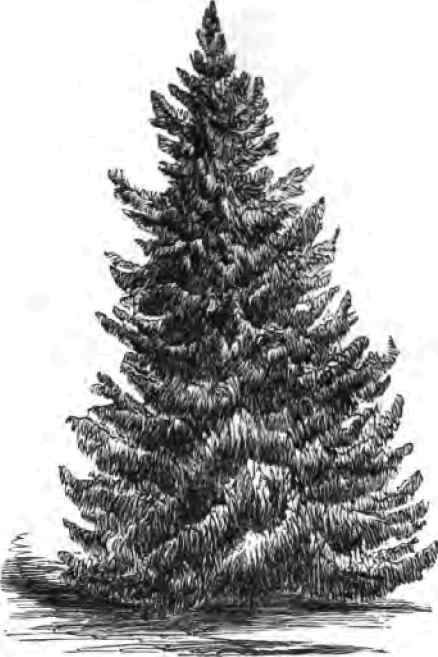
Fig. 62. - The American Med Spruce,
The American, Or Fountain Willow. Salix Americana Pendula
A variety with very slender, graceful branches, which droop perpendicularly, like so many cords, that, taken with its light and comparatively sparse foliage, form for it one of the most airy and pleasing weepers in the whole list. It is admirably adapted for planting upon small lots in cemeteries.
Amorphophallus Rtiveri
From indication this is to be the "coming plant" for 1873. A. S. Fuller thinks it is destined to be a general favorite, on account of its luxuriant growth, and rapid multiplication of tubers. At present they are quite high-priced.
Continue to:


My Books

