


Davis Pear
Description
This section is from "The Horticulturist, And Journal Of Rural Art And Rural Taste", by P. Barry, A. J. Downing, J. Jay Smith, Peter B. Mead, F. W. Woodward, Henry T. Williams. Also available from Amazon: Horticulturist and Journal of Rural Art and Rural Taste.
Davis Pear
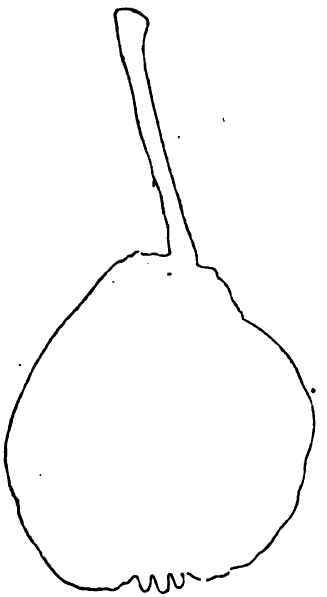
Specimens of this seedless native Pear were received from Mr. Samuel Davis, Haverford Township, Delaware County, Pennsylvania - six miles from Philadelphia, on the Westchester Road. They were produced by a grafted tree on his premises, the graft having been taken, about twenty years ago, by Mr. Davis's father, from a seedling on the farm of his neighbor, Mr. Adam Litzenberg, soon after which the original tree died.
Size, small, 1) inches long by 1 5/8 in breadth. Form, rather variable, sometimes roundish, usually obtuse-pyriform, widest at the crown, and obscurely pentangular. Skin, much russeted, with occasionally marblings of greenish-yellow. Stem, three-eighths of an inch long by one-eighth thick, inserted in a very shallow cavity. Calyx, small, partially reflexed, set in a wide, somewhat irregular, superficial basin. Core, medium, solid, being entirely devoid of seed cavities. Seed, not abortive, but altogether absent Flesh, buttery, gritty around the core. Flavor, slightly aromatic, and somewhat vinous. Quality, "good." Maturity, last of September and beginning, of October.
This seedless variety, though much smaller than the Poire sans Pepins, is much superior to it in quality. Were it not for the grittiness near the core, the Davis would be rated " very good." And even with this objectionable feature, it commands a good price in the Philadelphia market.
Ritter Pear.
Continue to:


My Books

