


Delaware Grape (3)
Description
This section is from "The Horticulturist, And Journal Of Rural Art And Rural Taste", by P. Barry, A. J. Downing, J. Jay Smith, Peter B. Mead, F. W. Woodward, Henry T. Williams. Also available from Amazon: Horticulturist and Journal of Rural Art and Rural Taste.
Delaware Grape (3)
The Delaware Grape #1
Mr. Thomas J. Myers, of Dundee, Yates county, N. Y., writes us that there is a Grape in Steuben county, where it has been cultivated for twenty years, that answers our description of the Delaware in every respect. He says the vine was owned by a queer old Dutchman, who never would give either a root or cutting of it even to his nearest neighbors; but that at length he has succeeded in getting cuttings, and will propagate it. It appears that the owner of this vine obtained it from a Mr. Maxfield, living between Philadelphia and Trenton; and that he brought it from Lisbon, and called it the "Lisbon wine Grape." Mr. Myers says it is perfectly hardy on the highest, coldest, barren hills of Steuben, and bears abundantly.
Two years ago, we gave expression to the opinion that this country was on the eve of attaining mnch better hardy grapes than we then possessed. This has come sooner than was anticipated, and in a different way, not so mnch by hybridization as by accident The Rebecca and Delaware have both originated in the same way; they may be said to have been accidental discoveries. The efforts of the hybridizer have yet to be heard from.
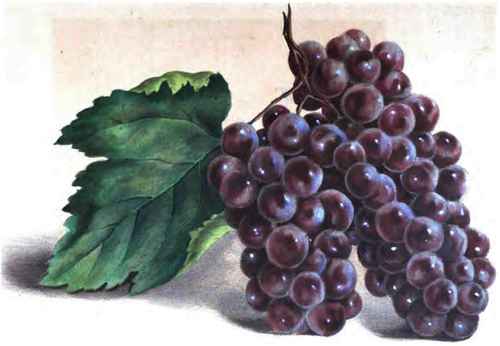
Mr. 0. Downing gives the report of the origin of the Delaware from the opinion of Mr. A. Thompson, of Delaware, Ohio, thus: " That it was an accidental seedling, as it is free from mildew, never prematarely losing its leaves, and seeming to luxuriate in our climate, which cannot be said of any foreign variety with which we are acquainted.
"Bunch, small, very compact, and generally shouldered. Berries, smallish, ronnd when not compressed. Skin, thin, of a beautiful light-red or flesh color, very translucent, passing to a wine color by long keeping. It is without hardness or acidity in its pulp, exceedingly sweet, but sprightly, vinous, and aromatic. * * It is a vigorous grower, an early and profuse bearer, and probably more hardy than Isabella or Catawba. In the garden of Mr. Thompson, where all other kinds were nearly destroyed by the unprecedented cold of 1855 and 1856, this alone was uninjured. It ripens nearly or quite three weeks before the Isabella. Its bunches and berries are very greatly increased in size by high culture".
This is a high character; probably not too high. Our artist has drawn the accompanying figure from the largest and most shouldered bunch forwarded to us by Mr. George W. Campbell, of Delaware, Ohio. Mr. Campbell remarks that this bunch was not fully colored - perhaps not quite ripe - having grown partially in the shade. He also finds the vines free from mildew, more hardy than the Isabella, Catawba, or Diana, and he, too, believes it to be an accidental seedling.
The vine is not so vigorous in its growth, especially while young, as the Isabella or Catawba, but more so than the Rebecca; it makes new shoots of fifteen or twenty feet in length, and a vine of Mr. Campbell's ripened one hundred bunches in its fourth year.
Mr. Henry C. Noble, of Columbus, Ohio, writes thus respecting the Delaware: - "Columbus, Ohio, Nov. 3,1857.
"Editor Horticulturist: In your November number, you speak justly in high praise of the • Delaware Grape,' yet, for a proper appreciation of its peculiarities, a few notes from experience may not be out of place. In the spring of 1854,1 procured a Tine from Mr. Thompson, of Delaware, Ohio (the gentleman who introduced it into notice), and planted it with great care. The first season it grew about twelve inches. It is a peculiarity of this variety worthy of notice, that no treatment will make it grow rapidly the first season after transplanting; and sometimes it grows quite slowly for several years. It may be as well, in this connection, to speak of the difficulties of propagating it. It will not be a favorite of nurserymen. Out of thirty cuttings set out last spring, under the most favorable circumstances, but five or six grew at all, and none of these made more than a few leaves of growth. Such plants are too weak to endure severe weather. The true way to propagate this variety is by layering.
The layers become stout and good the second year.
•• To return to my experience. The second year, my vine produced two fine, healthy shoots, about ten feet long. These ripened their wood early and well, notwithstanding the season was very wet. The succeeding winter (1855-6) was very severe here (24º below zero), but the cold only destroyed a few buds about the centre of the vine. My Catawbas and Isabellas, in the same yard, and more protected, were very seriously damaged. The third year, one branch was layered, and the other trained for fruit. The layer produced six good shoots; the other branch grew very well, and produced a few grapes. This, the fourth year, the vine produced a beautiful crop of grapes, most of the fruit spurs having three, and some four perfect bunches. We gathered a hundred bunches from the one vine, some of which were finely shouldered, and as firm as'Miller's Burgundy/ and looked as if chiselled from amber. They were exhibited at our ' county fair,' and distributed among the 'diggers,' and pronounced 'very best.' , The flavor is much better when freshly gathered than after a few days' keeping. The wood, last winter, did not suffer a particle, even at the slenderest ends of the shoots, although the thermometer was again about 20° below zero.
Here, where we have a good horticultural society, and think we know something about fruit, we consider the Delaware Grape the best table grape for out-door culture we have ever had (the Rebecca has not yet reached us), and unhesitatingly pronounce it perfectly hardy. It is a little discouraging to start, but when obtained, it fully pays for all one's care and patience. There are no vines here to sell, and it is in great demand.
Respectfully, H. C. Noble".
We have a valuable communication from Mr. Samuel Miller, of Calm dale, Pa., respecting some other important additions to our stock of new and hardy grapes, which shall appear in January.
Continue to:


My Books

