


Design For An Italian Villa
Description
This section is from "The Horticulturist, And Journal Of Rural Art And Rural Taste", by P. Barry, A. J. Downing, J. Jay Smith, Peter B. Mead, F. W. Woodward, Henry T. Williams. Also available from Amazon: Horticulturist and Journal of Rural Art and Rural Taste.
Design For An Italian Villa
This design of a villa suited to the accommodation of a family of liberal mode of living, has been recently erected at Norwich, Conn. Its situation is eminently adapted for the display of architectural beauty, and on account of the commanding prospect enjoyed from the upper windows in the tower, amply justifies the introduction of such a feature in the composition. Its material is brick, dressed with Portland stone; the roofs are of tin, and the verandas, etc., of wood. The distribution of the rooms may be understood by an examination of the plans, which provide accommodations on a most liberal scale.
The principal floor comprises an entrance porch (No. 1), which leads by means of wide doors into the hall (2) of spacious dimensions, in which is contained the principal stairway (3). At the end of the hall is a handsome doorway, with niches on either side, opening into the drawing-room (4), which possesses a charming feature in the shape of a large bay (5), a side-window, which opens into the conservatory (6). No. 7 is the library, a well proportioned room, having a projecting reading-window, with also French windows leading on either side into verandas, marked on plan No. 8. The library, it will be seen, contains a large closet No. 9 is the family parlor, with windows on one side opening to the veranda, and with a projecting window looking upon a terrace (10). This room conducts, by means of a private lobby, into the entrance hall and stairway, so as to afford a retreat for the ladies, if surprised by too matutinal a visitation. The dining-room (11) is a large and handsome room on the opposite side of the entrance hall, having connected with it a spacious and well lighted butler's pantry, complete with every convenience (12), and also an inner hall (13) leading to the kitchens, and containing various closets, and the back and cellar staircases.
The kitchen and domestic arrangements are as follows: No. 14 is a large and well lighted kitchen, well supplied with closets, and having a separated lobby that permits access to the hall and main body of the house, and yet entirely •huts off the domestic office from exposure. This lobby terminates in a covered way near the conservatory, which gives access to the usual adjuncts of the building, which space would not permit to be shown upon the plan. No. 15 is a laundry, or back kitchen, containing a large larder and store closet. Beneath the whole house is ample cellarage, seven feet high in the clear, and well lighted and ventilated, and in the very center of the building is a sub-cellar, some six or seven feet deeper, containing the heating apparatus - one of Chilson's largest sized furnaces - a position which prevents the loss of heat by pressure upon a long length of horizontal pipe, and secures the easy ascent of the warmed air into the rooms, and its ready and natural distribution by proper ducts throughout the house.
The chamber floor is thus apportioned: No. 1 is a large, well lighted corridor, leading from the principal stairway, and conducting by an open lobby (2) to a chamber (3) over the library. No. 4 is a chamber of the same size as the parlor beneath, and 6 a smaller single room, or it may be a dressing-room. No. 6 is a large room, the same size as dining-room. 7, the back staircase. 8 is a dressing-room, or single chamber. 9, a large sleeping-room, amply supplied with closets, and reached from the landing, 1. 12 is a hall leading to water-closet (11) and bathing-room (10); the tub in which occupies very little room, placed as the plan represents.
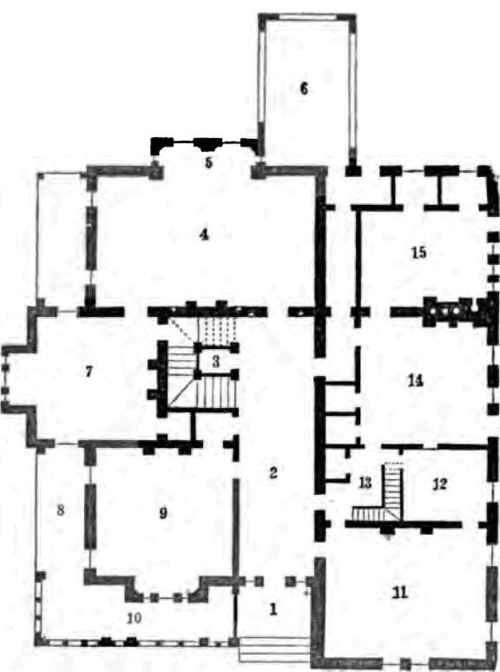
PRINCIPAL FLOOR.
It will be seen that the portions of the building containing drawing-room, laundry, etc., only extend one story; the house could, therefore, at any future time, be thus much increased in size, and light to the hall and staircase elsewhere obtained.
The attic floor contains abundant accommodation for servants, and a large room over No. 6 suitable, from its airy position, as a nursery, or spare room. There is also a handsome room in the upper story of the tower, which is reached by a staircase placed in the corridor on the attic floor. All the apartments throughout the house are of large size, and the height of the stories are in proportion.
The external appearance of the building is very effective - the breaking up of the parts that the plan permits giving an opportunity for picturesque treatment of its outlines. The character of the work is bold, and the general effect of the mass harmonizes very well with the surrounding scenery.
The cost of the building, with its adjuncts, has not exceeded twelve thousand dollars, and it is well built and finished throughout.
There are many minutiae of convenience that the smallness of the scale does not permit me to show in the plans, but as a type of the American Suburban Villa, I think the design will bear inspection, and the arrangements of the building a close and critical examination.
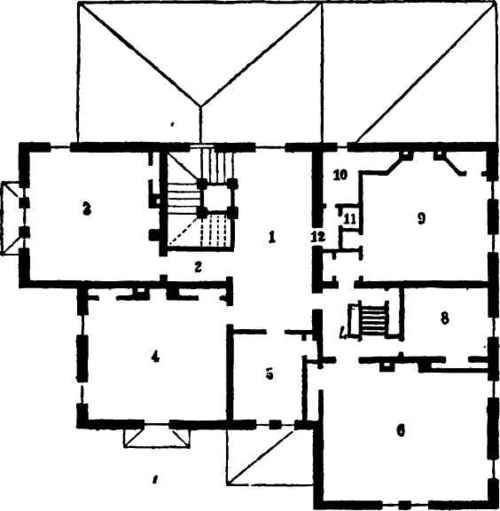
SECOND FLOOR.
Continue to:


My Books

