


Diseases Of The Peach-Tree
Description
This section is from "The Horticulturist, And Journal Of Rural Art And Rural Taste", by P. Barry, A. J. Downing, J. Jay Smith, Peter B. Mead, F. W. Woodward, Henry T. Williams. Also available from Amazon: Horticulturist and Journal of Rural Art and Rural Taste.
Diseases Of The Peach-Tree
I have been for a few years a slight observer of the disease, as it is manifested in this region, and which your correspondent, " C. E. Goodrich, Utica," designates " the curled leaf on the peach tree." It may be that our peach trees are afflicted with a different disease from that mentioned by your correspondent, as it varies in many particulars from that described by him. And first, the trees having serrated leaves, are generally much more affected by the curl', than the glanded sorts; in some few cases, however, the gland-ed are more affected. But the effect on the after health of the tree, is uniformly more injurious on trees whose leaves have not glands. Again, the large uniform glanded leaves, are less liable to the curl, and the trees suffer, afterwards, less than any other.
The general symptoms of the disease resemble those described by your correspondent, with some additional ones, which I shall presently describe.
The disease is not owing to an exhausted soil. The character of our soil is threefold. On the flat, a rich black mold, with a sub-soil of clay or gravel; on our east hill, generally, a rich sandy loam; and on our south hill a heavy clay. On all these soils are to be found peach trees, varying in their age from fifteen to thirty years, and from eight to twelve inches in diameter - which are no more affected by the disease than those upon the various soils in localities which have never been cultivated until within the last 4 or 5 years.
• Nature is always giving us both hints and materials for this purpose. For instance, the peach, so common in oar orchards all over the middle states, does not ripen well, and is rarely seen in northern New-England. Yet in a large garden of iudling peaches, that we saw in a cold part of Mansachntettt, where all the better varieties hod failed, there were three or war so perfectly hardy as to bear every year the finest crops. The fruit was only second rate - but by crowing with the hardier of the fine sorts, might in one generation have been rendered both hardy and delicious.
The disease, as exhibited here, is not owing to the winter, or the changes of temperature. Trees on the east or south wall of a house, which would be more liable to suffer from such causes, uniformly escape, whatever the character of the leares.
In addition to the symptoms mentioned by your correspondent, if the disease with him is the same as with us - if he will go into his peach orchard in winter, and examine the last years' wood - he will find, principally near the base of the branch, blotches or warts varying in sue from one-eighth to one-quarter of an inch in diameter. The smaller blotches are generally round, and unbroken mostly, and looking like a blister or burn - the larger ones generally eliptical in form - the bark within the elipse entirely gone, and the woody parts bulged out, and sometimes slightly gummed. These blotches are frequently upon, and sometimes just under the bud - more frequently, however, on the branch between the buds. If your correspondent will again go into his orchard in the spring shortly after the leaves have expanded, and the blossoms fallen, he will find, with the exception of those buds which have the blotches on or under them - the whole branch covered with the most luxuriant vegetation - the blotches, however, will be seen, as the season advances, to be gradually extending themselves in size, and those branches having many, or large ones, round the base of the stem, will be gradually encircled by a ring of dead bark; as soon as this happens, the leaves and branch beyond, all die.
This occurs about the time that the curled leaves have dropped from the trees. After this, those trees which have not died, put forth fresh leaves, and make a healthy growth until the end of the season. When the months of July or August have arrived, (the precise time I have omitted to note,) if your correspondent will examine closely the wood of the current year, in places corresponding to those where he now finds the blotches above referred to - he will find pieces taken out of the young wood, as if eaten or bitten out; and if he will watch these punctures, he will find them gradually assume the appearance of those blotches which are now wanting bark.
If opened with a knife at this present time, by slight and successive slices, the outer blotch removed, presents a slightly discolored surface, which increases to the center of the branch, extending frequently up the branch a considerable distance, and accompanied, near the exterior surface, with a black line, similar to that seen in the plum knot - below the blotch; frequently the wood in the center is not discolored, and at some distance above presents the same healthy appearance.
Looking at this present time along the wood of two or three years growth, he will find the same eliptical shaped marks, indicating where the same injury has been inflicted for successive years.
Should your correspondent find the marks which I have hastily and imperfectly described, I suggest whether -
1. It may not be the puncture of an insect, and the blotch the nest for its young.
2. Whether the curl is not the old and long known disease mentioned and described by all authors, and particularly in Downing's work.
3. Whether amongst the remedies, the knife is not the most certain, and the time, at the annual shortening.
4. Whether the serrated leaf trees should not be wholly abandoned, and their place supplied with trees having glanded leaves. I have myself, almost entirely abandoned the cultivation of all trees having serrated leaves.
I have omitted to state, that in the spring, about the time the branch dies, the punctured part gums after a rain, as also the old blotches in the older wood.
Again, here, if the disease is permitted to progress, the trees surely die. I have seen many trees that have knots upon them almost as large as those on the plum.
By the way - should you deem this article worthy of publication - I would remark that the time to cut out the plum knot is the latter part of June, when the green knots begin to appear; if then cut out thoroughly, (that is the black line running up and down all removed,) they will never return. 1 have the scars on my trees, but not a single knot - my neighbor's trees are dead or dying.
W.
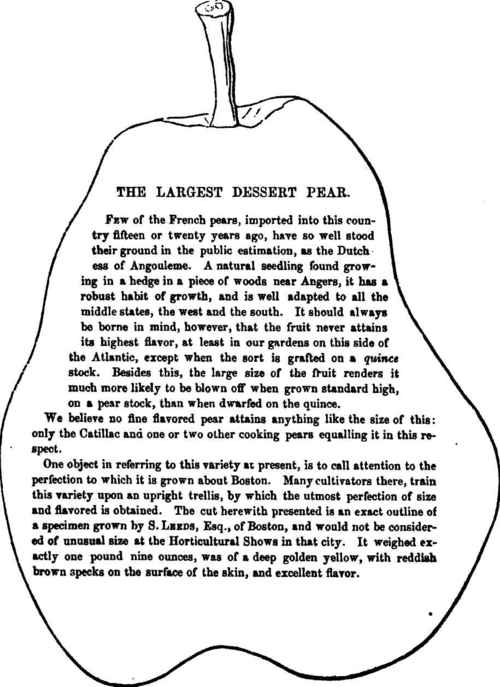
Outline OF A DUCHESs OF ANGOLEME PEAR,RAISED AT BOSTON.
Continue to:


My Books

