


Evils Of Deep Sowing
Description
This section is from "The Horticulturist, And Journal Of Rural Art And Rural Taste", by P. Barry, A. J. Downing, J. Jay Smith, Peter B. Mead, F. W. Woodward, Henry T. Williams. Also available from Amazon: Horticulturist and Journal of Rural Art and Rural Taste.
Evils Of Deep Sowing
In many seeds, the vital principle is so strong, that to scatter them upon the soil is sufficient to insure their speedy germination; but in others, the power of growth will only manifest itself under more favorable conditions. Moisture is necessary, but not an unlimited quantity; if a seed is thrown into water, and exposed to a proper temperature, the act of germination will take place; but, unless the plant is an aquatic, it will speedily perish; no doubt, because its powers of respiration are impeded, and it is unable to decompose the water it absorbs, which collects in its cavities, and becomes putrid. There must, therefore, be some amount of water, which, to the dormant as well as the vegetating plant, is naturally more suitable than any other; and experience shows that quantity to be just so much as the particles of earth can retain around and among them by the mere force of attraction. To this is to be ascribed the advantage derived from those mixtures of peat, loam, and sand, which gardeners prefer for their seedlings; the peat and sand, together, xeep asunder the particles of loam which would otherwise adhere, and prevent the percolation of water; the loam retains moisture with force enough to prevent its passing off too quickly through the wide interstices of loam and peat.
Under what depth of earth seed should be buried, must always be judged by experience; but it should be obvious that minute seed, whose powers of growth must be feeble in proportion to their size, will bear only a very slight covering, while those of a larger size, and more vigor, will be capable, when their vital powers are put in action, of upheaving considerable weights of soil. As the extent of this power is usually uncertain, the judicious gardener will take care to employ for a covering no more earth than is really necessary to preserve around his seeds the requisite degree of darkness and moisture. An erroneous opinion prevails that seeds must be "well" buried, in order that the young plants may have " sufficient hold of the ground." But a seed, when it begins to grow, plunges its roots downwards, and throws its stem upwards from a common point, which is the seed itself; and, consequently, all the space that intervenes between the surface of the soil and the seed, is occupied by the base of the stem, and not by the roots.
The seeds of the Araucaria illustrate this, as remarked by Professor Lindley; they always grow best when merely laid on the surface of the soil with a little earth raised round their edges.
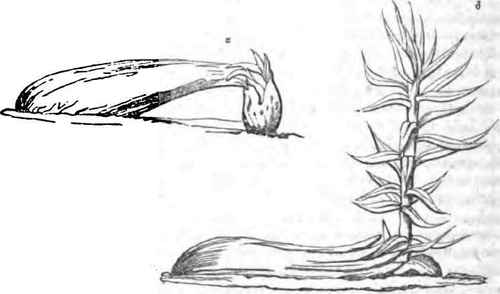
Germination of Arancaria imbricate; a, the seed after it has inserted its radicle in the soil, the stem and leaves Just appearing; b, the same seed, at a later period, firmly fixed in the ground by its roots.
The finest oaks spring from acorns dropped in the forest, and covered by a tew leaves. The sycamore, the ash, the beech, the horse-chestnut, etc, will all sow themselves wherever their seeds can stick to the ground, until a coverlet of leaves is moistened by an April shower, and warmed by an April sun. Neither have such seeds any difficulty in steadying themselves by their roots; a fang is driven by a vital impulse into the earth, and it is to that, and not to the buried neck of the stem, that the seedling trusts for support and nourishment.
It is not a little remarkable, that not only do seeds germinate unwillingly if buried too deep, but that, although they may grow, they cannot, even if forest-trees, develop with vigor for many years. Atmospheric air, which is indispensable to germination, is too much excluded; the injury is not from the superincumbent pressure of the soil.
Thouin, in his Cours d'Agriculture, remarks, that small seeds should be covered only a line deep, with earth spread very loosely; seeds, of the size of peas and beans, about three-quarters of an inch deep, and the bulky seeds of our fruit-trees, such as the apricot, nuts, peaches, almonds, with from two to three inches of soil.
"The Flower Garden, or Brook's Book of Flowers," is the title of a large duodecimo, published by J. P. Jewett & Co., of Boston, and a very good hand-book it is, being a revised edition of the one published in 1851. It contains a chapter on the cultivation of plants in the parlor, which we recommend to the ladies.
Continue to:


My Books

