


Exercise XVIII. The Cherry. A Study Of Buds (Prunus Sp.)
Description
This section is from the book "Laboratory Manual Of Horticulture", by George W. Hood. Also available from Amazon: Laboratory Manual Of Horticulture.
Exercise XVIII. The Cherry. A Study Of Buds (Prunus Sp.)
Material and apparatus. Branches of the sour and the sweet cherry, bearing both branch buds and fruit buds; razor, dissecting lens.
The Cherry
There are two large groups of cherries - Prunus cerasus and Prunus avium - which probably sprang from the European species. They differ in habit of growth, in shape, and in the arrangement of buds, as well as in other characteristics. The domestic forms of Prunus avium are characterized by a tall, erect growth, by reddish-brown bark, and by flowers generally in clusters on lateral spurs. The fruit is red, yellow, or black, and sweet. Prunus avium has four representatives in the United States - mazzards, hearts, bigarreaus, and dukes. Prunus cerasus is characterized by low-headed and spreading forms of trees, by flowers in clusters on lateral spurs, and by thin, willowy branches. There are two representatives in the United States - amarelles and morellos. For convenience all cherries are divided into the bigarreaus, or sweet cherries, and the morellos, or sour cherries. These are subdivided according to color and form of fruit, but the subdivisions are of minor importance for consideration at this time.
1. Bigarreau group. The bigarreaus, or sweet cherries (Prunus avium), include the following varieties: Black Eagle, Black Heart, Black Tartarian, American Heart, Cleveland, Coe's Transparent, Sweet Montmorency, Windsor, Bing, Lambert, Royal Ann, and many others.
a. Secure branches from one or more of the varieties named above, and study thoroughly. Make a drawing, natural size, and at least four inches in length, showing both the branch buds and the fruit buds. Where are they located, and how are they arranged? What external differences do you find between the fruit bud and the branch bud? What bud predominates, and why? Does the position of the fruit bud differ from that of the branch bud? Is the relative position of the two kinds of buds always the same? Discuss.
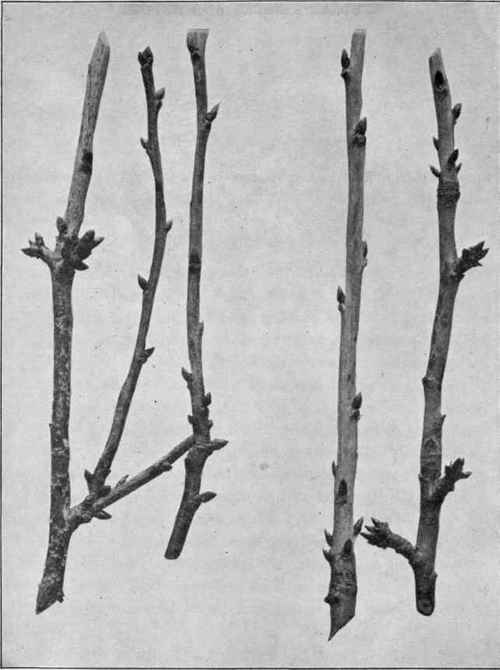
Fig. 12. Branches showing the branch buds and the flower buds of the sour and the sweet cherry.
b. Make a drawing, at least one inch in length, of a branch bud and a flower bud. Remove a scale from each bud, and draw. Are there any differences between the branch-bud scales and the fruit-bud scales? Describe.
c. Make a drawing of a longitudinal and a cross section of a branch bud and a fruit bud. Describe the internal differences. Make a dozen or more sections of the flower buds and count the ovules in each. Is the number constant? Can you give any reason for variation? Is there any ratio between the number of ovules in the buds and the number of clusters in the group? Do you find the buds arranged singly, or in groups on short spurs? Where do you find the greatest number of buds, and how old is the wood on which they are borne? Describe the relative position of the branch bud and the fruit bud.
2. Morello group. The morellos, or sour cherries (Prunus cerasus), include the following varieties: Early Richmond, May Duke, Montmorency, Morello, Royal Duke, Wragg, and several more.
a. Secure branches from one or two of the above-named varieties, or from any other of the sour cherries, and. study carefully. Make a drawing of a branch, natural size, and at least four inches in length. Describe the differences between the branches of the sweet and the sour cherry.
b. Make a drawing, at least one inch in length, of a fruit bud and a branch bud. How do these buds differ from those of the sweet cherry? Are the buds arranged singly or in clusters? Do you find spurs on the sour cherries? Describe fully. Now cut cross sections of several fruit buds. How many ovules do you find? Is the number constant, and does it differ from the number in the sweet cherry?
c. Describe fully the differences between the buds of the sweet cherry and those of the sour cherry. Describe the general appearance of a branch of each. Which branch gives the impression of a rigid, stiff, and upright growth? Describe the difference in the bark of the two cherries.
Continue to:


My Books

