


February - Third And Fourth Weeks. Flowers. Part 3
Description
This section is from the book "The Garden Week By Week Throughout The Year", by Walter P. Wright. Also available from Amazon: The Garden Week by Week Throughout the Year.
February - Third And Fourth Weeks. Flowers. Part 3
Hydrangeas
Readers have read of the wonderful Hydrangeas that grow around the late Mr. Cecil Rhodes' Cape home, Groote Schuur. I am told by the people who know the plants and the man that they were a remarkable sight when in full bloom, and that Rhodes took a deep interest in them. I fear that we cannot grow many plants here as they can in South Africa, and yet there are colonies of Hydrangeas in English gardens. I have a recollection of seeing a large colony of them in a Sussex garden in years gone by, and owing to the presence of iron in the soil the flower heads were blue instead of the normal pink. Watering sulphate of iron into the soil tends to change the colour. My immediate object in referring to Hydrangeas is to point out that those amateurs who have plants established in pots may force them into early bloom by putting them in a warm house. They will stand a good deal of heat if they are well rooted. The pots should really be full of roots now, and the plants will need a good deal of water; a dose of fertiliser once a week will also do them good. If there are two houses the plants may go into the cooler one as soon as they have come into bloom, as the flowers will last better there than in a warm one.
A Pretty Edging Plant [Koniga Or Alyssuni)
Low-growing plants of neat habit that have pretty flowers serve a useful purpose as edgings to beds or borders. Such a one is the Variegated Woodruff, Koniga (or Alyssum) Maritima Variegata. This very useful and pretty little plant may be propagated easily at this time of year by those who have put a few stock plants into pots in autumn, together with blue Lobelias. The plants will begin to grow in a warm house, and all that is necessary is to take cuttings consisting of a couple of inches or so of the growing tips, put them just clear of each other in boxes of very sandy soil, cover with a square of glass, and put them in a warm place. As soon as they have started growing they should go on to a shelf, and they will then make good plants speedily.
Orchids
Growers of Orchids have a great advantage over mere everyday plant lovers in that they get the principal part of their bloom in winter and spring, when less aristocratic flowering plants are in a minority. We cannot get away from the overpowering claims of Orchids; we can only pass them by on the plain, honest, straightforward ground that we cannot afford them.
Orchids have every beauty that a plant can possess. They have great diversity of form, infinite variety of colour, and perfume. The hues have an indescribable delicacy of tone, which distinguishes them from most non-orchidaceous flowers. The reds have the flaming intensity of volcanic fires, the creams have the density of old ivory, the blues have the appealing softness of southern skies.
Nature has taxed her ingenuity to the utmost in designing Orchid flowers. They have been constructed with a marvellous cunning. The devices to insure cross-fertilisation by insect agency almost approach the incredible. Flower and insect have been adapted to each other so cleverly that the one seems a necessary complement of the other; indeed, when one examines the structure of some Orchid flowers, it seems impossible to avoid the conclusion that their extraordinary mechanism has been devised with the sole object of utilising the insect as an instrument of transport - a sort of carrier. Darwin and other scientific writers have described these floral wonders in their own solid way, but the subject is treated with greater literary charm in the writings of Maurice Maeterlinck. In Flowers and Immortality that strange and subtle genius probes deeply into the mystery of the life and structure of plants, and builds up on them a theory of life after death that is not the less absorbing because coloured with his singular and elusive fancy.
The amateur gardener may not approach Orchids in the attitude of one who seeks interest in complexity of structure, or of those unsatisfied souls who fail to find contentment in the religions of the majority. He may admire them for their intrinsic beauty, leaving the rest to the botanical student, the mystic, and the searcher for divine revelation. They will richly reward him. Any one of the four principal genera - Cattleya, Cypri-pedium, Dendrobium, and Odontoglossum - will afford him an abundant harvest of beautiful forms and colours. He may be wise to deal first with these, passing to the less important kinds - Angraecum, Laelia, Oncidium, Vanda, and the like - subsequently.
Considered collectively, Orchids are certainly a somewhat expensive class, but some of the best kinds are cheap, and a few will thrive without much heat. They are imported in large quantities in winter and spring, and it is by no means a bad way of starting Orchid study to visit the auction sales where these importations are disposed of. The sales are advertised in the horticultural journals. It is true that the amateur, whose interest in Orchids has been aroused by seeing a collection in bloom in a botanic garden, or at a show, or in the garden of a friend, may feel nonplussed when he sees the condition in which the importations are sold. Some of them look as much like bundles of grey faggots as anything. They bear only a very remote and distressing resemblance to plants. But they have life in them, and if they are managed properly beauty will gush from them like water from a fountain.
Theoretically, certain kinds of Orchids, notably Cypripedium Insigne and Odontoglossum Crispum, can be grown successfully in cool houses of mixed plants. In practice, lovers of Orchids will find it prudent to specialise them in houses of their own. In large Orchid-growing establishments there may be found three structures, the cool house, the Cattleya or intermediate house, and the hot or East India house - nay, there are sometimes four. But very gratifying results may be secured from one roomy house separated into two divisions, a cool one for the plants at their resting stage, and a warmer one for the growing period. The maximum winter temperature for the former may be 450, and for the latter 550.
An amateur who intends to grow Orchids may well commence preparations in February. He may get his house built and heated, and procure the necessary supply of mechanical appliances. Most of the Orchids are grown in pots, but not in the ordinary form of flower pot. Orchid pots are generally wide and shallow, approximating to what gardeners call pans; but a few kinds are grown in deep pots. The receptacles are generally made, too, with a series of large holes in the sides. Some Orchids are not grown in any kind of pot, but are bound on to blocks or rafts, or grown in baskets.
The root material also differs from that of ordinary plants. It is not "soil" in the usual sense. It is true that peat is used in some potting composts, but it differs from Orchid peat, which is an entirely separate and special article. The best way of getting it is to apply to a trade Orchid grower, or to a dealer in horticultural sundries. Orchids are grown sufficiently largely in these days to justify its being made into a recognised commercial unit. With it may be procured a supply of Sphagnum Moss, which is a particular kind used extensively for Orchids, and generally associated with peat.
A considerable quantity of crocks are also required in Orchid growing. These (pieces of broken flower pot) accumulate in all gardens where pot plants are grown; but if it is necessary to purchase them there need be no difficulty, as any florist or garden sundries-man will supply them. Charcoal is also useful.
When house and materials are ready the Orchids may be bought, either at a nursery or an auction sale. The beginner should try to get the advice of an expert friend in the latter case, or he might employ one of the buying agents who frequent the auction rooms to purchase on commission for amateurs who are unable to be present themselves.
He may like to try a few Cattleyas, which are Orchids of large size and glorious colour. Mossiae (late spring) is the best known species, and next to it Trianae (winter). There are always thousands of the former going at the sales, and the price is low. They will like the warmer house.
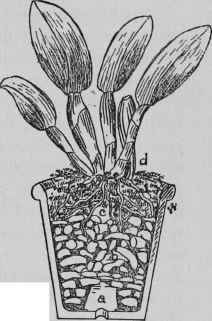
Fig. 30. - Potting Orchids.
a. Empty inverted pot over the drainage hole. i. Crocks and charcoal.
c. Roots.
d. Roots covered with sphagnum moss well above the rim.
The Cypripediums or Ladies' Slippers are less brilliant than the Cattleyas, but equally popular. In-signe (winter) is the best known species. It is not a showy flower, but the colouring is harmonious and pleasing. This species will thrive in a cold house, and another that will succeed without a great deal of heat is Spicerianum, which is an autumn bloomer.
The Dendrobiums are lovely Orchids, having flowers of charming form and delightful colour. The best known species is perhaps Nobile, but Wardianum runs it close. Both bloom in mid-winter.
The Odontoglossums are perhaps the most useful of all to amateurs, especially Crispum, of which there are numerous varieties, mostly with white or ivory-coloured flowers, but spotted or splashed in varying degrees with other colours. An imported collection of Odontoglossum Crispum alone will afford the amateur great interest and pleasure, as the flowers are of exquisite beauty.
When imported pieces are received it is wise to put them in a warm house, and keep them moist, until they show signs of growth. Setting them in damp crocks, with which the pots may be two-thirds filled, suffices to start them, but as soon as root and stem growth begins to break, a layer of Sphagnum Moss should be laid on the crocks, and covered with a mixture of Sphagnum and peat, using about two-thirds peat and one-third moss. If the mixture is kept moist, and a warm temperature provided, the plants will progress rapidly. Care must be taken to keep the plants firm, and this is best done by placing a stake in the crocks, and fixing it securely, so that it will keep the plants steady when tied to it.
Continue to:


My Books

