


January - Third And Fourth Weeks. Flowers. Part 3
Description
This section is from the book "The Garden Week By Week Throughout The Year", by Walter P. Wright. Also available from Amazon: The Garden Week by Week Throughout the Year.
January - Third And Fourth Weeks. Flowers. Part 3
New Lawns
Makers of lawns should never hesitate between turves and seeds so long as they can get the former free from weeds. When you have laid your turves the lawn is made - that is, if the soil has been properly levelled, and the turf is well beaten. And you can lay turves, in most districts, in eight months of the year. The four excluded are May, June, July, and August. Even these are not tabu if there is sufficient water available. The ground men at Lord's, the Oval, and that most delightful of all cricketing centres, the St. Lawrence ground at Canterbury, do not stand on the order of laying turves, They are reclaiming damaged pitches all the summer through.

Fig. 22. - Cutting of Chrysanthemum.
a. Where the stem should be severed.
b. Basal leaves to be cut off.
c. Clean growth without flower buds.
To placate the seedsmen, I am very willing to admit that seeds make nice lawns under particular circumstances, but you cannot sow seed over as long a period as you can lay turves, and you have to be very thorough in two things - to clean the ground, and to keep off birds. With all your care the result may not be satisfactory if bad weather follows the sowing. Soil chilled by cold, sleety rains in spring is not favourable to the germination of grass seeds; but it is a fact worth noting that weed seeds will grow, and they get a start of the grass which the latter is long in catching up, to say nothing of the labour of weeding.
The normal seasons for sowing grass seeds are (1) mid-March to mid-May; (2) September. So far as the first is concerned, experience teaches me that in districts where cold springs prevail May is quite early enough. The longer the seed lies in the ground ungerminated, the more prolonged is the battle with the birds, which love grass seeds. But May sowing does not give much chance of a thick, firm sward the same year. Three-quarters of a pound of seed per square rod is a fair allowance.
A playing lawn, whether for tennis, croquet, or Badminton (but particularly for tennis, which is a more forceful game than either of the others), ought, I think, to be made of turves. The soil, if poor, needs to be dug and manured, but all the same it must be firm, or the grass will sink in places and holes be formed. It takes longer to lay turves than to sow seeds, but the task is not a very long one, provided the turves are carefully cut, so as to be not only of the same size, but of the same thickness. If they are not of the same size there is a great deal of dovetailing to do; if not of the same thickness, of packing soil under the thin spots. Neither ought to be necessary. Given firm, level soil and well-cut turves, lawn-making is nearly as easy as dealing Bridge hands. I say "nearly," because I recall that in dealing Bridge hands one does not have to wield a heavy "beater" (although one yearns for this to be the privilege of harassed players when a forgetful partner fails to return a lead), whereas in laying turf the use of a beater is indispensable. It is a heavy wooden plate or flat block mounted on a curved handle. It is swung up, and allowed to drop with a thud on turf after turf, compressing all equally. When the turf is all down and the beater has done its work, the lawnmaker (who has by this time got his muscles both strong and pliant) may make assurance doubly sure by spending an hour or two on the lawn with the garden roller.
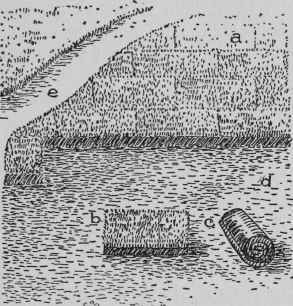
Fig. 23. - Laying Turf.
a. New turves laid down.
b. A piece of turf ready cut for laying.
c. How to roll turves to prevent damage when carrying them.
d. Ground bevelled for new turves. e. path.
Continue to:


My Books

