


July - Third And Fourth Weeks. July 16-31. Flowers. Part 4
Description
This section is from the book "The Garden Week By Week Throughout The Year", by Walter P. Wright. Also available from Amazon: The Garden Week by Week Throughout the Year.
July - Third And Fourth Weeks. July 16-31. Flowers. Part 4
Lifting And Dividing Daffodils
Narcissi and Daffodils will have completed their growth by now, and may be taken up for division. There will be large bulbs and small in the clumps - bulbs large enough to give good flowers next year, and bulbs which will not bloom until the second year. The sizes can be separated, as it is convenient to know, when planting, what bulbs can be relied upon to bloom. It is difficult to advise as to the exact sizes, because the varieties differ a great deal in size of bulb, and what would be a large bulb for Poeticus would be a small one for Sir Watkin. It will be safe to assume that all bulbs equal to two-thirds the size of the largest flowering bulb will bloom the following year. Bulb dealers necessarily dry and store their bulbs, but amateurs need not do so, they may replant at once, and the deeper, the moister the soil the more likely the plants are to do well. Strong bulbs may be forced in pots or boxes.
Improving Annuals
The earlier kinds of annuals will have been flowering for some time now, and a critical time has arrived. The plants are a little the worse for wear, and moreover are going to seed. When once they start going downhill they move fast, and an effort should be made to stop the down-grade movement at the very outset. Preventing seeding by the prompt removal of all fading flowers, stirring the soil with a hoe, watering, and occasional doses of liquid manure will all help to keep the plants fresh.
Repotting Cinerarias
Plants raised in spring, and subsequently placed in small pots, will be ready for larger ones as soon as roots protrude at the drainage hole, and 5-inch may be chosen. Drain with crocks and moss, use a compost of loam, leaf-mould, and sand, pot firmly, keep them close and shaded for a few days, then put them in a cold frame and give abundance of air. See that the green fly does not establish itself on the young plants, or it will soon do great harm. It is to be hoped that the Star Cinerarias are being grown. They are lovely for winter blooming.
White Roman Hyacinths
These charming bulbs are generally procurable at the end of July, and may be bought and potted, or grown in vases of fibre.
Wallflowers should be taken from the seed beds and planted out, or they will spoil each other by overcrowding.

Fig. 53. - Potting Roman Hyacinths.
a. Drainage and compost.
b. How the bulbs are inserted, leaving the crowns just above the soil.
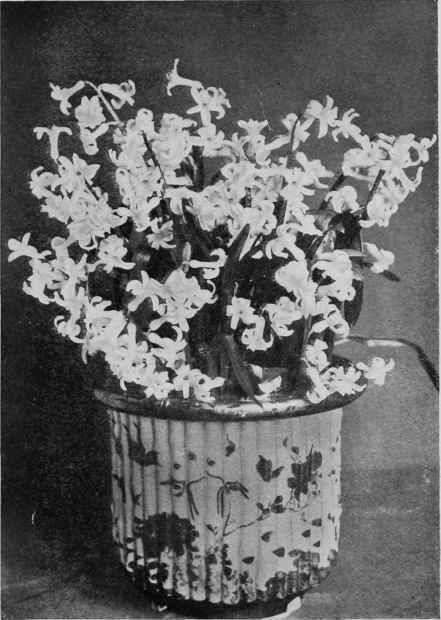
Early white Roman Hyacinths grown in an ornamental Vase containing peat moss fibre; no soil is used.
Continue to:


My Books

