


Some Carpeting Plants
Description
This section is from the book "The Garden Week By Week Throughout The Year", by Walter P. Wright. Also available from Amazon: The Garden Week by Week Throughout the Year.
Some Carpeting Plants
The above lists give an indication of the genera available at different seasons. I may now specify a few plants that are particularly valuable for forming large masses, drooping over the stones in a broad sheet of blossom. Such plants will be useful alike on orthodox rockeries and on steep rock banks such as my own.
Alyssum Saxatile Compactum
A free-blooming, yellow-flowered plant, easily raised from seed in early summer for flowering in late spring of the following year.
Arabises Or White Rock Cresses
The old singles are the best for the particular purpose in view, but the double is a better plant for borders.
Aubrietias
The varieties Leichtlini, Fire King, and Dr. Mules are all good. The commoner Aubrietias and Arabises are as easily raised from seed as the Alyssum.
Campanula Muralis
A pretty violet species, flowering in the summer.
Cerastium (Snow In Summer)
There are two species, Biebersteinii and Tomentosum, both of which spread an abundant mat of silvery foliage over the stones, and bear white flowers.
They can be raised from seed.
Convolvulus Mauritanicus
A blue and white species, which twines about the stones and produces beautiful flowers.
Coronilla Varia
A rosy trailer, which flowers in summer.
Dianthus Deltoides (Maiden Pink)
A charming rosy Pink which blooms in summer. There is a white variety of it.
Epigaea Repens (May Flower)
A dense, close evergreen, with sweet, white flowers in spring; somewhat scarce.
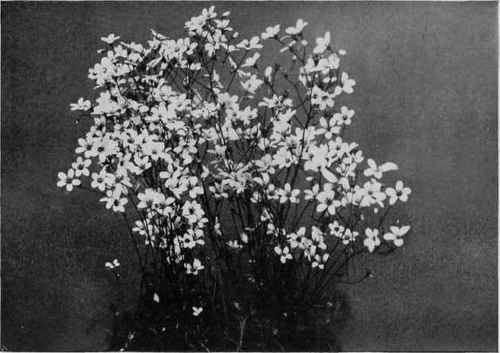
One of the best of rock plants - saxifraga hypnoides. It covers a considerable area of rockwork with foliage quickly, and blooms profusely.
Gypsophila Repens
A white summer bloomer; the well-known G. Paniculata, the flowers of which are used a good deal in floral decorations, is a totally different plant. There is a rose-coloured variety of Repens.
Helianthemums Or Sun Roses
These ramble freely, are evergreen, and flower more or less all through the summer, commencing in late spring. The flowers are produced abundantly, are large, and are of many beautiful colours. A great point in favour of the Sun Roses is that they will thrive in hot, dry positions. Those who are particularly interested in this useful class might get a few of the best named varieties, such as Golden Queen, Magenta Queen, Pink Beauty, Snowflake, and Mrs. C. W. Earle. The names are a guide to the colours except in the case of the last, which is crimson. These varieties are not dear.
Iberises Or Perennial Candytufts
Some of these are evergreens, and flower profusely in late spring and early summer, forming dense white cushions, which may be several feet across. They enjoy sunshine, but do not object to shade for a part of the day. Sempervirens is the most popular species, and there are several special varieties of it, such as the double (Flore Pleno), Gar-rexiana (with very large flowers), and Little Gem, dwarf.
Leontopodium Alpinum (The Edelweiss)
A white Alpine of very distinct appearance, which spreads into broad cushions and flowers freely. There is a large variety of it called Himalayanum.
Linarias Or Toad Flaxes
There are several charming kinds of this pretty genus, notably Alpina, violet with yellow centre; Cymbalaria, the Kenilworth Ivy, lilac and orange; and the white variety of the latter species. They trail and flower freely in summer.
Lithospermum Prostratum
Lithospermum Prostratum is one of the best of trailers for rock-work. It is evergreen, it grows freely, it bears its flowers abundantly for several months, and the colour is a rich deep blue.
Mossy Saxifrages
Mossy Saxifrages, notably Saxifraga Hypnoides and its varieties, such as Purpurea, with dark red flowers; and Rosea, with rosy blossoms, are dainty plants, forming a close carpet of foliage dotted with pretty flowers.
Mountain Thymes (Thymus Serpyllum And Its Varieties)
Mountain Thymes (Thymus Serpyllum And Its Varieties), of which Albus, white, and Coccineus, crimson, are desirable, are of prostrate habit, spread freely, and enjoy sunny places, even if dry. Dwarf, early flowering bulbs like Scillas, Narcissi, and Irises may be planted among the Thyme.
Continue to:


My Books

