


Chapter VIII. The Common Shrubbery, Woods And "Woodland Delves
Description
This section is from the book "The Wild Garden", by W. Robinson. Also available from Amazon: William Robinson: The Wild Gardener.
Chapter VIII. The Common Shrubbery, Woods And "Woodland Delves
It must not be thought that the wild garden can only be tunned in places where there is some extent of rough pleasure-ground. Excellent results may be obtained from the system in comparatively small gardens, on the fringes of shrubberies and marginal plantations, open spaces between shrubs, the surface of beds of Rhododendrons, where we may have plant-beauty instead of garden-graveyards. I call garden-graveyards the dug shrubbery borders which one sees in nearly all gardens, public or private. Every shrubbery and plantation surface that is so needlessly and relentlessly dug over by the gardener every winter, may be embellished in the way I propose, as well as wild places. The custom of digging shrubbery borders prevails now in every garden, and there is in the whole course of gardening no worse or more profitless custom. When winter is once come, almost every gardener, although animated with the best intentions, simply prepares to make war upon the roots of everything in his shrubbery border. The generally-accepted practice is to trim, and often to mutilate the shrubs, and to dig all over the surface that must be full of feeding roots. Delicate half-rooted shrubs are disturbed; herbaceous plants are destroyed; bulbs are displaced and injured; the roots as well as the tops of shrubs are mutilated; and a sparse depopulated aspect is given to the margins, while the only "improvement" that is effected by the process is the annual darkening of the surface by the upturned earth.
Illustrations of these bad practices occur by miles in our London parks in winter. Walk through any of them at that season, and observe the borders around masses of shrubs, choice and otherwise. Instead of finding the earth covered, or nearly covered, with vegetation close to the margin, and each individual plant developed into something like a fair specimen of its kind, we find a spread of recently-dug ground, and the plants upon it with an air of having recently suffered from a whirlwind, or some calamity that necessitated the removal of mutilated branches. Rough-pruners precede the diggers, and bravely trim in the shrubs for them, so that nothing may be in the way; and then come the diggers, plunging their spades deeply about plants, shrubs, or trees. The first shower that occurs after this digging exposes a whole network of torn-up roots. There is no relief to the spectacle; the same thing occurs everywhere - in botanic gardens as well as in our large West-end parks; and year after year is the process repeated.
While such is the ease, it will be impossible to have an agreeable or interesting margin to a shrubbery or plantation. What secrets one might have in the central hidden portions of these now dug and bare shrubberies - in the half-shady spots where little colonies of rare exotic wildlings might have their first introduction to our wild garden ! Of course all the labour required to produce this miserable result of dug borders is worse than thrown away, as the shrubberies would do better if let alone, and by utilising the power thus wasted, we might highly beautify the positions that are now so ugly.
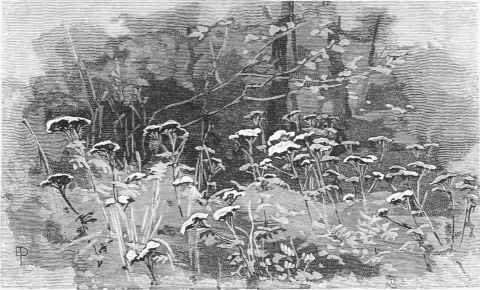
Large White Achilleas spread into wide masses under shade of trees in shrubbery.
If we resolve that no annual manuring or digging is to be permitted, nobody will grudge a thorough preparation at first. When a plantation of shrubs is quite young it is well to keep the ground open by lightly stirring it for a year or two. Then the planting should be so arranged as to defeat the digger. To graduate the vegetation from the taller subjects behind to the very margin of the grass is of much importance, and this could be done best by the greater use of dwarf evergreens. Happily, there is quite enough of these to be had suitable for every soil. Light, moist, peaty, or sandy soils, where such things as the sweet-scented Daphne Cneorum would spread forth its dwarf cushions, would be somewhat more desirable than, say, a stiff clay; but for every position suitable plants might be found. Look, for example, at what we could do with the dwarf-green Iberises, Helianthemums, Aubrietias, Arabises, Alyssums, dwarf shrubs, and little conifers like the creeping Cedar (Juniperus squamata), and the Tamarix-leaved Juniper, in spreading groups and colonies. All these are green, and would spread out into dense wide cushions, covering the margin, rising but little above the grass, and helping to cut off the formal line which usually divides margin and border. Behind them we might use other shrubs, deciduous or evergreen, in endless variety; and of course the margin should be varied also as regards height.
In one spot we might have a wide-spreading tuft of the prostrate Savin pushing its graceful evergreen branchlets out over the grass ; in another the dwarf little Cotoneasters might be allowed to form the front rank, relieved in their turn by pegged-down Roses; and so on without end. Herbaceous plants, that die down in winter and leave the ground bare afterwards, should not be assigned any important position near the front. Evergreen Alpine plants and shrubs, as before remarked, are perfectly suitable here ; but the true herbaceous type, and the larger bulbs, like Lilies, should be in groups between spreading shrubs. By so placing them, we should not only secure a far more satisfactory general effect, but highly improve the aspect of the herbaceous plants themselves. To cany out such planting properly, a little more time at first and a great deal more taste than are now employed would be required; but what a difference in the result! All that the well-covered borders would require would be an occasional weeding or thinning, and, in the ease of the more select spots, a little top-dressing with fine soil. Here and there, between and amongst the plants, such things as Forget-me-nots and Violets, Snowdrops and Primroses, might be scattered about, so as to give the borders interest even at the dullest seasons; and thus we should be delivered from digging and dreariness, and see our once ugly borders alive with flowers. The chief rule should be - never show the naked earth: clothe it, and then allow the taller plants to rise in their own way through the turf or spray. Here is a little sketch of what is meant. A colony of the white Arabis carpets the ground in which strong hardy Lilies are growing; and the Lilies are pushing up their bold unfolding shoots. The latter are none the worse in winter for this light carpet of foliage over the border; and then for a long time in spring it is bedecked with white flowers. Indeed, in fairly good seasons it blooms in winter too. It would take a big book to tell all the charms and merits belonging to the use of a variety of small plants to carpet the ground beneath and between those of larger growth. It need hardly be said that this argument against digging applies to two or three beds of shrubs, and places where the "shrubbery" is little larger than the dining-room, as much as to the large country seat, public park, or botanic garden.
Continue to:


My Books

