


62. Plants Poisonous To Eat. Part 4
Description
This section is from the book "Plants And Their Uses - An Introduction To Botany", by Frederick Leroy Sargent. Also available from Amazon: Plants And Their Uses; An Introduction To Botany
62. Plants Poisonous To Eat. Part 4
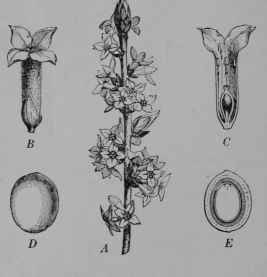
Fig. 195.-Daphne (Daphne Mezereum, Mezereum Family, Thymeloeaceoe). A, flowering branch. B, flower, entire. C, same, cut vertically. D, fruit, entire. E, same, cut vertically. (Baillon.)-Shrub 30-90 cm. tall; leaves very smooth; flowers rose-purple, fragrant; fruit fleshy, red. Native home, Europe.
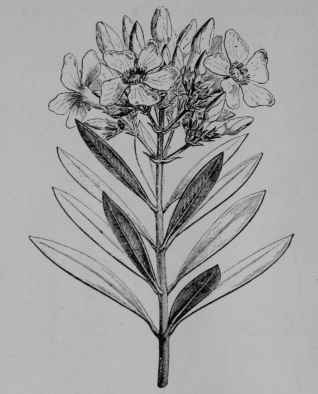
Fig. 196.-Oleander (Nerium Oleander, Dogbane Family, Apocynacece). Flowering branch. (Baillon.)-Shrub 2-5 m. tall; leaves leathery; flowers deep rose-color or white; fruit dry. Native home, Mediterranean region.
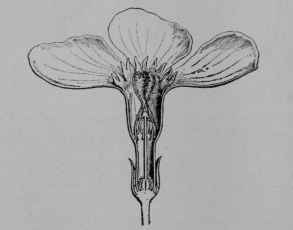
Fig. 197, I.-Oleander. Flower, cut vertically. (Baillon.)
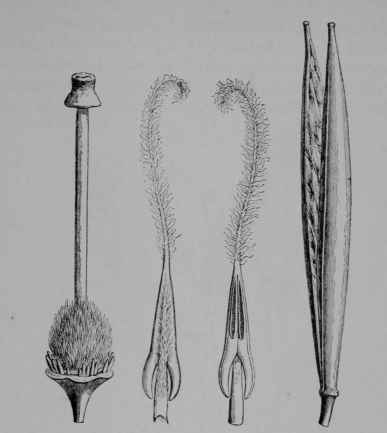
Fig. 197, II.-Oleander. Pistil. Stamen, outer view. Same, inner view. Pod, opening to shed the seeds. (Baillon.)
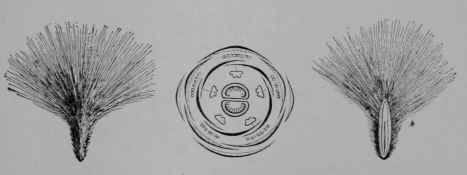
Fig. 197, III.-Oleander. Seed, entire, enlarged. Same, cut vertically. Floral diagram. (Baillon.)
More dangerous than any other parts of poisonous plants are the fruits and seeds, for the reason that they are often of tempting appearance and because fruits in general are good to eat. In the case of the poison hemlock, the pokeweed, and the wild cherry we have already noticed the poisonous character of these parts. It is safe to regard all the other poisonous plants mentioned as further examples more or less dangerous in proportion to their attractiveness. That special attractiveness, however, is not always a necessary element of danger in this matter, appears from the following instance which comes from New York. "Four children were playing in one of the public parks of the city where jimson-weeds were growing luxuriantly. The boys imagined themselves Indians and roamed about and ate parts of various plants. Three of them ate the seeds of the jimson-weed. One died in a state of wild delirium; another was saved after heroic treatment; the third who ate but few of the seeds was but little affected." This miserable weed has one of the worst records among poisonous plants. Many lives are lost through permitting this plant to grow in places frequented by children.
A few further examples of poisonous fruits and seeds require mention. The green berries of the white potato, although scarcely attractive to most people, have been eaten with fatal results. The berries of the nearly related black nightshade (Fig. 198) and the bittersweet (Fig. 199) are somewhat poisonous, and from their bright colors especially liable to attract children. At Christmas, young children sometimes suffer from eating the white berries of the mistletoe (Figs. 200-202) used in decoration. Similar cases of poisoning are recorded with regard to the scarlet berries of the Christmas holly (Fig. 203). The tempting red pulp surrounding the poisonous seeds of the yew (Fig. 204) while itself harmless has sometimes led children to eat the seeds, with fatal results. Young children are also liable to eat the pretty seeds of the castor-oil plant which is very commonly planted for ornament. These seeds are poisonous although, as is well known, the pure oil expressed from them is quite harmless under ordinary conditions.
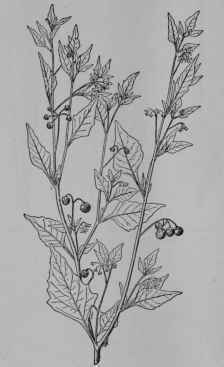
Fig. 198.-Black Nightshade (Solanum nigrum, Nightshade Family, Solanaceoe). Flowering and fruiting branch, 1/3. (Chesnut.)-Annual 30-60 cm. tall; leaves smooth; flowers white; fruit a black berry. Native home, Eurasia and America.
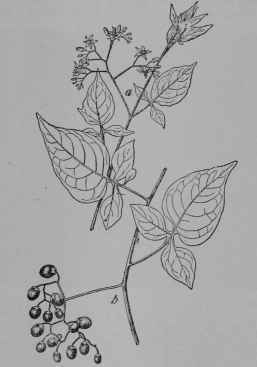
Fig. 199.-Bittersweet (Solarium Dulcamara, Nightshade Family, Solanaceoe). a, flowering branch; b, fruiting branch. (Chesnut.)-A somewhat woody vine 1-3 m. long; leaves smoothish; flowers violet-purple with greenish spots; fruit red. Native home, Europe.
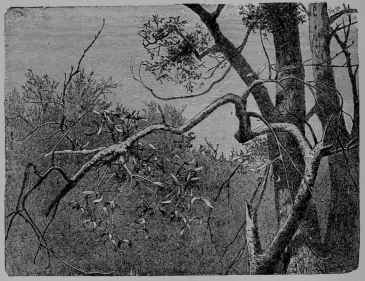
Fig. 200.-Mistletoe (Viscum album, Mistletoe Family, Loranthaceoe). Bunches of the plant growing upon a leafless tree in winter. (Kerner.)-Woody parasite, growing on various trees, principally apple and poplars, and attaining a length of 1 m. or more; leaves evergreen; flowers greenish; fruit a white berry with viscid pulp. Native home, Europe.
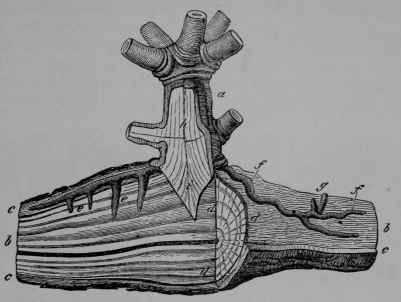
Fig. 201.-Mistletoe. Stem base showing mode of attachment to a branch of the "host" upon which it grows; h, wood of the mistletoe extending into the wood of the host as a primary "sinker" (i); f, f, cambium suckers growing between wood and bark, and sending through the bark buds, as at g, which become shoots; and pushing into the wood secondary sinkers, as at e. e: b, b, wood of the host cut half across at d, d, d, to show the annual rings of growth; c, bark. (Sachs.)
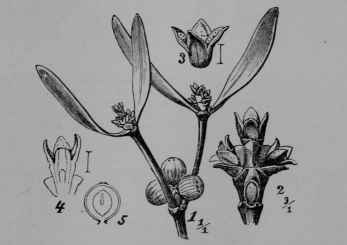
Fig. 202.-Mistletoe. 1, pistillate branch with flowers and fruit. 2, pistillate flower-cluster. 3, staminate flower. pistillate flower, cut vertically. 5, fruit, cut vertically. (Wossidlo.)
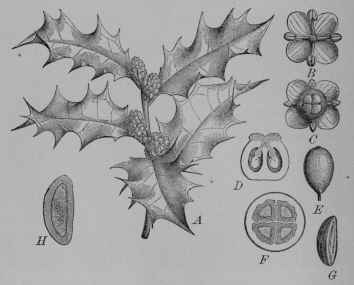
Fig. 203.-Christmas Holly (Ilex Aquifolium, Holly Family, Aquifoliaceoe). A, branch bearing leaves and staminate flowers. B, staminate flower. C, pistillate flower. D, pistil, cut vertically. E, fruit. E, same, cut across. G, seed. H, same, cut vertically. (Kronfeld, Reichenbach.)- Tree growing 12 m. tall, leaves evergreen; flowers whitish; fruit scarlet. Native home, Eurasia.
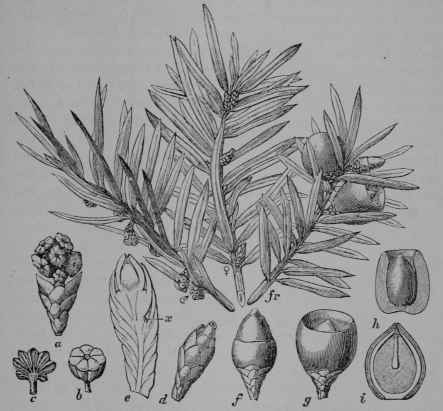
Fig. 204.-Yew (Taxus baccata, Yew Family, Taxaceoe). Branches with leaves and staminate flowers, ovule-bearing flowers, and fruit (fr.); a, a single staminate flower; b, stamen with anthers still closed; c, same, with anthers open for discharging pollen; d, an ovule-bearing flower, the tip of the ovule seen projecting beyond the protecting scale-leaves; e, same, cut vertically, showing tip of the stem-branch at x; f, fruit, half ripe, showing the cup-like envelope (aril) growing up from the base of the young seed; g, ripe fruit; h, same, cut vertically; i, seed, cut vertically. (Eichler, Richard.)-Tree growing 20 m. tall; bark, reddish, flaky; leaves dark green above; fruit (aril) scarlet.
Continue to:


My Books

