


Logwood - Coloring Matters Or Dyes
Description
This section is from the book "Plants And Their Uses - An Introduction To Botany", by Frederick Leroy Sargent. Also available from Amazon: Plants And Their Uses; An Introduction To Botany
Logwood - Coloring Matters Or Dyes
Logwood is obtained from a small Central American tree (Fig. 276). It is exported in the form of logs from which the sap-wood has been removed. The coloring matter which it yields, is, like indigo, not present in the living plant but is derived from a colorless glucoside called hoematoxylin (C16H1406) which in turn readily oxidizes to form the deep violet-purple compound known as hoematein (C16H1206). It is interesting to observe that this transformation involves the loss of two atoms of hydrogen just as does the change of the white indigo into the blue. Unlike indigo, however, logwood of itself does not make a permanent dye. It requires the use of a mordant, that is to say, some substance such as a salt of iron which fixes the dye upon the fabric. Thus used it makes one of the best blacks for wool or cotton. In combination with iron, etc., it is used also widely in the manufacture of writing inks.
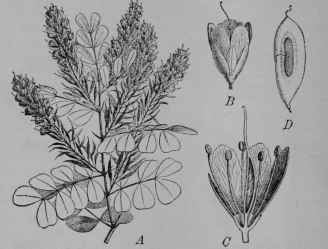
Fig. 276.-Logwood-tree (Hoematoxylon campecheanum, Pulse Family, Leguminosoe). A, flowering branch. B, flower. C, same, cut vertically. D, pod. (Taubert.)-Tree about 8 m. tall; leaves smooth; flowers yellow, fragrant; fruit dry. Native home, Tropical America.
Continue to:


My Books

