


Oak - True Woods
Description
This section is from the book "Plants And Their Uses - An Introduction To Botany", by Frederick Leroy Sargent. Also available from Amazon: Plants And Their Uses; An Introduction To Botany
Oak - True Woods
Oak (Figs. 235, 242, 243) is used extensively for heavy construction in common carpentry and shipbuilding, and in car and wagon work on account of its extraordinary strength; also in the manufacture of farm implements and parts of machinery because of its hardness and toughness, while its unusual durability leads to its use for piling, wet cooperage, and railway ties. The great beauty of the wood, especially on radial section as shown in "quarter-sawing," and its susceptibility of fine polish combined with its other valuable qualities make oak one of the most highly valued woods for furniture and interior finish, and even for turnery and carving in spite of its coarse texture. Many species afford timber.
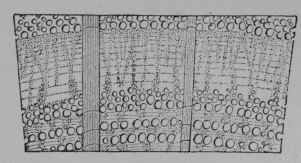
Fig. 235.-Transverse section of white oak wood, 3/1. (Hartig.)
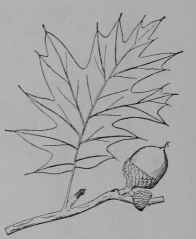
Fig. 242.-Red Oak (Quercus rubra, Beech Family, Fagaceoe). Flowering and fruiting branch, 1/3. At the base of the leaf is a pistillate flower. (Britton and Brown.)-Tree growing 40 m. tall; bark dark gray; leaves dull green; flowers greenish yellow; fruit reddish, requiring two years to ripen. Native home, Eastern North America.
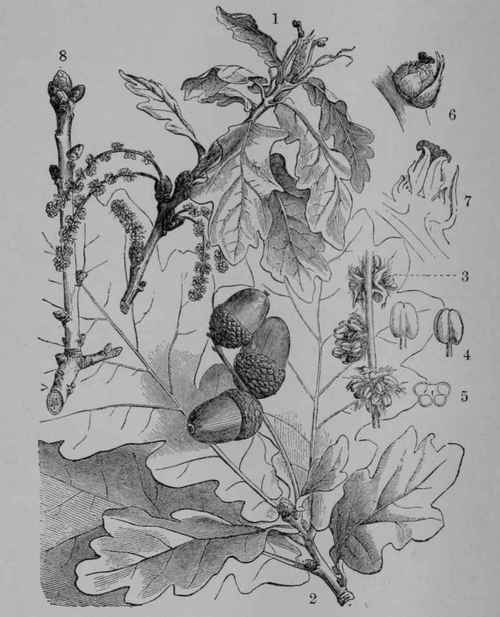
Fig. 243.-English Oak (Quercus pedunculata, Beech Family, Fagaceoe). 1, flowering branch. 2, fruiting branch. 3, part of staminate flower-cluster. 4, anthers. 5, anther, cut across. 6, pistillate flower. 7, same, cut vertically. 8, winter twig. (Willkomm.)-Tree growing 36 m. tail; bark grayish-brown or blackish, deeply furrowed; leaves dark green above, pale beneath; flowers greenish yellow; fruit brownish. Native home, Eurasia and Northern Africa.
Continue to:


My Books

