


Part 175. The Brown Algae - Plant Life-Histories
Description
This section is from the book "Plants And Their Uses - An Introduction To Botany", by Frederick Leroy Sargent. Also available from Amazon: Plants And Their Uses; An Introduction To Botany
Part 175. The Brown Algae - Plant Life-Histories
Part 175. The brown algae (Class Phaeophyceae) are characterized in general by a brown coloring matter, phycophoein,1 masking the chlorophyll. They are almost entirely marine. Besides many comparatively simple forms there are some showing a remarkably high development of the vegetative system.
1 Phy"co-phae'in - Gr. phycos, seaweed; phaios, brown.
In their methods of reproduction the brown algae present rather close parallels to various chlorophyceous types, very rarely, however, exhibiting an alternation of generations.
One of the commonest genera is Laminaria (Fig. 316) which includes the familiar leathery "sea-tangles," "kelps," or "Devil's aprons" often cast upon beaches after a storm. The thallus consists of a flat, more or less leaf-like part (pseudo-leaf) attached to a stalk (pseudo-stem) at the base of which is a hold-fast (pseudo-root), often much branched, which clings to stones or other means of anchorage on the bottom. This thallus which may be yards in length consists of an exceedingly large number of cells among which a considerable differentiation may be observed. Thus in the stalk as shown in Fig. 317 we have an outer group of cells forming a sort of rind (r, r) which is comparatively tough and thus protective, while at the same time it serves as a food-making part since the cells are rich in chlorophyll. Those inclosed by the rind, (p, p) form the chief bulk of the stalk, are pale in color, and serve largely for the storage of food-materials elaborated by the outer cells. In the rind occur numerous cavities (g, g) filled with a mucilaginous material. The pseudo-leaf shows a differentiation of cells similar to that of the stalk. For the most part as soon as they are formed the cells lose the power of dividing; but in the region where the pseudo-leaf joins the stalk there is a cell-mass which retains this power, and from time to time exhibits it in a striking way; that is to say, it forms a new pseudo-leaf at the base of the old one which it eventually casts off, as indicated in the figure. Any mass of connected cells all of which are similar in origin and character is called a tissue. An undifferentiated tissue, made up of cells still capable of division is termed a meristem,2 or is described as meristematic, while a fully differentiated tissue is distinguished as permanent.
2 Mer'is-tem - Gr. meristos, divisible.
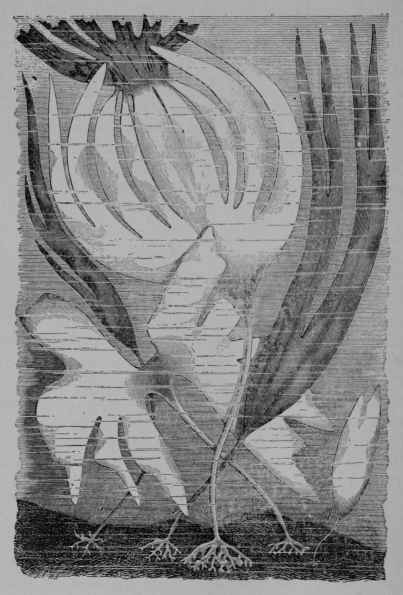
Fig. 316.-Sea-tangles (Laminaria spp., Sea-tangle Family, Laminariaceoe). Various forms more or less reduced in size; the larger ones often having the stalk over 1 m. long and the expanded part 2 m. (Luerssen.)- These brown, leathery seaweeds are familiar objects along our coasts.
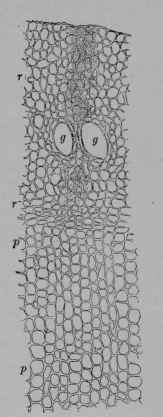
Fig. 317.-Sea-tangle. Transverse section through the outer part of a stalk 2 cm. in diameter, 63/1, showing the darker rind (r, r) containing slime-canals (g, g); and the lighter interior tissue (p, p) which form the greater bulk. (Luerssen.)
Laminaria reproduces only by swarm-spores which are formed in sac-like sporangia projecting from the surface of the pseudo-leaf. They are crowded closely, together with a number of curiously shaped protective cells called paraphyses.3 The swarm-spores have a red eye-spot and two flagella which are attached at the side. There are no gametes.
3 Pa-raph'y-ses - Gr. para, besides; physis, growth.
A somewhat higher development both of the vegetative and reproductive systems is found in the genus Fucus (Figs. 318, 319) which includes the common "bladder-wracks" of the sea-shore, so called because of the bladder-like floats (1) developed in the thallus. The meristematic tissue is at the tip of the thallus-lobes. A disk-like pseudo-root attaches the thallus to rocks which lie mostly between tides. The pseudo-shoot has forking midribs with flat expansions on either side in which the inflated bladders often appear. There is a rind and an inner, somewhat pith-like tissue much as in Laminaria. The tips of certain branches become swollen (s, Fig. 318) and produce a number of small cavities (conceptacles) each opening by a pore at the surface and lined with numerous paraphyses among which appear either male or female gametangia (Fig. 319, a). Within a female gametangium (b, c) eight large, spherical, non-flagellate gametes arise and are pressed out into the surrounding water by swelling of the paraphyses. The male gametangia, (d) expelled at the same time emit numerous flagellate gametes (g) which resemble somewhat the swarm-spores of Laminaria. They are attracted in large numbers to a female gamete, and, attaching themselves to its surface, often cause the sphere to revolve by the energetic movement of their flagella (e). Directly after fertilization the oospore comes to rest and germinates (f), attaching itself to some rock by projections which form the beginnings of a pseudo-root, while the main part above becomes a meristem for the shoot. No swarm-spores are produced and there is no alternation of generations.
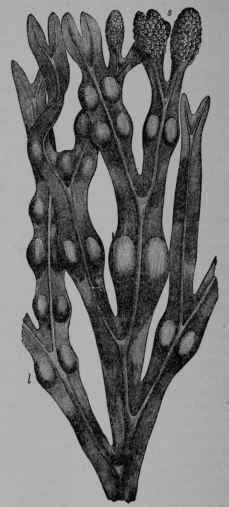
Fig. 318.-Bladder-wrack (Fucus vesiculosus, Wrack Family, b ucaceoe). Branch bearing air-bladders (1) and swollen tips (s) containing con-ceptacles. (Luerssen.)-Brown, slimy, tough seaweed, sometimes 1 m. long, growing attached to rocks, etc., between tides along the North Atlantic coast.
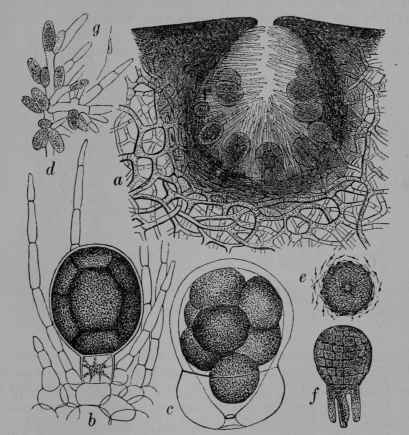
Fig. 319.-Bladder-wrack; a, vertical section through a conceptacle (50/1) showing the female gametangia; b, female gametangium beginning to form its eight gametes; c, the same, beginning to set free its gametes; d, male gametangia (shaded) from which come ciliate gametes like the one (g) shown near by; e, female gamete surrounded by numerous male gametes which cause it to revolve in the water; f, young plant produced directly from the fertilized female gamete, b-f, 350/1, g, 160/1. (Thuret.)
Continue to:


My Books

