


Part 76. Elastic Gums Or Rubber
Description
This section is from the book "Plants And Their Uses - An Introduction To Botany", by Frederick Leroy Sargent. Also available from Amazon: Plants And Their Uses; An Introduction To Botany
Part 76. Elastic Gums Or Rubber
Part 76. Elastic gums, including india-rubber or caoutchouc 1 and gutta-percha,2 are tough, more or less elastic and waterproof solids which separate as a curd from the milky juice of a number of tropical plants.
1 Pronounced koo'chuk.
2 Ch pronounced as in church.
Small quantities of caoutchouc are present also in many of our native plants having a milky juice, but the amount is much too small to be of any economic significance. The use of this juice to the plant is not altogether clear; but from the fact that it flows readily from a cut and after a little while hardens upon exposure to the air, the conclusion seems warranted that it serves in part at least as a ready means of covering wounds promptly with a waterproof protection against agencies of decay.
One of the most important American sources of caoutchouc is the Brazilian rubber-tree (Fig. 270). Long before the coming of Europeans the South American Indians made use of crude rubber for various articles including water-vessels, shoes, and torches. Similar prehistoric use was made by the East Indians of the product they obtained from the india-rubber tree (Fig. 271) which yet remains one of the more important Asiatic sources of this remarkable substance.
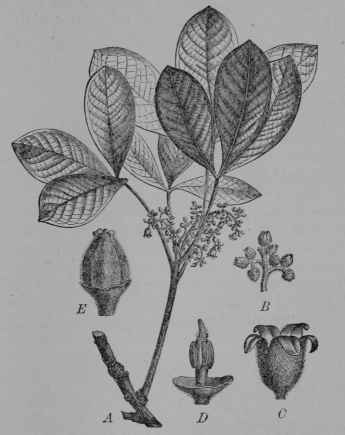
Fig. 270.-Brazilian Rubber-tree (Hevea guyanensis, Spurge Family, Euphorbiacea). A, flowering branch. B, part of flower-cluster. C, staminate flower. D, same with calyx removed. E, pistillate flower, with calyx removed. (Berg and Schmidt.)-Tree growing 20 m. tall; leaves thin: flowers inconspicuous; fruit somewhat fleshy. Native home, Brazil.
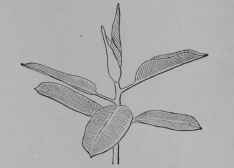
Fig. 271.-India Rubber-tree (Ficus elastica, Mulberry Family, Moraceoe). Tip of branch showing leaves, the youngest unfolding and still partly enwrapped by the protective stipule-case. (Original.)-Tree growing 30 m. tall; leaves thick and glossy; flowers similar to those of the fig; fruit fig-like, greenish-yellow. Native home, Tropical Asia.
Simple, primitive methods of obtaining the raw material are still practised very generally by the natives of to-day who in various parts of the world collect the rubber which is exported to Europe and America for manufacture. First, ax cuts are made in the bark of a good-sized tree in such a way that the milk which flows from the wounds will run into little cups so placed as to receive it. The collector on his rounds empties the contents of these into a larger vessel which he finally carries to where the milk is to be curdled. The separation of the caoutchouc from the whey-like part of the milk is accomplished variously; as for example, by mere exposure to the air, or by the addition of water or various salts; but the best rubber is obtained by the process of smoking as practised in Brazil. Over a smoky fire, made by burning Brazil-nut shells or certain palm seeds, the operator holds the broad end of a clay-covered paddle which has been dipped in the fresh milk, and turns it slowly till an even layer of the rubbery curd has set. Then he dips the paddle into the creamy liquid again, and repeats the operation till successive layers form a cake of considerable thickness. The cake is then cut from the paddle, and hung up to dry until firm enough to pack for transportation. Crude rubber comes into the market also in the form of sheets, balls, or masses of various shapes; and is often mixed with a considerable quantity of clay, bark, and other impurities.
Rubber was first made known to Europe in the report of Columbus' second voyage, where the statement occurs that the Indians were found playing with elastic balls which bounced better than the "wind balls" of Castile. It was not, however, till after the middle of the 18th century that this elastic material came much into use. For many years it was scarcely more than a curiosity, serving in a practical way for little else than to rub out pencil marks. From this circumstance it gained the name "rubber" and was called "india-rubber" because of its importation from the West Indies. Caoutchouc did not come from Asia till much later.
As the unique properties of rubber-its unequaled elasticity combined with its great imperviousness to moisture- became more fully realized, effort was made to bring it into wide use. Thus, it was manufactured into elastic webbing, overshoes, waterproof garments, and various impervious fabrics. Such goods became popular for a while, but their use was much restricted by the fact that the best rubber obtainable was apt to harden and crack in cold weather, and to soften or grow sticky in summer. Moreover, it was found that unprotected surfaces of pure rubber adhere; and that articles made of it were often worthless after a few months keeping, and were ruined by contact with oils. Much futile effort was expended to remedy these defects. Finally in 1844, Charles Goodyear, an American, announced his discovery that mixing a little sulphur with caoutchouc, and subjecting it to considerable heat, produces a substance that is even more elastic than pure rubber, is unchanged by any temperature between - 20° and + 180°C., is less affected by oils or other solvents of the unchanged caoutchouc, does not become adhesive, and keeps well. This process of combining sulphur with caoutchouc is called vulcanization. By using much sulphur and a high degree of heat hard rubber or vulcanite is produced.
Continue to:


My Books

